Most amateur golfers miss greens short. Not wide. Not long. Short. Studies from Arccos Golf’s shot data platform consistently show that recreational players leave approach shots 15 to 20 feet short of the target on average. Understanding what does pin high mean in golf is one of the simplest mental shifts that can reverse that habit. This guide gives you the full definition, the history of the term, why it separates good ball strikers from great ones, and a practical five-step routine for hitting the flag distance more consistently. Read through once, take notes, and you’ll think about every approach shot differently.
What Does Pin High Mean in Golf? The Core Definition
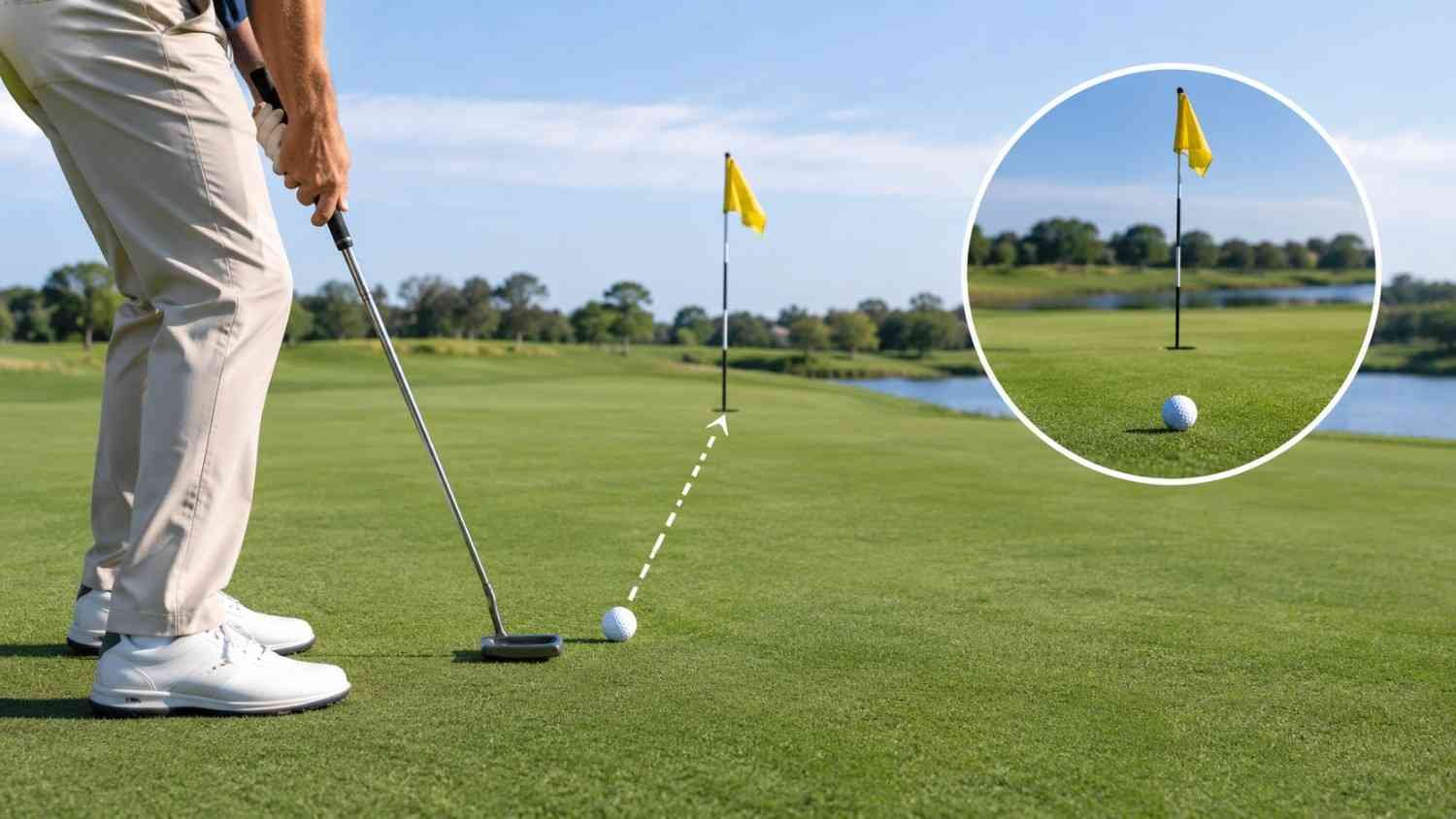
Pin high means your ball came to rest at the same distance from the tee box, or from wherever you played your approach, as the flagstick itself. The ball may be left of the hole, right of the hole, or exactly at the hole, but it stopped at the correct yardage. That’s the whole idea. You nailed the distance.
The phrase shows up everywhere in broadcast commentary and casual Saturday rounds alike. The pin high golf meaning has nothing to do with direction. A shot that drifts 30 feet right of the cup but lands at the exact same depth as the flag is still pin high. You missed laterally, but you owned the distance. For newer players, understanding this distinction can be just as useful as learning basic first round success golf etiquette, since both help make early rounds more confident and enjoyable.
Golfers use the term interchangeably with “hole high,” and that matters enough to address separately below. For now, anchor the definition: distance matched, direction separate.
Pin High vs Hole High: Is There Actually a Difference?
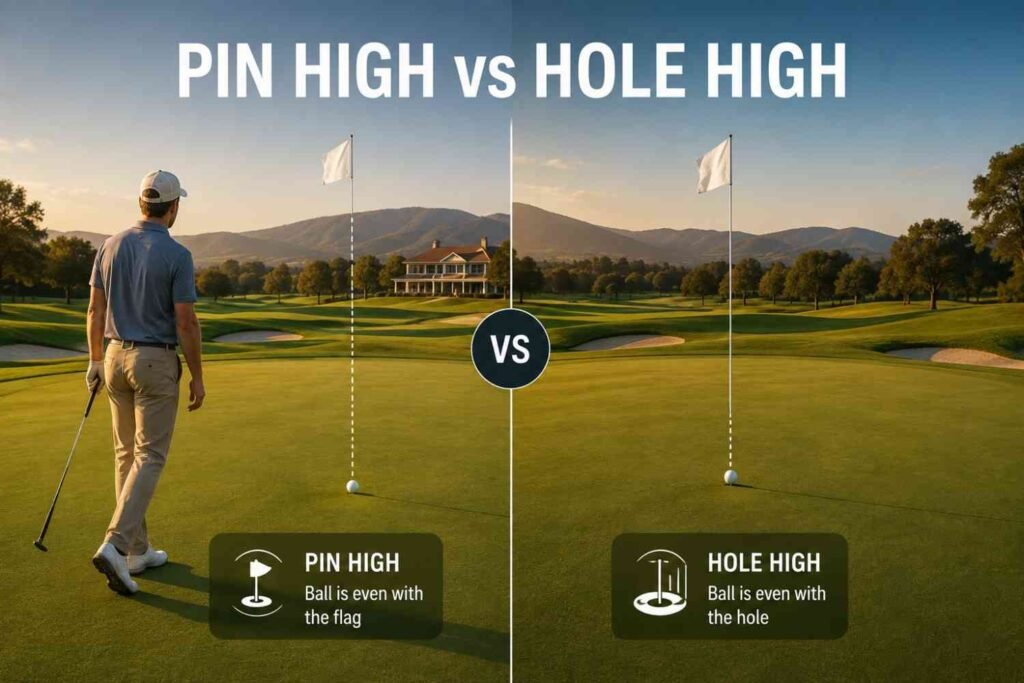
Technically, no. Practically, there’s a minor distinction worth knowing.
The pin high vs hole high debate comes up in golf forums regularly. “Pin high” refers to the position of the flagstick, which sits in the cup but can be placed anywhere on the putting surface. “Hole high” refers to the physical hole itself. Because the flag is always inside the hole, the two terms describe the exact same location in every round you will ever play. The community consensus is that they are synonyms.
“Pin high is one of those terms that sounds technical but really just means you figured out your yardage. The direction piece is a separate problem entirely.” This view is widely shared by PGA teaching professionals on the MyGolfSpy community forums, where the what is hole high in golf question surfaces every season from newer players trying to decode broadcast language.
So if someone in your foursome says “hole high, right side,” they mean the ball stopped at the correct yardage but drifted to the right. Same picture as “pin high, right side.” Both terms work. Use whichever feels natural, because any playing partner will understand either one.
What Does Pin High Left Mean and What Does Pin High Right Mean?
These two phrases are directional qualifiers stacked onto the distance compliment.
What does pin high left mean? Your ball traveled the correct yardage but missed the target to the left. You pulled it, drew it too hard, or misread the wind from the right. The distance was correct. The aim, swing path, or club face angle caused a lateral miss to the left side of the green.
What does pin high right mean? Same story, opposite direction. Correct yardage, missed right. Could be a push, a fade, or a block. Again, you solved the distance equation and failed the direction equation.
Here’s why these qualifiers matter so much in a practice or post-round analysis context. If you’re pin high left three times in a round, that pattern tells you something specific about your swing or alignment. Your distance control is working. Your shot shape or alignment is the variable to fix. If you’re 20 yards short and 20 yards left, you’ve got two separate problems to diagnose, and conflating them wastes your practice time.
Splitting the two concepts, distance and direction, is one of the most underused diagnostic tools at the amateur level. That’s my opinion and I’ll stand on it.
Why Pin High Matters in Golf: The Strategic Case

The reason why pin high matters in golf comes down to the geometry of putting. When you’re pin high, you have a straight putt or a near-straight putt. When you’re short of the flag, you’re putting uphill on most green designs. When you’re long, you’re dealing with a downhill putt that accelerates. Short-siders and deep misses create lag-putt territory. Pin high gives you a flat look at the cup, or close to it.
The data reinforces this. A 2019 analysis published by Mark Broadie’s Strokes Gained research at Columbia Business School demonstrated that approach shot proximity to the hole is the single largest driver of scoring differences between scratch golfers and 10-handicappers. Distance control is the bigger half of that proximity equation. A golfer who’s pin high and 15 feet right has a much better two-putt probability than a golfer who’s 30 feet short and 10 feet left.
There’s also a mental game component. Hitting it pin high, even if you miss the green, often leaves a chip or pitch from flat ground rather than an uphill or downhill lie. That’s a meaningful difference in tour statistics and a massive difference for the weekend player who chips from difficult lies far more often than professionals do.
Golf Terminology: Pin High in Context With Other Distance Terms
Understanding golf terminology pin high means knowing where it fits relative to other common phrases you’ll hear on the course. Here’s how the distance vocabulary maps out:
|
Term |
What It Means | Distance Correct? | Direction Correct? |
|---|---|---|---|
| Pin High / Hole High | Ball stopped at exact flag yardage | Yes |
Maybe |
|
Short-Sided |
Missed green on same side as pin placement | No | No |
| Over the Flag | Ball carried past the pin yardage | No (long) |
Maybe |
|
Tight to the Flag |
Close proximity in both distance and direction | Yes | Yes |
| Pin High Left | Correct yardage, left of target | Yes |
No (left) |
|
Pin High Right |
Correct yardage, right of target | Yes |
No (right) |
The table makes one thing obvious. Being pin high is a partial win every single time. If you’re a mid-handicapper who starts consistently hitting approaches at the correct yardage, your scoring average will drop before you ever touch your swing mechanics. Distance control and shot shape are two separate training lanes.
Golf Distance Control and Pin High: The Numbers Behind the Goal
Let’s get concrete about what golf distance control pin high actually looks like in practice.
Tour professionals hit shots within 10 feet of their intended carry distance on iron shots from 150 yards roughly 60 percent of the time, according to data compiled from the PGA Tour’s ShotLink system. Amateur golfers hit within 10 feet of their intended carry distance from 150 yards about 12 percent of the time. That gap is almost entirely a function of how well players know their own carry numbers, not raw swing talent.
The single biggest mistake recreational golfers make is using the wrong reference number. They’ll look at a yardage book, see 148 yards to the front edge, and calculate for that, when the pin is actually 158 yards away. Or they’ll pick a yardage to the flagstick but forget to account for an uphill slope that plays four yards longer. Approach shot distance control starts with accurate input, not better mechanics. A consistent simple golf setup can also make it easier to repeat the same process before every approach and avoid unnecessary changes that affect distance control.
The chart above lays it out plainly. The drop-off between tour players and 10-handicappers is steep, but the drop-off between a 10-handicap and a bogey golfer is where the most improvement opportunity lives. Getting to “pin high” distances more often doesn’t require a new swing. It requires a new pre-shot process.
How to Hit Pin High: A Five-Step Pre-Shot Routine

This is the section you can act on today. Learning how to hit pin high consistently isn’t about swinging harder or finding a magic drill. It’s about building a repeatable information-gathering habit before you ever pull a club from the bag.
The framework I use here is called CANDY: Carry, Adjustment, Number, Decide, Yes. Here’s how each step works:
Step 1: Carry
Know your true carry yardage for every club, not your total yardage with roll. Use a launch monitor like a Garmin Approach R10 or a Trackman session at your local simulator to get clean carry numbers. If you think your 7-iron goes 155 yards, you need to know whether that’s carry or total. Most amateur golfers are using total distance as their carry number, which causes them to consistently fly shots short. This is the root cause of most “left it short” misses.
Step 2: Adjustment
Factor in the conditions that change effective carry distance. Wind into your face adds yardage demand. A headwind of 10 mph plays roughly one extra club for most golfers. Elevation matters at roughly one yard per ten feet of rise or fall, though courses at altitude add significant carry. Temperature plays a smaller role, with cold air reducing carry by about 1.5 percent per 10 degrees Fahrenheit drop. Do the math before you pick the club, not after.
Step 3: Number
Get the exact yardage to the pin, not the front of the green. Use a rangefinder with slope compensation enabled if your course allows it, or use a GPS app like Golfshot that shows pin-adjusted distances. Front edge yardages feel safe but they’ll cost you strokes on every hole where the pin sits in the back third of the green.
Step 4: Decide
Pick one club and commit. Do not stand over the ball second-guessing between a smooth 8-iron and a full 9-iron. The difference between a controlled 80 percent swing and a forced full swing on the wrong club is almost always the controlled swing. Take more club, swing smoother, and let the distance happen naturally. Tour players almost never swing at 100 percent on approach shots from normal distances, and that’s a deliberate strategy.
Step 5: Yes
Commit to the shot with full trust. Once you’ve done the calculation, the mental job is done. Your only focus at address is a smooth tempo and a clean contact point. Any distance doubt that creeps in during the swing will cause you to either quit on it or overpower it. Both outcomes kill your chances of landing pin high.
What Does Pin High Mean in Golf for Course Management?
Understanding what does pin high mean in golf also changes how you think about target selection before you ever swing.
On par fours and par fives where you’re laying up, “pin high” becomes the layup target yardage, not just a green description. You want to leave yourself a full approach from a distance where you carry the ball comfortably and predictably. Most pros will lay up to 100 yards on par fives because that’s a full wedge, not a tricky partial swing. Smart amateurs should be doing the same kind of planning. If your ideal full pitching wedge distance is 110 yards, your layup target should be 110 yards from the pin, not 120 or 90.
Approach shot distance control is a whole-hole concept, not just a decision you make from the fairway. It starts with the tee shot and the layup choice and finishes with the putt you’re left with. Pin high thinking threads through all of it.
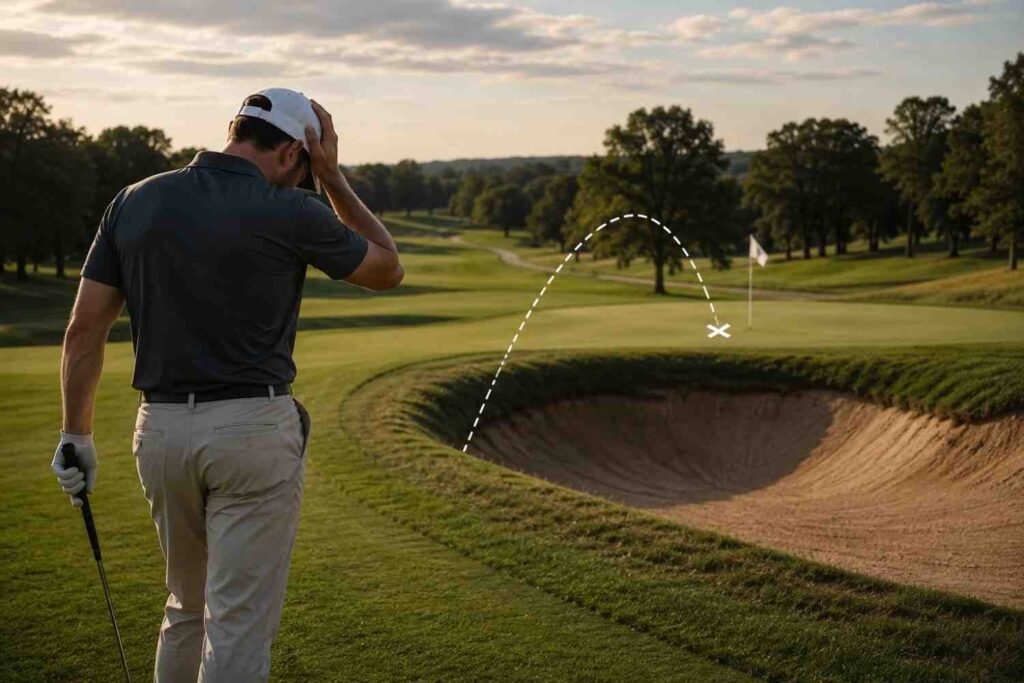
There’s also a risk management angle. When the pin is tucked behind a bunker or near a water hazard, playing to the pin high position on the safe side of the green, the pin high left or pin high right side away from trouble, is your best play. You’re aiming for the correct depth but dialing the direction toward safety. It’s the smarter version of the same concept.
Common Mistakes That Keep Golfers From Hitting Pin High
Four patterns show up repeatedly when golfers struggle with golf distance control pin high:
- Using “max” yardages for each club instead of average carry yardages. Your 7-iron might go 160 yards twice a year. On most swings it’s 148. Build your club chart around median numbers. Choosing equipment that matches your game matters too, and knowing how to choose golf balls can help you get more consistent performance from tee to green.
- Ignoring pin position on the scorecard or app. A pin at the back of a 40-yard-deep green is 20 yards different from a front pin. That’s a full club difference that many players overlook.
- Forgetting uphill and downhill slope adjustments. Uphill approaches play longer. Downhill approaches play shorter. Failing to account for slope is one of the easiest adjustments to make and one of the most commonly skipped.
- Letting adrenaline inflate your swing on pressure shots. When you’re nervous, you swing faster, grip tighter, and typically overshoot. The result is a long miss, not the pin high position you had in mind.
Fix any one of these and you’ll see immediate improvement. Fix all four and your approach shot proximity statistics will look completely different by the end of your next season.
How the Best Players Think About Pin High
Tour-level approach shot distance control is built on obsessive yardage tracking. Players like Rory McIlroy and Scottie Scheffler carry detailed notebooks, use caddies who measure distances to the inch, and factor in green firmness as a variable that changes carry targets day by day. That level of precision isn’t realistic for the average golfer, but the principle scales down perfectly.
You don’t need a caddie. You need a rangefinder, a club distance chart you’ve actually verified on a launch monitor or radar unit, and a pre-shot routine that makes the same three calculations every time. That’s it. That’s how what is hole high in golf goes from being a phrase you hear on TV to something you’re achieving on 11 of 18 holes.
The pin high golf meaning also carries a psychological weight worth understanding. When you say “pin high” after a shot, even if you missed the green, you’re acknowledging that you solved the hardest part of the approach equation. That positive reinforcement anchors your confidence in distance control even on days when your direction is off. It separates two variables mentally, which makes it easier to fix each one in isolation.
And for the record: pin high on the wrong side of a bunker beats short of the bunker almost every time from a scoring standpoint. You’d rather be chipping from level ground at pin depth than pitching from below the green front edge. The geometry just works out better.
Building Your Personal Pin High System

Here’s a practical checklist you can print or screenshot for your next practice session. This is the operational version of the CANDY framework above, broken into a before-round and during-round routine.
Before Every Round:
- Check your verified carry yardages for your wedges, 9-iron, 8-iron, and 7-iron. These are the clubs you’ll hit most approaches with.
- Note the temperature and wind forecast. Adjust your reference yardages mentally before you tee off.
- Confirm whether your rangefinder’s slope mode is legal for today’s round (it’s only banned in formal competitions, not casual play).
- Download or print the pin sheet if the course provides one, or check the app for daily pin positions.
On Every Approach Shot:
- Range to the pin, not the center of the green.
- Add or subtract for slope, wind, and elevation.
- Select the club that carries your adjusted yardage comfortably at 85 percent effort.
- Pick a landing zone, not just a direction, and swing to that zone.
- After the shot, note whether you were pin high, short, or long. Keep a mental tally. Three or more short misses in a row means you’re underclubbing or swinging tentatively.
That tally habit is the piece most golfers skip. Post-shot analysis doesn’t require a video camera or a coach. It requires honesty and pattern recognition. Five rounds of honest noting will tell you more about your distance tendencies than a year of vague practice.
Understanding what does pin high mean in golf has given you the vocabulary and the strategy. Now the gap between knowing and doing is just repetition with a purpose.
The next time your approach rolls out 12 feet right of the hole at the same depth as the flag, don’t shrug it off as a miss. Call it what it is: pin high right, with a direction correction still needed. You solved half the problem. That’s worth something, and knowing exactly which half you solved means you’re already ahead of most golfers on the course.