

If you are wondering how many days a week should golfers workout, I would start with two to four days. That range gives most golfers enough training to build strength, mobility, balance, and speed without carrying constant fatigue onto the course.
The exact number changes with your playing schedule. A golfer playing twice every weekend should not train like someone who plays twice per month.
My preferred approach is simple: schedule the gym around golf, not golf around the gym.
The Short Answer: Most Golfers Need 2–4 Workout Days
For most recreational golfers, two to four training sessions per week is a practical range.
Two days can maintain and improve strength when life and golf already fill the calendar. Three days gives me the best balance for many amateur golfers. Four days can work during an off-season when rounds are less frequent.
Federal U.S. physical activity guidance recommends muscle-strengthening activities involving the major muscle groups on at least two days each week.
University of Utah Health goes one step further for golfers. Its golf-focused program uses three weekly sessions covering strength, mobility, rotational power, balance, and lower-body endurance.
| Golf Schedule | Gym Days | Main Goal |
| Playing 2–3 rounds weekly | 1–2 | Maintain strength and mobility |
| Playing 1 round weekly | 2–3 | Strength, power, mobility |
| Light playing schedule | 3 | Build overall golf fitness |
| Off-season | 3–4 | Strength, speed, power |
So, how many days a week should golfers workout during a normal season? For most weekend players, I would start at two or three.
Golf Strength Training Frequency: Why More Is Not Always Better
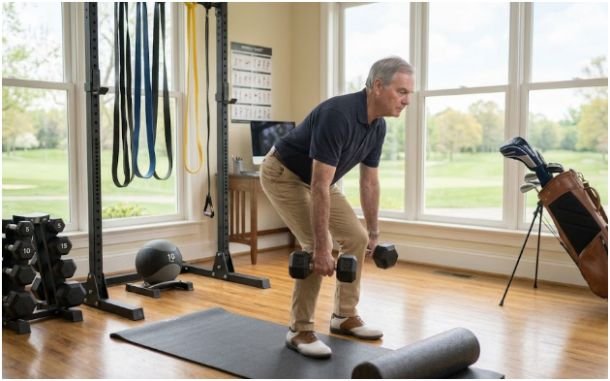
Golfers do not need a bodybuilding schedule.
The goal is not to accumulate the most gym sessions. The goal is to create physical adaptations that support the swing.
Golf uses lower-body force, trunk rotation, balance, coordination, and speed. Strength and conditioning research supports training these qualities. A systematic review of 25 studies found that many strength-and-conditioning interventions improved golf performance measures. Significant findings produced average gains of about 4% to 6.4% across clubhead speed, ball speed, and distance measures.
Another systematic review found resistance training can improve clubhead speed and hitting distance. Combined general and golf-specific training appeared especially useful.
That does not mean four workouts automatically beat two.
A hard leg workout before Saturday morning golf may improve fitness eventually while making Saturday’s swing worse. Frequency only works when recovery supports it.
For simple strength sessions without a commercial gym, I often structure training around a dumbbell workout for golfers at home. Squats, Romanian deadlifts, rows, presses, and split squats cover plenty of useful movement without complicated equipment.
In-Season vs Off-Season Golf Workout Schedule
Season matters when deciding how many days a week should golfers workout.
In-Season Training
When rounds become frequent, I reduce training volume.
One to two focused strength sessions may be enough for someone playing several times each week. The aim shifts toward maintaining strength, keeping the hips and thoracic spine mobile, and preserving speed.
I would rather finish a workout feeling capable of doing more than arrive at the first tee with sore legs.
Off-Season Training
The off-season gives golfers more room to train.
Three or four weekly sessions can make sense because there are fewer rounds competing for recovery. This is where I place more emphasis on progressive strength work, explosive movement, and measurable progression.
The answer to how many days a week should golfers workout therefore changes throughout the year. Training frequency should breathe with the golf calendar.
My Practical 3-Day Golf Workout Split
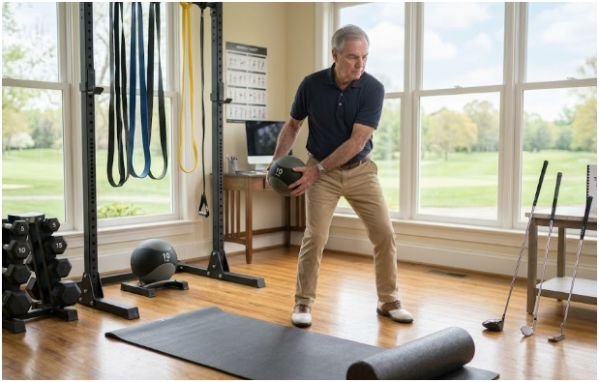
Three days is my favorite starting point for a golfer who plays about once per week.
It creates enough training exposure without turning every day into either golf or gym work.
Day 1: Full-Body Strength
I make the first session the strongest session of the week.
Goblet squats, Romanian deadlifts, rows, push-ups, and anti-rotation core exercises work well here. University of Utah Health uses similar movements in its golf strength program.
The objective is basic force production, not exhaustion.
Day 2: Rotational Power and Mobility
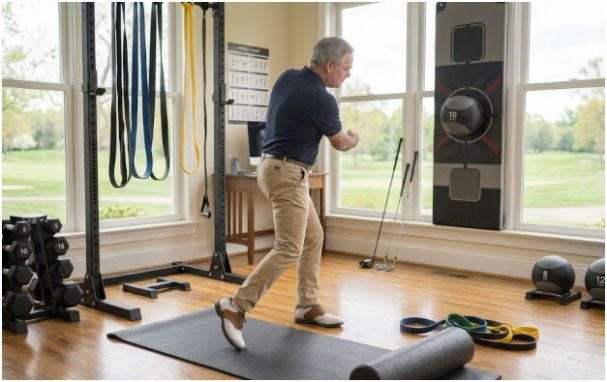
The second session becomes faster and lighter.
Medicine-ball throws, jumps, band rotations, hip mobility, and thoracic rotation fit well. Power exercises should stay crisp. Once speed falls noticeably, I stop chasing extra repetitions.
Golfers training in limited space can use a resistance band workout for golfers at home to train rotation, anti-rotation, rows, and shoulder control.
Day 3: Legs, Balance, and Core
The final session builds single-leg control.
I like split squats, reverse lunges, single-leg hinges, side planks, bird dogs, and balance drills.
This session does not need huge weights. Good control matters more than loading every exercise heavily.
How I Match Workout Days to Golf Days
This is the part many generic programs miss.
I treat golf itself as training load. Eighteen holes, range work, speed practice, and gym sessions all draw from the same recovery budget.
If You Play Once Per Week
Three gym sessions usually fit well.
For a Saturday golfer, I might train Monday, Wednesday, and Thursday. Thursday stays moderate so Friday can be a recovery day.
If You Play Twice Per Week
I usually reduce training to two quality sessions.
For example, a golfer playing Wednesday and Saturday could strength train Monday and Thursday. Short mobility sessions can fill other days without creating heavy fatigue.
Tournament or Heavy Golf Weeks
During an important golf week, I cut volume before I cut movement completely.
One or two short sessions can maintain rhythm without producing unnecessary soreness.
This is my “golf-load budget” rule: the more golf volume rises, the less gym volume I try to force into the same week.
That framework gives a more useful answer to how many days a week should golfers workout than blindly prescribing three sessions year-round.
Recovery and Mobility Matter as Much as Training Frequency
More training only works when you recover from it.
Persistent soreness, falling training performance, unusually heavy legs, poor sleep, or noticeably slower swings can all be reasons to reduce training load.
Mobility work does not always require another full workout day either. Ten minutes of controlled hip, shoulder, ankle, and thoracic movement can fit after practice or between strength sessions.
University of Utah Health recommends a five-to-ten-minute warm-up before its golfer workouts and uses exercises such as bodyweight squats, shoulder circles, Cat-Cow, and rotational movements.
After a round, I prefer lower-intensity recovery work rather than another hard training session. A post round golf stretching routine for weekend golfers can make more sense than trying to squeeze strength work into an already demanding golf day.
If soreness continues beyond normal training fatigue, or pain changes your swing, stop treating it as a programming problem and get appropriate medical or physical-therapy advice.
FAQs
1. How many days a week should a beginner golfer workout?
Two strength sessions per week are a sensible starting point before adding more volume.
2. Is working out three days a week enough for golf?
Yes. Three well-designed sessions can train strength, mobility, power, balance, and core control effectively.
3. How many days a week should golfers workout during golf season?
Most recreational golfers can use one to three sessions depending on how often they play and practice.
4. Should golfers workout the day before playing?
Light mobility can work well, but I avoid demanding leg or high-volume strength sessions before an important round.
Train for the Tee Sheet, Not the Mirror
So, how many days a week should golfers workout? I would put most players at two to four days, with three as the most useful year-round starting point.
The smarter decision comes after checking the tee sheet.
Play frequently and training volume should come down. Play less during the off-season and you can push strength, power, and progression harder.
My next step would be simple: start with two or three full-body sessions for four weeks. Track soreness, energy, swing speed, and how fresh you feel on the first tee. Then add training only when your recovery earns it.