

If your swing feels shorter and your legs disappear somewhere around the 15th tee, hitting another bucket of balls may not fix the problem. A smart golf fitness routine for golfers over 50 should improve the physical qualities your swing depends on without leaving you too sore to play.
My rule is simple: fitness should make golf easier, not become another sport you have to recover from. That means prioritizing hip mobility, upper-back rotation, core control, balance, and functional strength.
Why Golf Fitness Matters More After 50

Golf demands a fast rotational movement while you maintain posture and transfer force through the ground. Strength, mobility, balance, and physical function can become harder to maintain with age, but regular exercise helps preserve them. ACSM specifically highlights strength and balance as important parts of active aging.
The CDC recommends muscle-strengthening activity on at least two days each week. For older adults, it also recommends activities that challenge balance.
That is why a golf fitness routine for golfers over 50 should go beyond stretching. You need mobility you can control and strength you can use during the swing.
There is encouraging golf-specific evidence too. A study of 31 male golfers with an average age of about 65 tested an eight-week strength and flexibility program. Mean clubhead speed increased from 85.0 to 87.1 mph, alongside improvements in strength and several range-of-motion measures.
That is roughly a 2.5% clubhead-speed improvement. It is not a guaranteed result, but it shows that modest fitness gains can translate into measurable golf performance.
The 3-2-1 Golf Longevity Framework
I prefer a simple structure rather than a long menu of “golf-specific” exercises.
Train three qualities: mobility, stability and balance, and functional strength. Complete two main strength sessions weekly. Before each workout, perform one readiness check.
Try a comfortable bodyweight squat, a standing torso rotation, and a 20-second single-leg balance. Pain or unusually poor control is a reason to reduce the day’s load or range of motion.
Mobility: Keep Your Hips and Upper Back Moving
Start with thoracic rotations. Hold a club across your shoulders in golf posture. Rotate your chest back and through while keeping the movement controlled. Perform eight repetitions per side.
Next, use standing hip circles while holding a club or chair for support. Finish with a gentle kneeling hip-flexor stretch.
These movements prepare the hips and thoracic spine without exhausting you.
Golfers who want to begin without weights can build the same foundation through a bodyweight workout for golfers over 50, using squats, supported lunges, mobility drills, and core exercises.
A useful golf fitness routine for golfers over 50 does not force extra range. It develops comfortable motion you can actually control.
Core Stability and Balance: Control Your Rotation
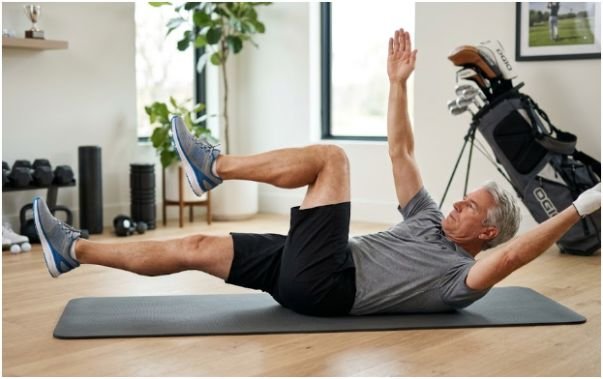
Rotation creates speed, but control determines how well that movement transfers through the swing.
Dead bugs are useful because the trunk stays stable while opposite arms and legs move. Complete six to ten slow repetitions on each side.
Follow them with a side plank. Add controlled rotation once you can hold the basic position without losing posture.
Then practice single-leg balance for 20 to 30 seconds beside a wall or sturdy chair. Balance training fits directly with current physical activity recommendations for older adults.
This part of a golf fitness routine for golfers over 50 can be especially valuable for uneven lies, weight transfer, and maintaining control late in a round.
Functional Strength: Build Power From the Ground
Your legs and hips provide the platform for the swing. They also carry you through several hours on the course.
Goblet squats are a practical starting exercise. Hold a light dumbbell close to your chest and complete eight to twelve controlled repetitions.
Next, perform dumbbell or kettlebell deadlifts. Push your hips backward, keep the weight close, then stand tall without overextending your lower back.
Incline push-ups add upper-body strength without requiring the difficulty of floor push-ups.
If free weights are inconvenient, a resistance band workout for golfers can train rows, presses, hip hinges, and anti-rotation exercises with adjustable resistance.
Golf Fitness Routine for Golfers Over 50: Weekly Plan
You do not need to train every day. Two structured workouts plus short mobility sessions can cover the essentials.
| Day | Training Focus | Approx. Time |
| Monday | Mobility + strength | 30 minutes |
| Tuesday | Walking or aerobic activity | 20–30 minutes |
| Wednesday | Mobility + balance | 15 minutes |
| Thursday | Mobility + strength | 30 minutes |
| Friday | Rest or easy mobility | 10 minutes |
| Weekend | Golf + dynamic warm-up | As needed |
This golf fitness routine for golfers over 50 leaves recovery space around your golf schedule.
Busy week? A 20 minute golf workout at home can combine thoracic rotations, goblet squats, dead bugs, incline push-ups, hip hinges, and single-leg balance.
How Hard Should You Train After 50?

ACSM recommends resistance exercise at least twice weekly for older adults and notes that one to three sets in roughly the six-to-15-repetition range can be useful, depending on the goal and load.
For a recreational golfer, I would start with two sets of eight to twelve repetitions.
| Exercise | Sets | Reps/Time | Primary Goal |
| Thoracic rotation | 2 | 8/side | Rotation mobility |
| Goblet squat | 2 | 8–12 | Leg strength |
| Dumbbell deadlift | 2 | 8–12 | Glutes and hips |
| Dead bug | 2 | 6–10/side | Core stability |
| Incline push-up | 2 | 8–12 | Upper-body control |
| Single-leg balance | 2 | 20–30 sec/side | Balance |
The final repetitions should feel challenging without destroying your technique. Add weight only when you can control every repetition.
That approach keeps a golf fitness routine for golfers over 50 progressive without treating soreness as proof of success.
The Best Pre-Round Fitness Routine
Do not turn your warm-up into another workout.
Spend five to eight minutes on hip circles, thoracic rotations, easy bodyweight squats, and gradually faster practice swings.
Save demanding strength work for another day. The objective before teeing off is to feel warm and mobile, not fatigued.
Training Mistakes That Can Hurt Your Golf
One common mistake is stretching everything while strengthening nothing. Greater range of motion has limited value if you cannot control it.
Another is performing a hard leg workout immediately before an important round. Schedule demanding strength sessions far enough from competition that normal fatigue does not interfere with your game.
Do not ignore general conditioning either. Current US guidance recommends at least 150 minutes of moderate aerobic activity each week alongside regular muscle-strengthening work.
Finally, avoid adding load just because an exercise feels easy once. Smooth, repeatable movement matters more than impressive dumbbell numbers.
A sustainable golf fitness routine for golfers over 50 should fit around your golf rather than compete with it.
Stronger at 18 Than You Were at 1
Forget trying to win the gym.
Your real test comes when you reach the final four holes and can still turn, maintain posture, and walk to the next tee without feeling drained.
Start with two training sessions this week. Record your exercises, weights, and repetitions. After four weeks, pay attention to your balance, comfort, and energy on holes 15 through 18.
The best golf fitness routine for golfers over 50 is not the hardest one. It is the one you can repeat, recover from, and still enjoy when Saturday’s tee time arrives.
FAQs
1. What is the best golf workout for golfers over 50?
Combine mobility, functional strength, core stability, and balance two or three times weekly.
2. How many days a week should golfers over 50 lift weights?
Two weekly strength sessions are a practical starting point and align with CDC and ACSM recommendations.
3. Can a golf fitness routine for golfers over 50 increase swing speed?
It may help; one eight-week study in older male golfers reported improvements in strength, flexibility, and mean clubhead speed.
4. Should golfers over 50 stretch every day?
Gentle mobility can be performed frequently, but it should complement strength, balance, and regular physical activity.