
When I structure a bodyweight workout for golfers over 50, I am not trying to leave someone exhausted on the living-room floor. I want each exercise to make walking 18 holes, rotating freely, staying balanced, and finishing the swing feel easier.
You do not need a barbell or expensive home gym. About 20 minutes of focused mobility, stability, and lower-body work can train many of the physical qualities used during a golf swing.
Why Golfers Over 50 Need a Different Kind of Workout
Strength still matters after 50, but golf requires more than raw muscle.
The swing depends on coordinated pelvis and upper-torso rotation. Research involving recreational golfers has linked these rotational mechanics with driving performance and ball velocity.
That is why my bodyweight workout for golfers over 50 does not revolve around endless squats or crunches. I combine rotation with anti-rotation control, hip strength, balance, and weight transfer.
Train Rotation Without Forcing the Lower Back
Trying to manufacture a bigger backswing through the lumbar spine can be counterproductive.
Golf research has connected hip mobility, trunk muscle function, pelvic movement, and trunk rotation with lower-back mechanics in golfers.
I therefore prefer exercises that encourage movement through the hips and thoracic spine while keeping the lumbar area controlled.
Build Stability Before Chasing More Speed
A fast swing is not especially useful when you cannot control your finish.
Balance becomes increasingly valuable as we age. CDC recommendations for adults 65 and older specifically combine aerobic exercise with muscle-strengthening and balance activity.
Current resistance-training evidence is encouraging too. A 2026 American College of Sports Medicine position stand found resistance exercise can improve strength, power, balance, and physical function across adults.
Quick Reference: 20-Minute Golf Workout
| Exercise | Reps | Main Golf Benefit |
| Half-kneeling thoracic rotation | 8–10/side | Upper-body rotation |
| Cat-cow | 10 cycles | Spinal mobility |
| Side plank thread-the-needle | 8/side | Core and rotation control |
| Bird-dog | 8–10/side | Trunk stability |
| Glute bridge | 12–15 | Hip extension |
| Split squat with rotation | 8/side | Leg strength and separation |
| Follow-through drill | 10 reps | Weight transfer and balance |
Keep transitions short and move deliberately. One or two rounds will fit most golfers into a roughly 20-minute session.
The Bodyweight Workout
1. Mobility and Golf Warm-Up
Start the bodyweight workout for golfers over 50 with three to five minutes of controlled movement.
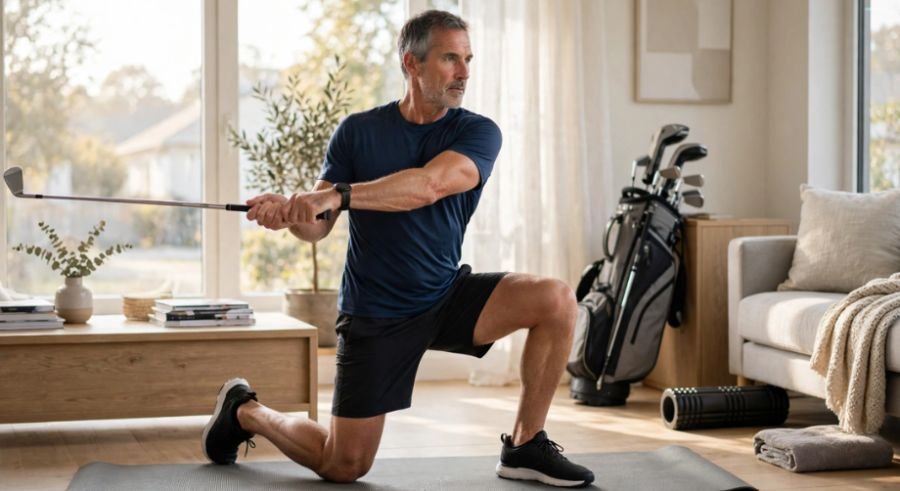
For half-kneeling thoracic rotations, place one knee down and the opposite foot forward. Brace your lower body. Rotate your chest toward the front leg’s open side without forcing the range. Complete 8 to 10 repetitions before switching sides.
Follow with 10 slow cat-cow cycles. Move between a comfortable rounded and extended spine rather than chasing the largest possible range.
The goal is simple: arrive at the strength exercises able to move comfortably, not already fatigued.
2. Core and Rotational Stability
Next, perform side plank thread-the-needle.
Support yourself on one forearm. Use bent knees if the full version feels unstable. Reach your top arm upward, then rotate your rib cage and pass that hand beneath your torso.
Complete about eight controlled repetitions per side.
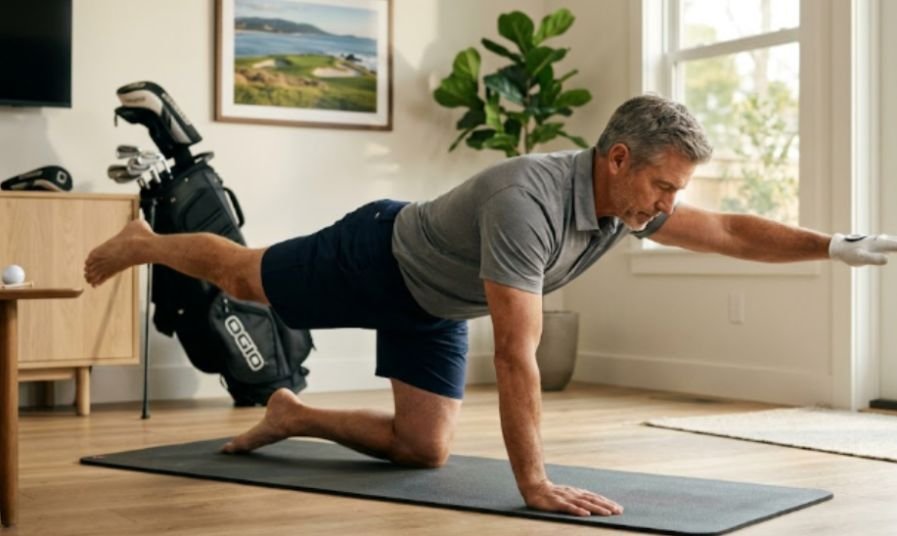
Move directly into bird-dogs. From all fours, extend your right arm and left leg while resisting the urge to twist. Return slowly and alternate sides.
I value bird-dogs because they make the trunk resist movement while the arms and legs move independently. Golf requires similar control when force travels between the ground, hips, torso, and club.
Complete 8 to 10 repetitions per side.
3. Lower-Body Strength and Weight Transfer
Glute bridges come first. Lie on your back with your knees bent. Drive through your feet and raise your hips until your torso and thighs form a comfortable line.
Perform 12 to 15 repetitions.
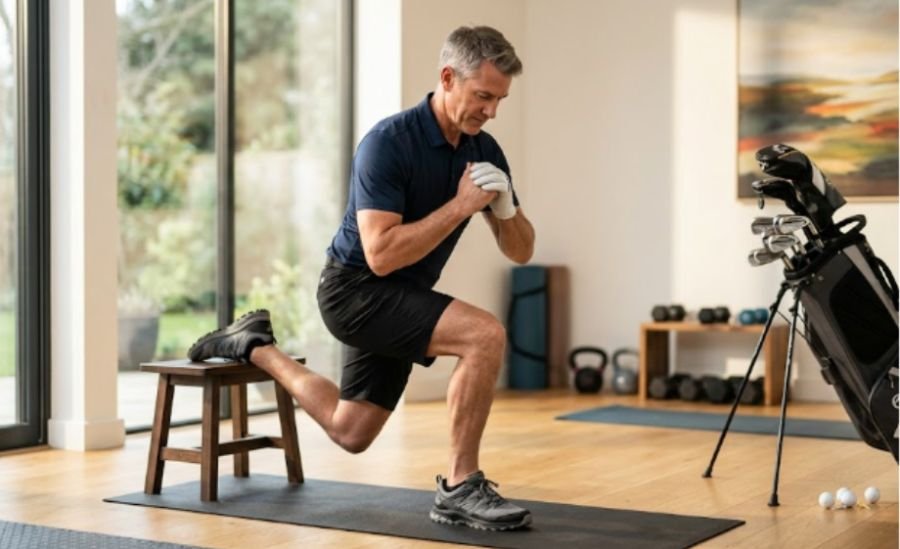
Next, use split squats with gentle torso rotation. Establish a stable split stance, lower under control, then rotate your chest slightly toward the lead side. Keep your front knee tracking comfortably over the foot.
Perform eight repetitions on each leg.
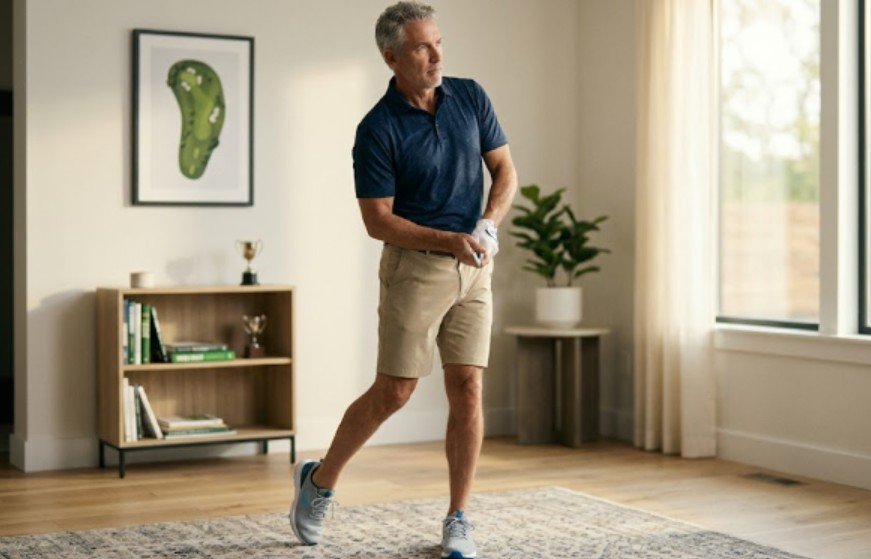
Finish with a golf-specific weight-transfer drill. Begin in your normal address stance. Slowly shift onto the lead side while rotating your trail heel upward. Finish tall and balanced, as if you had just watched a solid approach shot land beside the flag.
Hold each finish for two seconds.
That small pause matters. If you cannot own the finish slowly, adding swing speed will not magically create more control.
How to Progress Without Beating Up Your Joints
Your bodyweight workout for golfers over 50 should become harder because your control improves, not because every session becomes more punishing.
Once the basic movements feel easy, a resistance band workout for golfers at home can introduce rotational resistance without requiring heavy equipment.
Later, a dumbbell workout for golfers at home can provide more conventional strength loading for the legs, hips, back, and shoulders.
As your strength improves, a dumbbell workout for golfers at home can provide a natural next step by adding more resistance to squats, hinges, rows, and rotational exercises while still keeping the training practical for home use.
Use the 3-2-1 Swing Reserve Rule
I use a simple progression concept I call the 3-2-1 Swing Reserve Rule.
Finish each set when you feel you could still perform roughly three clean repetitions. Use about two seconds when lowering into strength movements. Hold the final position of balance-based drills for one full second or longer.
This is not a clinical testing protocol. It is a practical coaching framework designed to keep movement quality ahead of fatigue.
For example, imagine you can perform eight split squats cleanly but rep nine makes your knee collapse inward. Eight is your current working number. Do not chase 12 ugly repetitions because a generic workout chart says so.
Progress first by improving control. Then add repetitions, range, resistance, or speed.
How Often Should Golfers Over 50 Train?
I would perform this bodyweight workout for golfers over 50 two or three times each week, ideally with recovery between harder sessions.
That schedule also fits established physical-activity guidance. Adults 65 and older are advised to perform muscle-strengthening work on at least two days each week and include balance training.
Golf days can still include training, but timing matters. Avoid turning leg work into a fatigue contest two hours before an important round.
On busy weeks, a 20 minute golf workout at home is often more useful than planning a perfect 60-minute session that never happens.
Consistency wins.
If you have been inactive, have recently had surgery, or experience chest pain, unusual shortness of breath, or sharp joint pain during exercise, get appropriate medical guidance before pushing harder. Federal health guidance also recommends starting gradually when returning to exercise after inactivity.
Frequently Asked Questions
1. What is the best bodyweight workout for golfers over 50?
A useful routine combines hip and thoracic mobility, core stability, leg strength, balance, and golf-specific weight-transfer drills.
2. Can golfers over 50 build swing speed with bodyweight exercises?
Bodyweight training can improve strength, balance, control, and rotational function, all of which support efficient swing mechanics.
3. How long should a golf workout be after age 50?
About 20–30 focused minutes can be practical, provided the session includes quality strength, mobility, and balance work.
4. Should golfers over 50 exercise on golf days?
Yes, but keep pre-round exercise light and mobility-focused if harder strength work makes your swing feel fatigued.
Keep the Birthday Candles, Lose the Stiff Swing
Age does not automatically demand a shorter backswing, weak legs, or a cautious shuffle toward every shot.
What usually matters more is keeping useful movement available.
My priority with a bodyweight workout for golfers over 50 is simple: rotate where you should rotate, stabilize where you should stabilize, and stay strong enough to use the ground effectively.
Better physical control can make it easier to work on technique, but your hands still provide the direct connection to the club. If your grip feels uncomfortable or inconsistent, understanding overlap vs interlock golf grip can help you choose a hand position that feels secure without adding unnecessary tension.
That same practical approach can extend to the equipment you carry. A golf bag buying guide for everyday players can help you choose a bag that suits how often you walk, ride, practice, and organize your clubs without adding unnecessary bulk.
Start with two sessions this week. Do not worry about making them brutal. Make every repetition clean enough that your final rep looks almost identical to your first.
Your scorecard does not award bonus strokes for being sore.