
Changing the way you hold a club feels unnatural, yet 40% of PGA Tour pros intentionally swap their hand placement on the greens. The conventional grip drops your dominant trailing hand lower down the shaft. That layout instantly causes your trailing shoulder to drop, throwing off target alignment.
A cross-handed putting grip guide flips this geometry. By dropping your lead hand lower, you lock the lead wrist straight and pull your shoulders into a square, level plane. This simple shift replaces twitchy hand movements with a repeatable, pendulum stroke driven entirely by your core.
Biomechanics Behind Left-Hand-Low
Conventional golf grips place your dominant hand (right hand for righties) lower on the shaft. This asymmetry forces your lower shoulder down, tilting your spine and opening up your chest.
Golf Grip Pressure Tips can help golfers maintain a light, consistent hold that supports this setup without creating unnecessary tension in the hands and forearms.
When putting, this tilt introduces undesirable rotation. Your dominant hand tries to “flip” at impact, introducing dynamic loft and face-angle errors. 3D motion-capture studies from GolfWRX reveal that even a 1-degree shift in wrist flexion at impact alters your ball’s starting line enough to miss a six-foot putt.
Conventional Setup: [High Shoulder] \ —> [Low Shoulder] (Causes wrist flip)
Cross-Handed Setup: [Level Shoulder] — [Level Shoulder] (Drives pendulum stroke)
Cross-handed putting flips that kinetic chain:
- Level Shoulder Alignment: Placing your lead hand low brings your lead shoulder down. Thislevels your shoulder line parallel to your target line without forcing awkward spinal bends.
- Lead Wrist Stabilization: The lower hand acts as a rigid extension of the putter shaft. This prevents your lead wrist from bending backward or collapsing forward during impact.
- Elimination of Trailing-Hand Dominance: Moving your dominant hand up to the top position dampens active muscle twitching, curing small hand flips.
How to Set Up the Cross-Handed Grip
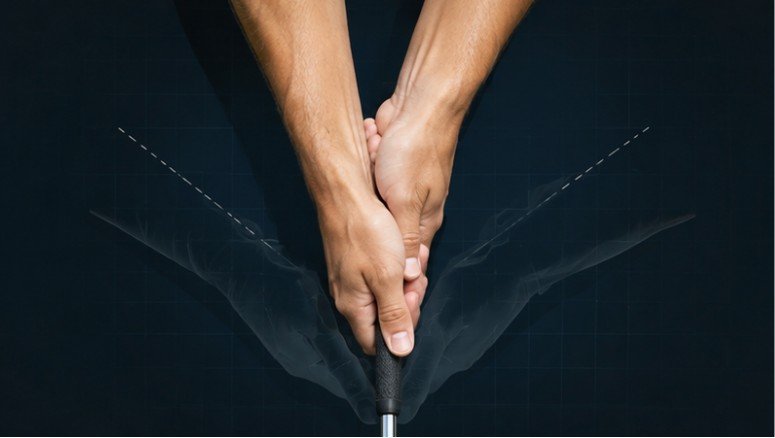
Setting up this grip requires precision. Small adjustments in finger placement directly change how the putter face opens and closes through your stroke. How to Practice Putting at Home Disc Golf can build on this precision by encouraging players to repeat the same grip and release while practicing short, controlled putts in a consistent indoor setup.
+——————+——————————————————-+
| Setup Step | Key Execution Detail |
+——————+——————————————————-+
| 1. High Hand | Place trailing hand high on the grip handle. |
| 2. Low Lead Hand | Slide lead hand underneath trailing hand. |
| 3. Finger Lock | Interlock or overlap fingers across the rubber. |
| 4. Index Alignment| Extend lead index finger flat along the shaft. |
| 5. Shoulder Check| Ensure shoulders are level using a mirror or alignment|
+——————+——————————————————-+
Step 1: Position the Trailing Hand High
Place your dominant trailing hand at the top of the putter handle. Rest the top pad of your palm flat against the front flat section of the grip.
Step 2: Slide the Lead Hand Low
Position your lead hand directly below the trailing hand. Your lead palm should cradle the side of the grip, placing your thumb flat along the top.
Step 3: Choose Your Finger Connection
Use an overlapping or interlocking style. Rest the pinky of your lead hand between the index and middle fingers of your trailing hand, or interlock them to lock both hands together as one unit.
Step 4: Index Finger Extension
Extend your lead index finger straight down the side of the putter grip. This acts as a physical guide to keep your lead wrist stable through impact.
Step 5: Level Your Shoulder Line
Stand over the ball and look in a full-length mirror. Verify that your shoulders sit level and parallel to your target line, rather than dipping low on your dominant side.
What PGA Tour Pros Prove About Cross-Handed Putting
The tour switched to left-hand-low because it produces measurable results under pressure.
Rory McIlroy switched to a cross-handed grip to quiet his active right hand and simplify his stroke mechanics. Jordan Spieth has relied on left-hand-low for most of his career, using it to dominate short-to-medium range putting stats.
Research published by the Professional Golfers’ Association (PGA) highlights that cross-handed putters experience less face-angle variance on off-center hits. By removing wrist hinge, speed control becomes a function of shoulder rotation rather than hand timing.
Putting Alignment Drills for Beginners can build on this principle by helping players develop a stable setup, consistent face position, and reliable starting direction before focusing on more advanced putting techniques.
Who Should Use Cross-Handed Putting (and Who Should Avoid It)

This grip isn’t a silver bullet for every player or green condition.
Ideal Candidates
- Golfers fighting the yips: If your trailing hand twitches at impact, taking its power away calms down your stroke.
- Players missing putts left: If you pull putts due to active wrist closure, a locked lead wrist holds the putter face square longer.
- Visual alignment thinkers: Cameras and laser tracking confirm that level shoulders make it easier to line up putts accurately down your target line.
Situations to Avoid Left-Hand-Low
- Long-distance lag putting: Eliminating wrist hinge in golf makes it harder to feel touch and distance on long lag putts over 45 feet.
- Golfers with limited shoulder mobility: A shoulder-driven pendulum motion requires comfortable torso rotation.
The 5-Minute Alignment and Wrist-Lock Test
Test whether this grip fits your natural mechanics before heading out to play.
[Setup Putter] —> [Place Coin 3 Feet Away] —> [Stroke 10 Times] —> [Check Path]
- Set the Target: Place a coin on the carpet or putting green 3 feet away from your ball.
- Take Your Stance: Build your cross-handed grip with your lead hand low.
- Execute 10 Strokes: Focus on keeping the back of your lead hand facing the target throughout the entire stroke.
- Evaluate: If your ball rolls over the coin on at least 8 of 10 strokes, your shoulder alignment is working. If you miss right or left, adjust your lead index finger to stabilize the putter face.
To refine your setup, explore specialized equipment like those discussed at Golf.com for putters with flatter grip profiles that complement left-hand-low mechanics.
Frequently Asked Questions
1. What is the best grip for cross-handed putting?
The reverse overlap cross-handed grip works best. Placing your lead hand low with your lead index finger extended along the flat part of the shaft provides maximum face control.
2. What is Scottie Scheffler’s putting grip?
Scottie Scheffler uses a modified claw grip on short putts, placing his left index finger extended down the shaft to stabilize his lead wrist through impact.
3. What are the benefits of using a cross-handed grip when putting?
It levels your shoulders, prevents wrist breakdown, and eliminates active trailing-hand twitches to create a consistent pendulum motion driven by your shoulders.
4. What putting grip does Rory McIlroy use?
Rory McIlroy uses a cross-handed (left-hand-low) putting grip with a pistol-style putter grip to maintain shoulder alignment and face stability.
Finding Your Ideal Putting Alignment
Swapping your hand placement alters your biomechanics on the green. By positioning your lead hand low, you level your shoulders, lock your wrist angles, and build a repeatable pendulum stroke.
While lag putting on long greens takes practice to dial in, the accuracy gains on short-to-medium putts make this transition worthwhile. Test the setup, commit to the feel, and give your stroke the mechanical upgrade it needs.
Learn more about adjusting your putting mechanics by watching this Rory McIlroy Putting Technique Guide which visually demonstrates the benefits of left-hand-low alignment on the green.