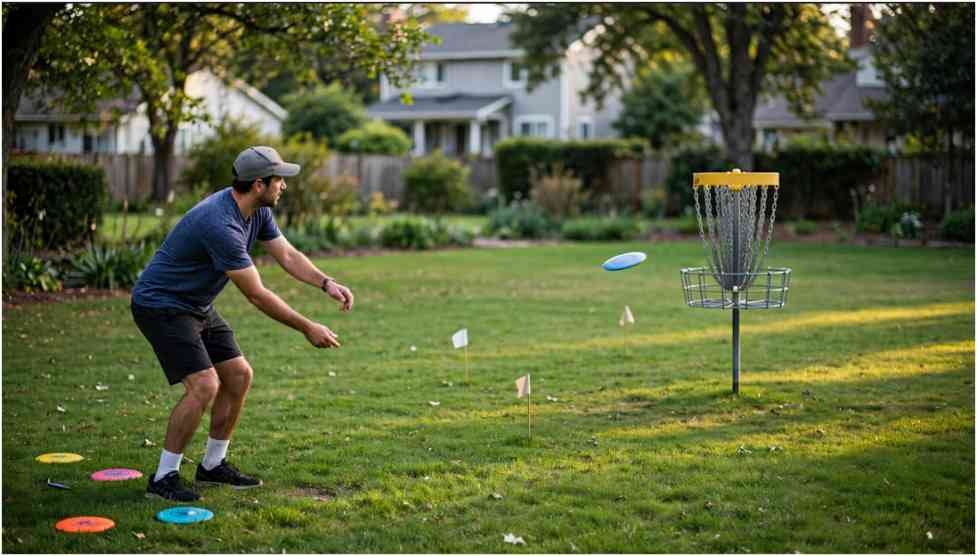
Most disc golfers lose rounds on the green, not the tee pad. Research from the PDGA consistently shows that putting accounts for roughly 40% of all throws in a typical recreational round. You can rip a 400-foot backhand all day, but if your putt misses a 15-foot basket, that driver shot means nothing.
The good news is that putting is the one part of disc golf you can genuinely master at home, no course required, no weather excuses. This guide covers exactly how to practice putting at home disc golf players of all skill levels can use, from alignment drills to basket setup, form checks, and the mental habits that separate consistent putters from wishful ones.
Why Home Putting Practice Beats Range Sessions
Going to the course to practice sounds productive, but it’s rarely efficient. You spend time walking between holes, waiting on groups, and splitting your focus between putting and full-round decisions. At home, every rep is intentional.
Repetition is the engine of skill development. A study published by researchers at the Journal of Motor Learning and Development confirmed that blocked practice, which means repeating one specific movement in a controlled setting, accelerates early skill acquisition significantly. Home putting is blocked practice in its purest form. You get 200 reps in the time it takes to play six holes on a course.
There’s also the honesty factor. On the course, you pick up a missed putt and move on. At home, you face every miss directly and can adjust your form before the next throw. That feedback loop is where real improvement lives.
Gear You Actually Need to Build a Home Setup
You do not need much to get started. Here is what makes a functional home putting station:
- A portable disc golf basket, or a DIY alternative
- Three to five mid-range or putter discs
- A small strip of tape or a coin for alignment markers
- Eight to ten feet of open indoor space, or a backyard patch
The basket question is real. A regulation practice basket runs between $80 and $200 depending on the brand. The Disc Golf Association Mach Lite sits around $80 and is a solid buy for beginners who want something portable. If you’re not ready to buy one, a laundry basket on a stool works fine for learning release angle and flight path. It won’t give you the chain-hit satisfaction, but it will improve your accuracy and form just as well at this stage.
On discs: do not practice putting with a driver or fairway disc. Use dedicated putters. Popular choices are the Innova Aviar, the Latitude 64 Pure, and the Dynamic Discs Judge. They’re understable enough to fly true on a short putt without the overstable fade that a driver would introduce.
The Core Putting Stance and Form Breakdown
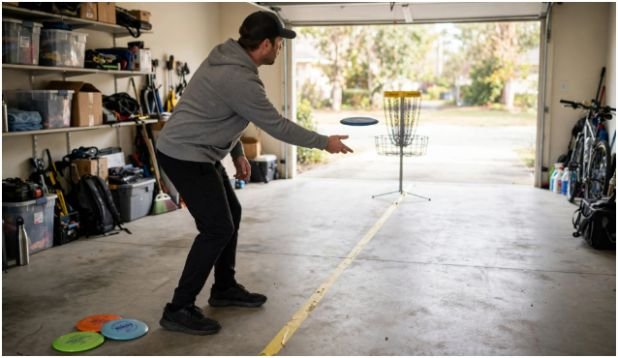
Before you build distance, build a repeatable form. Inconsistency in putting almost always traces back to grip, stance, or release point, and fixing those three things is where your home practice should start.
Grip: Most players learn the fan grip for putting. Your fingers spread across the bottom rim of the disc, and your thumb sits on top. This grip gives you control and lets you feel the disc through the entire throwing motion. The stack grip, where fingers are closer together, works better for some players on longer putts. Try both and stick with whatever lets you hold the disc consistently at the same angle every single time.
Stance: For a standard straddle or inline stance, your weight should be slightly forward. Think about driving your hips toward the basket as you release. Your arm extends fully on release, and your follow-through should point directly at the chains. If your arm swings off-center, your disc will too. This way, you can master the proper golf stance while practicing at home.
Release angle: A flat release is the goal for most putts under 25 feet. Hyzer, meaning the outside edge of the disc tilts down, causes the disc to fade left for a right-handed backhand player. Anhyzer, where the outside edge tilts up, causes the disc to turn right. On a dead straight 20-foot putt, you want zero hyzer and zero anhyzer. Getting this dialed in at home, where you can focus on nothing else, is the whole point.
“Putting is 90% mental and 10% mechanics, but the mechanics have to be solid before the mental game matters at all.”
This consensus comes directly from top-ranked PDGA professional Paige Pierce in interviews with DGCourseReview, where she has repeatedly emphasized that home repetition of putting mechanics is what builds the confidence needed on the course.
How to Practice Putting at Home Disc Golf Style: 6 Specific Drills
These drills are ordered by priority. Start at drill one and spend at least a week there before moving on.
Drill 1: The 10-Foot Commitment Drill.
Place your basket or target 10 feet away. Throw 50 putts in a row. Your only goal is to make every single one. Do not move back until you can hit 45 out of 50 consistently over three separate sessions. This is not about power. It’s about accuracy and building trust in your form.
Drill 2: The Alignment Walk-Back.
Put a piece of tape on the floor pointing directly at the basket. Stand on the tape at 10 feet, putt five times. Step back to 15 feet. Putt five more. Keep stepping back in 5-foot increments until your accuracy drops below 60%. Note the distance where that happens. That is your current reliable putting range, and every home practice session should include work at that threshold.
Drill 3: Circle 1 Simulation.
In official PDGA rules, Circle 1 extends 10 meters, about 33 feet, from the basket. Place markers at 15, 20, 25, and 33 feet. Rotate through all four distances throwing three putts each. Score yourself. Track your makes per session in a notebook or the free UDisc app. Numbers matter. If you can’t measure improvement, you won’t stay motivated to practice.
Drill 4: Form-Only Throws.
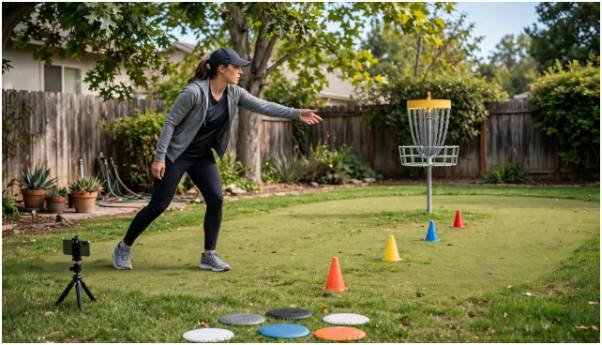
Remove the basket entirely. Stand in your putting stance and go through your full motion with no target. Focus only on your arm path, your grip pressure, and where your fingers point on release. This is especially useful for catching bad habits. Video yourself from the side on your phone. You will almost certainly see something your body didn’t tell you.
Drill 5: Left-Hand (or Off-Hand) Putting.
This sounds weird, but throwing a few putts with your non-dominant hand teaches you a huge amount about where your form is collapsing. When you learn a movement with your weak side, your brain pays closer attention. You’ll notice alignment and balance issues in a way your dominant hand hides through muscle memory.
Drill 6: The 100-Putt Challenge.
Once a week, throw 100 consecutive putts from 20 feet. Count every make. Write the number down. Do this every week for 90 days. The improvement in that single number over 13 weeks will tell you more about your progress than any conversation about form ever could.
Dealing with Hyzer, Anhyzer, and Flight Path Issues
If your putts are consistently curving left or right, the problem is almost always release angle rather than disc selection. Hyzer and anhyzer are not just technical terms, they’re the two biggest enemies of a beginner’s putting accuracy.
A reliable way to check your release angle at home: set your basket slightly below eye level and stand 15 feet away. Focus on the top of the basket as your target. If your disc is consistently arriving at the chains with a left or right tilt, look at where your elbow is during the release. A high elbow on a backhand putt often causes unintended anhyzer. A low, tucked elbow causes hyzer.
Disc selection plays a role too. Overstable putters like the Innova Aviar3 or the MVP Atom resist turning even with an off-axis release, which is helpful if you’re still working on your form. Understable putters are less forgiving but fly straighter when released cleanly. For home practice focused on building good habits, a neutral-stability putter is the right call.
Indoor vs. Outdoor Home Practice: What to Prioritize
| Practice Type | Best For | Space Needed | Recommended Distance
|
|---|---|---|---|
| Indoor putting (basement, hallway) | Form work, short-range accuracy | 10 to 20 feet | 10 to 20 feet |
| Indoor without basket (target on wall) | Release angle, arm path | Any room | 5 to 15 feet |
| Outdoor backyard basket | Full range simulation, wind reading | 40 to 60 feet | 10 to 40 feet |
| Garage with hanging target | Repetition volume, consistency | 20 to 30 feet | 10 to 25 feet |
For most players, a basement or garage setup with a portable basket is the sweet spot. You can practice year-round regardless of snow, you have a controlled environment, and you’re not fighting wind that would skew your feedback on release angle.
The chart above reflects average make percentages for recreational disc golfers across common putting distances, compiled from community-reported data on disc golf forums and apps. Your numbers will vary, but this gives you a benchmark. If you’re making 15-foot putts at less than 75%, home practice is the highest-leverage investment you can make in your game right now.
Tracking Progress: The Numbers That Actually Matter
Most players practice without measuring anything, which means they have no idea if they’re improving. Tracking a few specific numbers changes that completely.
Track these four metrics weekly:
- Make percentage from 15 feet (your baseline confidence distance)
- Make percentage from 25 feet (your Circle 1 edge, where pressure builds)
- Longest distance where you make 50% or better (your reliable max range)
- Total putts thrown per week (volume is a variable you control directly)
The UDisc app lets you log practice rounds and has a putting practice mode built in. It’s free to download and used by millions of disc golfers worldwide. Even a simple spreadsheet works. The point is to create data. Data shows trends that your memory can’t.
Here’s a concrete scenario: imagine you’re practicing every other day for six weeks. In week one, your 25-foot make rate is 32%. By week six, it’s 54%. That’s not a vague feeling of improvement. That’s 22 percentage points of measurable progress, and it happened because you practiced at home with intention instead of just lobbing discs at the course on weekends.
The Mental Side of Home Putting Practice
Putting mechanics without a mental routine is like building a house with no foundation. Your home practice is the perfect place to build that routine because there’s no pressure, no gallery, no tournament jitters.
A repeatable pre-putt routine takes about five to eight seconds. It should include one look at the basket, one breath, and the same grip-check motion every single time. The reason routines work is not mystical. They trigger a consistent physiological state before the throw, reducing the chance that anxiety or distraction enters the motion. Build the routine at home when nothing is on the line so that it’s automatic on the course when everything is.
On the mental side of miss recovery: every player misses putts. Beginners beat themselves up, which stiffens the next throw. The better approach is to diagnose and reset. Did you skip the routine? Did your elbow drift? Identify one specific mechanical reason for the miss, correct it mentally, and move on. That’s the cycle that builds skills instead of frustration.
Common Mistakes That Kill Home Practice Gains
A few patterns consistently undermine what would otherwise be productive home sessions.
Practicing from too far too soon is the biggest one. Your brain needs success reps to build the neural pattern for putting. If you’re standing 35 feet away making three out of twenty, you’re reinforcing a miss pattern. Start close. Stay close until it’s boring. Then move back.
Practicing without a specific intention is equally damaging. Walking up to a basket and just throwing is not practice. It’s recreation. Before each session, state one specific goal: “Today I’m working on keeping my elbow in on the release” or “Today I’m tracking my make rate from 20 feet.” One goal per session is the right number.
Ignoring disc quality also costs players. Old, warped, or heavily worn discs fly unpredictably. If your putter has a deep gouge from a tree strike, retire it from practice. You need consistent flight to get consistent feedback.
How to Practice Putting at Home Disc Golf: A 4-Week Plan
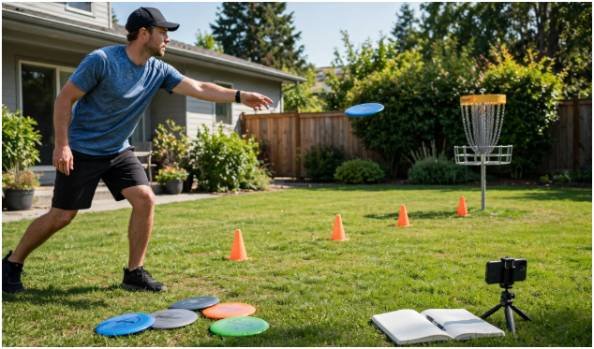
This plan assumes three practice sessions per week at 20 to 30 minutes each. It’s designed to build accuracy before distance, which is the correct order.
Week 1: Every session from 10 feet only. 50 putts per session. Focus entirely on grip consistency and a flat release. Count makes. Write the number down.
Week 2: Add a 15-foot station. Split sessions 50/50 between 10 and 15 feet. Start your pre-putt routine with every single throw. No exceptions.
Week 3: Add 20 feet. Spend 20% of reps at 10 feet, 40% at 15, and 40% at 20. Video one session from the side. Watch the video and identify one form adjustment to work on in week 4.
Week 4: Introduce the Circle 1 rotation drill from the list above. Hit all four distances in every session. At the end of the week, do a full 100-putt challenge from 20 feet and record your score. Compare it to your week 1 baseline. That number is your four-week progress report.
By the end of week four, most players who follow this structure see a 15 to 25 percentage point improvement in their Circle 1 make rate. That translates directly into two to four strokes per round on the course, which is a massive improvement for a 90-day recreational player.
If you want to go deeper on disc golf skill development beyond just putting, the Disc Golf Scene community has extensive forums on everything from forehand technique to course strategy that are worth exploring as your game grows.
When Home Practice Transfers to the Course
Home practice builds the mechanics, but you should also incorporate a golf warm up routine along with the practice sessions. The course tests the mental application. The transfer happens faster than most players expect, usually within two to three rounds of consistent home work, but only if you carry your routine from home to the tee pad.
The first time you step up to a 20-foot putt on hole 9 and feel genuinely calm about it, you’ll know the home practice is working. That calmness is not confidence from wishful thinking. It’s earned from 400 reps at that exact distance in your garage.
Keep showing up to those home sessions even after you start improving. Putting skill, more than any other part of disc golf, deteriorates quickly without maintenance. Two weeks off from putting practice and your circle one percentage will slide. One week back, and it returns. The schedule is the skill.
Your disc golf game is going to look very different six months from now if you take home putting seriously. The question is not whether the practice works. It’s how many reps you’re willing to put in before your next round.