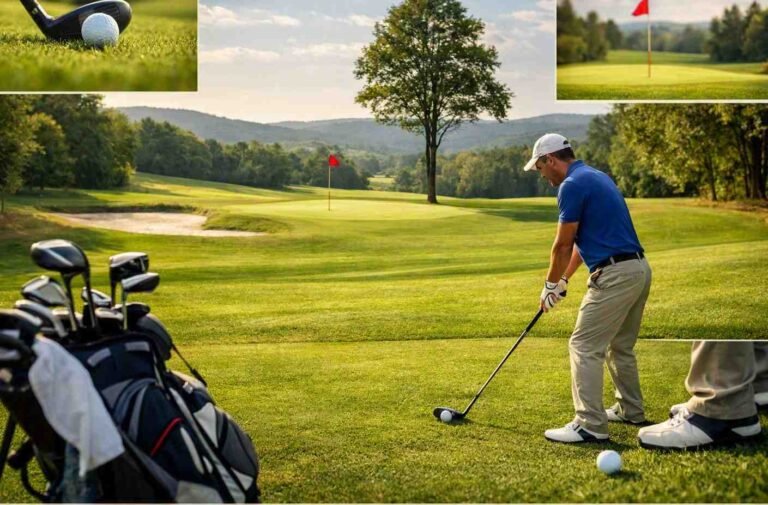

Mastering the Proper Golf Stance for Beginners in Golf

Mastering the Proper Golf Stance for Beginners in Golf

Golf swings do not fail at the top of the backswing—they fail before the club ever moves. Biomechanical studies from the Titleist Performance Institute reveal that over 80% of amateur swing errors trace directly back to address setup mistakes. 

For anyone accustomed to setting up camera tripods, framing horizon lines, or managing spatial physics, golf offers a familiar mechanical challenge. Dialing in a proper golf stance for beginners is less about arbitrary rules and more about structural balance, weight distribution, and leverage.

The Geometry of Setup: Why Your Golf Stance Is Like Setting Up a Camera Rig

Think of your body as a tripod system supporting a heavy payload. If the legs of a camera rig are set too narrow, the center of gravity shifts at the slightest breeze or pan. Set them too wide, and tracking movement becomes rigid and locked.

In the same way, a consistent Golf Workout At Home can help strengthen the legs, core, and stabilizing muscles needed to maintain a balanced and athletic golf stance.

In a golf setup, your lower body acts as that steady base while your spine operates as the central axis. If your alignment or kinetic chain is off by just three degrees at address, the clubhead can drift off path by several inches at impact.

Understanding spatial alignment gives you a massive head start in diagnosing these physical mechanics. A consistent Golf Warm Up Routine can also prepare your lower body, spine, and shoulders for the rotational demands of the swing while helping you establish better alignment before the first tee shot.

Deconstructing the Setup: Core Elements of Alignment

The base setup relies on four primary variables: foot width, knee flex, hip hinge, and arm hang. Mastering how these components interact creates a repeatable kinetic system.

Deconstructing the Setup Core Elements of Alignment

Base Width and Foot Flare

Standard iron shots require a base where the insides of your feet align directly with the outer edges of your shoulders. This creates an athletic base capable of handling rotational torque.

  • Driver Stance: Expand the feet slightly wider than shoulder-width to support higher rotational speeds.
  • Lead Foot Flare: Angling your lead foot outward by 15 to 20 degrees reduces torque stress on the lead knee and allows the hips to rotate freely through impact.

Spine Angle and Center of Mass

Rather than bending from the lower back, hinge directly from your hip sockets while maintaining a neutral spine. Allow your knees to flex softly without dropping into a full squat. Your arms should hang loosely beneath your shoulders, letting gravity drop your hands directly below your chin.

Club Category Feet Base Width Lead Foot Flare Ball Position Relative to Stance Weight Distribution
Short Irons (8-PW) Shoulder-width (inside to inside) 10–15 degrees Center of stance 50/50 balanced
Mid/Long Irons (3-7) Shoulder-width (outside edge) 15–20 degrees 1–2 inches forward of center 50/50 balanced
Driver Wider than shoulder-width 20–25 degrees Inside lead heel 60/40 rear-foot bias

Editor’s Note: For visual learning, a stacked bar chart illustrating weight distribution shifts across club types works best to visualize balance adjustments.

Ball Position Mechanics

Ball placement alters the attack angle at impact. Short irons require a neutral center ball position to strike down on the ball. Long irons move slightly forward, while drivers sit opposite the inside lead heel. This forward placement lets the clubhead catch the ball on an upward trajectory.

Biomechanics Data: What Sports Science Reveals

Biomechanics Data What Sports Science Reveals

Research published by the Journal of Sports Sciences highlights that dynamic balance during address directly correlates with center-face ball contact. Elite golfers maintain roughly 50/50 weight distribution from left to right with mid-irons, while shifting up to 60% of their body weight toward the rear foot when using a driver.

 [Target Line] ———————————————>


        (Lead Foot)                       (Trail Foot)

        Flared 15-20°                     Square (90°)

           \                                 |

            \                                |

          +——-+                       +——-+

          |  L    |                       |  R    |

          +——-+                       +——-+

             ^                               ^

             |——- Shoulder Width ——–|

                             |

                      [Ball Position]

                  (Center for Mid-Irons)

Furthermore, pressure plate testing conducted by golf biomechanists shows that stance width directly impacts rotational speed. A stance that is too wide restricts hip turn, forcing the upper body to compensate and leading to slices or severe pushes. Understanding How to Fix a Golf Slice can help golfers identify whether stance width, alignment, grip, or swing path is contributing to the problem.

A 4-Step Calibration Checklist for Range Days

Use this physical calibration protocol before every practice session to lock in your setup:

  1. Establish the Base: Ground your feet shoulder-width apart with weight evenly balanced between your heels and the balls of your feet.
  2. Hinge the Axis: Place a club shaft across your thighs, push your hips back, and tilt your torso forward until your chest points toward the ball.
  3. Soft-Lock the Knees: Flex your knees just enough to unlock your joints. Your weight should feel centered over your mid-foot.
  4. Check Hand Hanging Point: Let go of the grip with your trail hand and let it swing naturally. If it hangs straight beneath your nose, your distance from the ball is precise.

Limitations, Exceptions, and Real-World Adjustments

Limitations, Exceptions, and Real-World Adjustments

Standard stance advice acts as a baseline, not a rigid law. Physical variations like hamstring tightness, hip mobility limitations, or height discrepancies require adjustments.

Older golfers or players with limited lumbar flexibility often benefit from flaring both feet outward up to 20 degrees. This modification reduces rotational resistance on the hips and lumbar spine. Similarly, playing on uneven lies or thick rough demands a wider base and a lower center of gravity to preserve balance through impact.

Frequently Asked Questions

1. What is the proper golf stance for a beginner?

A proper beginner stance features feet shoulder-width apart, knees softly flexed, a waist hip hinge with a neutral spine, relaxed hanging arms, and weight balanced evenly across the middle of both feet.

2. What is the 70/30 rule in golf?

The 70/30 rule typically refers to short-game pitching, placing 70% of your body weight on your lead foot and 30% on your trail foot to encourage a clean, downward strike.

3. How far should a 60 year old man hit his driver?

The average drive for a 60-year-old male golfer ranges between 200 and 225 yards, depending on swing mechanics, physical fitness, equipment fitting, and total clubhead speed.

4. What is the 80/20 rule in golf?

In golf, the 80/20 rule suggests that 80% of your scoring improvement comes from mastering 20% of your fundamental skills—specifically setup posture, alignment, putting, and short-game control.

Summary and Next Steps

Establishing a proper golf stance for beginners is about constructing a balanced, repeatable mechanical frame. By treating foot width, spine angle, and weight balance as interconnected variables, you set up a system that yields consistent power and contact.

Just as sharp camera framing creates clean visual shots, an athletic stance lays the foundation for a predictable, effective swing path. Practice these positioning steps at home in front of a mirror until your setup feels effortless, setting you up for solid contact every time you step onto the tee.


Derek Whitfield

Derek Whitfield is a golf writer and equipment reviewer who believes the game should be fun before it is perfect. He covers golf tips and techniques, beginner guides, gear and equipment reviews, golf fitness, and course playing experiences — always with the relaxed, practical tone of someone who has shanked plenty of shots himself and learned to laugh about most of them. His work at Tappers Golf is built on one belief: golf does not need to be intimidating to be taken seriously. When he is not writing or testing the latest driver nobody asked him to review, Derek is losing golf balls in water hazards with impressive consistency, working on a swing that is always "almost there," and convincing friends that a good round is mostly about the company, not the score.

More From Author

Links Course vs Parkland Course: Which Is Better? When I first began comparing golf courses, I assumed the difference was mainly visual. One appeared rugged and windswept, while the other looked green, polished and carefully landscaped. I soon discovered that the distinction affects nearly every shot. Understanding links course vs parkland course conditions can change how I select clubs, control the ball and plan my way around all 18 holes. Although neither design is automatically better, each demands a different golfing mindset. Links golf encourages imagination, trajectory control and the use of natural contours. Parkland golf typically rewards accuracy, predictable carry distances and well-struck aerial approaches. What Is a Links Golf Course? A genuine links course is built on coastal linksland, usually over sandy, free-draining soil. The style originated in Scotland, where land near the sea was unsuitable for farming but naturally suited to golf. Traditional links layouts contain few trees. Instead, golfers encounter rolling dunes, deep pot bunkers, firm turf, long native grasses and uneven lies. Architects generally work with the existing landscape rather than dramatically reshaping it. Wind is one of the defining challenges. With limited shelter, its speed and direction can alter from one hole to the next. A club that normally carries a reliable distance may produce a completely different result when played into a strong coastal breeze. Firm ground also produces considerable bounce and roll. Rather than flying every approach directly onto the green, golfers can land shots short and use the contours to move the ball toward the target. This is commonly called the ground game. What Makes a Course a True Links? Not every seaside layout or course containing “Links” in its name qualifies as genuine linksland. Unlike the frozen, treeless conditions of the arctic tundra, a true links course normally combines: A coastal location Naturally sandy soil Excellent drainage Firm, fast-playing turf Open, largely treeless terrain Dunes, native grasses and natural contours Regular exposure to coastal weather An inland course can imitate these characteristics, but it is more accurately described as links-style. What Is a Parkland Golf Course? A parkland course is generally constructed inland and resembles a landscaped park. Its holes are frequently framed by mature trees, dense rough, ornamental planting and carefully maintained fairways. Compared with links turf, the ground is usually softer and greener. Many parkland sites contain clay or loam soils that retain more moisture. Irrigation and intensive maintenance help preserve the lush appearance golfers associate with this design. Trees, ponds, streams and shaped bunkers provide much of the strategic challenge. A misplaced drive may leave the golfer blocked by branches, while water hazards can require the ball to remain airborne until it reaches a safe landing area. Parkland greens are often receptive enough for a high approach to land and stop. Consequently, accurate carry distance, spin control and dependable iron play become especially valuable. The Biggest Differences Between the Two Styles Location creates the most obvious distinction. Links courses developed beside the sea, whereas parkland layouts were generally created inland. Their playing surfaces are equally important. Sandy linksland drains rapidly and normally stays firm after rain. Moisture-retaining parkland soil can become softer, and prolonged rainfall may affect drainage and playability. Links fairways are open but unpredictable. A shot landing in the correct area can still take an awkward bounce. Parkland holes appear more clearly defined, but narrow tree-lined corridors can severely punish inaccurate drives. Hazards differ as well. Links layouts use pot bunkers, dunes, gorse, and thick native grass. Course designers may effectively build a underground bunker into the natural contours, creating deep hazards that demand precise recovery shots. Parkland courses rely more heavily on trees, lakes, streams, constructed bunkers, and maintained rough. How Each Course Changes Golf Strategy The central lesson in links course vs parkland course strategy is that golfers should not use the same shot plan everywhere. On linksland, keeping the ball low can reduce the wind’s influence. Taking an extra club and swinging smoothly is often more controllable than forcing a shorter club. Bump-and-run approaches, low punches and even putts from beyond the green can be practical choices. Golfers must also consider where the ball will finish after bouncing. Landing directly beside the flag may send an approach through the back of a firm green. A safer target could be several yards short. Parkland golf usually places greater emphasis on flight. Players may need to carry bunkers or water and stop the ball quickly. Reliable yardages therefore matter. Tree-lined doglegs can also reward a controlled draw or fade, while an inaccurate drive may force a sideways recovery. Club Selection Considerations Links conditions favor clubs and shots that control trajectory. Long irons, hybrids and lower-lofted clubs can produce useful running approaches. Wedges require careful execution because tight, firm lies leave little margin for error. On parkland courses, higher-lofted wedges help golfers stop shots on softer greens. Fairway woods and hybrids can also be useful when an approach must carry a hazard or travel from thicker rough. Changing an entire set is rarely necessary. Adapting shot selection is normally more valuable than adding specialized equipment. Which Golf Course Is Harder? Links courses are often considered harder because wind, uneven lies and unpredictable bounces introduce uncertainty. However, they are not automatically more difficult. A wide links fairway may offer several routes toward the green. Meanwhile, a narrow parkland hole with water on one side and mature trees on the other can demand exceptional accuracy. Course length, rough height, green speed, weather and tee selection influence difficulty more than the category alone. Golfers who naturally hit high shots may struggle in strong links wind. Players who depend on open driving areas may find tree-lined parkland layouts more restrictive. Maintenance and Environmental Differences Linksland’s natural drainage can reduce the disruption caused by heavy rain. Its native grasses and firmer presentation may also require less irrigation and intensive mowing than a highly manicured parkland property. Parkland layouts often demand more water, drainage work, mowing, and landscape management. Because frequent lawn mowing lowers biodiversity by limiting native plant growth and wildlife habitat, some inland clubs are adopting links-inspired practices, including firmer surfaces, natural rough, and improved drainage. These changes can reduce maintenance demands, but they do not transform inland land into genuine links. Frequently Asked Questions 1. What is the main difference in links course vs parkland course design? Links courses occupy sandy coastal terrain and emphasize wind, firm turf and natural contours. Parkland courses are generally inland, greener and defined by trees, softer surfaces and constructed hazards. 2. Can an inland golf course be a true links course? Traditionally, no. An inland course can recreate firm turf, open sightlines and pot bunkers, but it is normally classified as links-style rather than true linksland. 3. Are links courses playable after heavy rain? They frequently recover quickly because sandy soil drains efficiently. Actual playability still depends on rainfall volume, maintenance and local conditions. 4. Which type is more suitable for beginners? A forgiving parkland course may offer predictable bounces and sheltered conditions. However, wide links fairways can also help beginners if the wind is moderate and rough is manageable. 5. Why are there fewer trees on links courses? Traditional linksland is naturally exposed coastal terrain. Sandy soil, salt air and strong winds do not support the dense tree growth commonly found on inland layouts. The Final Round After comparing both styles, I would choose according to the experience I want rather than declaring one universally superior. Links golf gives me freedom to invent shots, use slopes and respond to changing weather. Parkland golf tests my accuracy, distance control and ability to navigate carefully framed holes. Playing both is the best way to become more adaptable. Once I understand the land beneath the ball and the hazards ahead, I can stop fighting the course and start selecting shots that genuinely suit it. Meta Title: Links Course vs Parkland Course: Which Should You Play? Meta Description: Links course vs parkland course explained through terrain, hazards, weather and strategy. Discover which layout best suits your golf game before you play.

Links Course vs Parkland Course: Which Is Better?

How Long Does a Round of Golf Take? Real Times Explained

How Long Does a Round of Golf Take? Real Times Explained

Leave a Reply

Your email address will not be published. Required fields are marked *