A putt can be lost before the putter ever moves. Researchers comparing skill levels found that more than half of amateurs made visual-somatosensory errors during the perception phase of putting.
In simple terms, they were not always seeing or setting the target correctly before the stroke. That makes putting alignment drills for beginners valuable: they reveal whether your eyes, putter face, body, and ball are actually aimed together.
For photographers and other visually minded golfers, think of it like framing a shot. If the frame is crooked at capture, a smooth camera move will not fix the composition.
Golf Posture Exercises for Desk Workers can help address the rounded shoulders, tight hips, and limited upper-body mobility that often develop from prolonged sitting, making it easier to establish a balanced setup and repeatable swing position.
Why Alignment Comes Before a “Perfect” Stroke
Beginners often chase stroke mechanics first at rules of golf. They change grip pressure, force the putter straight back and through, or copy a tour player’s tempo. Yet research shows initial ball direction depends on putter-face angle, stroke path, and impact location. Novice golfers can also show directional aiming bias that experts do not.
The goal is therefore not a robotic motion. It is a repeatable setup that starts the ball on your chosen line.
Three Alignment Drills Worth Learning First
1. Build Train Tracks With Alignment Sticks
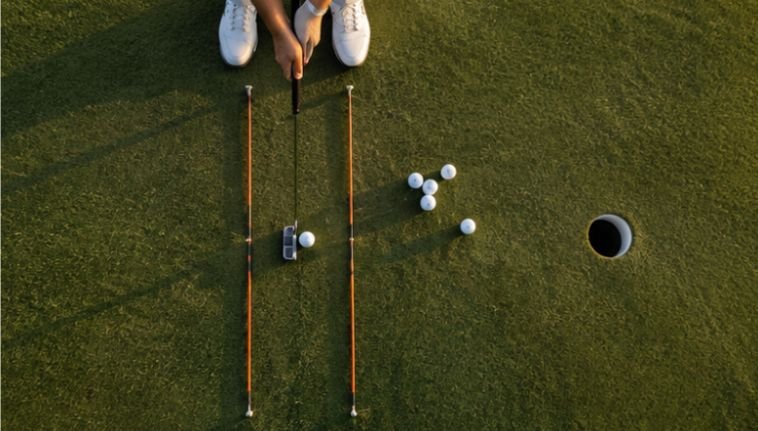
Lay two alignment sticks parallel on a flat green, pointing toward a hole 3 to 5 feet away. Space them slightly wider than your putter head and place the ball between them.
Make normal strokes without touching either rail. The sticks clarify the target line and expose excessive wandering through impact. Do not force the head perfectly straight for the whole stroke; a slight natural arc is common. Focus on returning the face squarely through the hitting area.
2. Use a Tee Gate for Instant Feedback
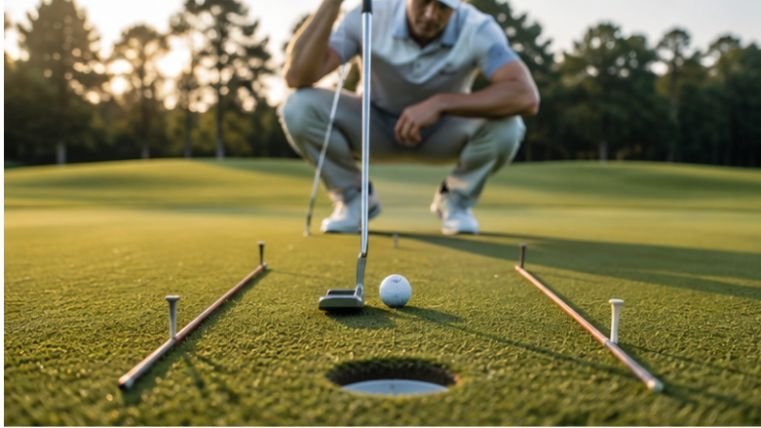
Choose a straight 3- or 4-foot putt. Put one tee just outside the heel and another outside the toe of the putter. Hit 10 putts without clipping either tee.
Then create a second gate 6 to 12 inches in front of the ball, with the tees just wider than the ball. This separates two useful tests: the putter gate checks delivery, while the ball gate checks actual start direction.
If you keep hitting a tee, widen the gate. Narrow it only after your motion becomes repeatable.
3. Make a Capital T for Setup
Point one alignment stick at the target and place another perpendicular to it near the ball, creating a capital T. Square the putter face to the crossbar, then settle your stance around that reference.
This exposes a common problem: aiming the body left or right, then manipulating the putter to compensate.
The USGA describes accurate self-alignment as a fundamental skill, which helps explain why a caddie cannot remain behind a player to line up the stance during a stroke.
Turn the Drills Into a 10-Minute Test
Do the drills in an order that separates setup from start line.
| Stage | Drill | Distance | Score |
| 1 | Capital T | 3 ft | Correct setup |
| 2 | Putter gate | 3–4 ft | Clean strokes |
| 3 | Ball gate | 4–6 ft | Balls through gate |
| 4 | No aids | 6–10 ft | Normal putts |
Hit 10 scored putts at each gate. Record how many pass cleanly. Aim first for 7 out of 10, then 8, then 9. Now practice becomes measurable instead of merely feeling productive.
If you enjoy technical feedback, film from directly behind the line with a phone or camera. Use video to compare setup consistency over several putts rather than obsessing over tiny frame-by-frame movements.
Add a Quiet-Eye Routine

Alignment is visual, so train your gaze too. A 2024 eye-tracking study found that two weeks of quiet-eye training improved putting performance under pressure and increased fixation time.
The NIH-hosted quiet-eye research supports using a steadier final fixation. A Loyola University explanation describes how quiet eye is studied across aiming tasks, while another NIH novice-golfer study found that visual information remained important as putting distance and task demands changed.
Try a simple sequence: read the putt, pick a start point, aim the face, look once at the target, return your gaze to the ball, settle briefly, and stroke.
Practice Aids Are Training Tools, Not Crutches

Alignment rods belong on the practice green, not under your feet during normal play. The USGA’s Rule 4 guidance explains that an alignment rod cannot be placed to help a player take a stance during a round.
Finish every session by removing the aids. The purpose of putting alignment drills for beginners is to train perception, not make you dependent on rails.
Simple Drills for More Consistent Iron Contact should reinforce that same principle: use alignment sticks, towels, or other training aids to develop better contact, then remove them and test the motion naturally.
Also remember that not every miss is an aim problem. Poor pace can make a correctly started putt miss, especially on slopes.
Golf Short Game Consistency depends on training direction and distance control separately at first. Train direction on short, relatively flat putts before combining alignment with longer-distance speed control.
Frequently Asked Questions
1. What are some good alignment drills for putting?
Train tracks, tee gates, a ball-start gate, and the capital T drill work well because they give immediate feedback on face aim, stroke delivery, and setup.
2. What are some good putting drills for beginners?
Begin with short gate drills for direction, then add a distance-control ladder. Separating aim and pace helps you identify what is actually causing your misses.
3. How to actually get better at putting?
Measure practice. Track gate success, short-putt makes, and distance errors. Work on one skill at a time, then remove training aids to test whether the improvement transfers.
4. How does Tiger Woods practice putting?
Tiger Woods has long used a two-tee gate around his putter head and has practiced repetitions with his right hand before adding both hands.
Final Takeaway
Good putting starts with knowing whether you are aimed where you think you are. The best putting alignment drills for beginners turn invisible mistakes into obvious feedback: a clipped tee, a missed gate, or a face that does not match the line.
Build practice from setup to start direction, then remove the aids and test the routine naturally. Keep putts short enough that speed does not hide the lesson. Ten minutes with a score gives you something random practice cannot: proof of what is improving. Aim first, verify it, and then let the stroke happen without adding a late correction.