Practicing at home is convenient, but it can also make bad alignment habits surprisingly easy to repeat. I have found that the best golf alignment aid for home practice is not necessarily the most complicated training device.
I want something that stays stable, gives me an obvious visual reference, works on common indoor surfaces, and helps me improve without turning my garage or living room into a driving range.
For golfers practicing in American homes, garages, basements, apartments, backyard setups, and simulator rooms, stability matters even more than it does at the range. Traditional alignment rods are excellent outdoors, but many drills require pushing them into turf.
Indoors, I prefer flat tracks, weighted alignment-stick bases, putting mirrors, or other golf training aids that stay secure on carpet, artificial turf, hardwood, concrete, and hitting mats.
Which Type of Golf Alignment Aid Works Best Indoors?
There is no single design that works for every golfer. I divide home golf alignment aids into three main groups: flat systems, weighted alignment-stick systems, and simple DIY options.
Are Flat Alignment Tracks Good for Indoor Golf Practice?
Flat track systems are among my favorite choices for indoor golf practice because they sit almost flush with the floor, making them a practical option when I want to Practise Golf At Home without creating a bulky setup.
A linear track template creates clear reference lines for my target, club path, feet, and ball position. I can create the familiar “railroad track” setup where the clubface points toward the target while my feet, hips, and shoulders align on a parallel line.
Unlike traditional rods, a thin plastic or rubber track does not need to be inserted into the ground. A well-designed system should also resist sliding and avoid scratching hardwood floors.
For a garage hitting station or home simulator, this type of golf swing alignment aid provides useful feedback without adding much clutter. It can also be paired with the Best Golf Balls for Slow Swing Speed to create a simple, focused practice setup.
Are Putting Alignment Mirrors Worth Using at Home?
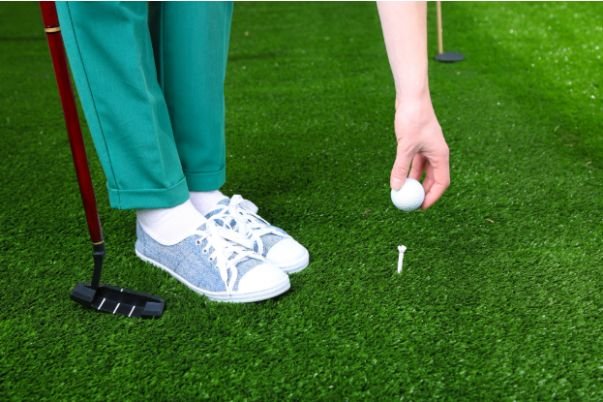
A putting alignment mirror is one of the most practical golf training aids for home use.
When I stand over the ball, the reflection lets me check my eye position and shoulder alignment while the printed or built-in reference lines help me square the putter face. That combination makes a mirror useful for both setup consistency and putting start-line practice.
I like combining a mirror with a small putting gate. Instead of judging a stroke only by whether a six-foot putt goes in, I try to roll the ball through the center of the gate. That tells me whether I actually started the ball on my intended line.
For apartments and smaller rooms, a mirror is particularly useful because I can practice without making a full swing or hitting high-speed shots.
Do Weighted Alignment Stick Bases Work Better Indoors?
Weighted base blocks solve one of the biggest limitations of standard golf alignment sticks.
Instead of pushing a rod into grass, I can insert it into a heavy wood, rubber, or plastic holder positioned beside my golf mat. Multi-angle rod holders often provide several positions, allowing me to create target lines, swing-plane references, club-path gates, or hip-turn guides.
This makes them especially useful in a garage or basement where I have enough room to rehearse a full golf swing but cannot stake equipment into the floor. They also work well for Golf Swing Consistency Drills, allowing me to repeat the same movements and practice setup without needing permanent equipment.
I prefer a substantial base that will not move easily. Lightweight holders can shift when bumped, which removes the reference I am trying to maintain.
Do Rubber-Backed Golf Alignment Guides Prevent Sliding?
Indoor stability becomes even more important on carpet and artificial turf.
Some alignment tools use textured rubber, small rubber nubs, or grippy backing materials to hold their position against the fibers of a practice surface. That can prevent a guide from moving every time I reposition my feet or accidentally touch it.
For me, this is an underrated buying feature. An alignment tool becomes frustrating when I have to reset it after every few swings.
Can I Use Alignment Sticks for Ball Position and Swing Path?
Standard golf alignment sticks remain one of the most versatile and affordable options if I have enough room.
For ball-position practice, I place one rod along my toe line and another perpendicular to it. The second rod becomes an easy reference for where the golf ball sits relative to my stance.
For swing-path work, I can arrange two sticks to create a visual channel around the hitting area. If I tend to swing too far from outside to inside, the channel provides feedback about the direction in which the club approaches the ball.
Angled rods can also illustrate swing plane, but I am cautious with this drill indoors. I never position a rigid stick where my hands, arms, body, or club could strike it during a fast swing. Slow rehearsals usually provide enough feedback.
What Is the Best Golf Alignment Aid for a Small Apartment?
For limited indoor space, I would choose a putting mirror, compact flat track, or collapsible alignment trainer rather than a full swing-plane system.
These tools require little storage space and do not depend on high ceilings. They also allow me to practice quietly without worrying about striking furniture, walls, or ceilings.
Golfers with larger garages or simulator rooms can consider weighted rod bases and adjustable alignment boards because there is more space for stance, ball-position, and swing-path drills.
Can I Make a DIY Golf Alignment Aid at Home?
Yes. One of the simplest options is painter’s tape.
I can apply a straight strip to a practice mat or suitable floor surface to create a fixed target line. A second strip can mark my toe line or ball position. Because the tape stays flat, it cannot roll away or interfere with the clubhead like a loose alignment rod.
I always check that the tape is suitable for the surface before applying it, particularly on finished flooring.
A laser level provides another interesting option. Positioned safely away from the hitting area, it can project a straight visual line without placing physical equipment in the swing path. However, I treat lasers carefully and never position a beam where it could reach anyone’s eyes.
Alignment Sticks vs Alignment Boards: Which Is Better at Home?
I choose alignment sticks when I want flexibility. I can use them for target-line training, stance width, ball position, putting, swing path, and slow swing-plane rehearsals.
An alignment board or flat track gives me more structure. It stays organized, creates consistent reference lines, and generally requires less setup.
Beginners may prefer a board because it removes some guesswork. More experienced golfers may appreciate sticks because they can create dozens of different golf alignment drills.
How Often Should I Practice Golf Alignment at Home?
I prefer short sessions several times per week rather than one exhausting practice session.
Ten focused minutes can be enough. One day I might work only on target line and body alignment. The next session could focus on ball position or putting start line.
I also avoid changing my grip, posture, stance, ball position, and swing path simultaneously. Changing one variable at a time makes it much easier to understand what is actually helping.
Frequently Asked Questions About Home Golf Alignment Training
1. What is the best golf alignment aid for home practice for beginners?
For most beginners, I would start with a flat alignment track, alignment board, or alignment sticks paired with a stable indoor base. These options make target line, stance, and ball position easier to see without requiring complicated swing changes.
2. Can I practice golf alignment without hitting golf balls?
Yes. I can rehearse posture, stance, target alignment, ball position, clubface position, and slow swing paths without hitting a ball. This is one reason alignment practice works particularly well at home.
3. What alignment aid is best for putting practice?
I prefer a putting mirror combined with a start-line gate. The mirror checks setup and putter alignment, while the gate provides immediate feedback about where the ball starts.
Final Thoughts: Build a Setup You Can Trust
I do not need expensive equipment to make home practice productive. I need clear feedback.
For full-swing fundamentals, I favor a flat alignment system or weighted alignment-stick base. For putting, a mirror and start-line gate make more sense. For a simple budget setup, painter’s tape can provide a surprisingly effective visual reference.
Whatever I choose, my goal stays the same: create a repeatable picture of correct alignment at home so that when I stand over a shot on the course, the setup already looks familiar.