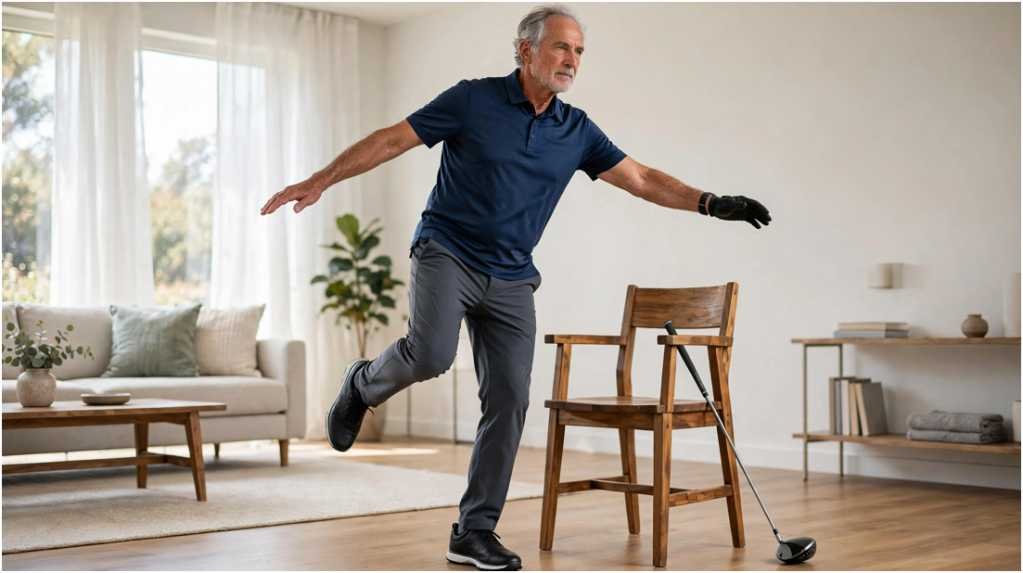
A golf swing becomes much harder when your feet and hips cannot provide a stable base. I prefer balance exercises for senior golfers at home that improve control without relying on wobble boards, heavy equipment, or risky movements.
The goal is not to see how long you can avoid falling. It is to build enough stability to transfer pressure, rotate, walk uneven ground, and finish a swing under control.
Why Balance Matters for Senior Golfers
Golf rarely happens from a perfectly level position. You walk slopes, step into bunkers, rotate over both hips, and adjust your stance on uneven lies.
For adults aged 65 and older, the CDC recommends including balance activities along with aerobic and muscle-strengthening exercise. The National Institute on Aging also identifies single-leg standing, heel-to-toe walking, and standing from a chair as useful balance activities.
That makes balance exercises for senior golfers at home useful beyond fall prevention. They train the same general qualities golfers need when controlling pressure through the feet.
The USGA has also highlighted how swinging, walking inclines, and playing uneven lies involve muscles that contribute to balance.
Quick 10-Minute Golf Balance Routine
I would start with this simple sequence.
| Exercise | Amount | Main Golf Benefit |
| Supported single-leg hold | 20 sec/side | Stable lead and trail leg |
| Heel-to-toe walk | 10–15 steps | Foot control |
| Chair sit-to-stand | 8–12 reps | Leg stability |
| Side leg raise | 10/side | Hip control |
| Weight shifts | 8/side | Pressure transfer |
| Single-leg head turns | 5/side | Dynamic balance |
| Golf-stance rotations | 8 reps | Swing stability |
Keep a sturdy chair, wall, or kitchen counter within reach.
Golf Balance and Stability Exercises for Older Golfers
Supported Single-Leg Balance
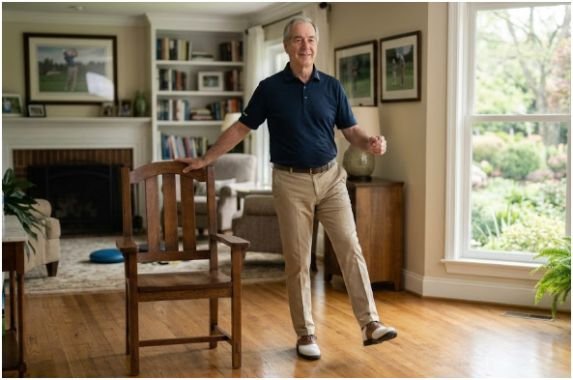
Stand beside a counter and lift one foot slightly from the floor. Hold for 10 to 30 seconds while keeping your chest tall.
Use one or two fingers for support when necessary.
Single-leg standing appears in both Mayo Clinic and NIA balance recommendations.
I prefer reducing hand support before extending the hold. Good control matters more than reaching an impressive time.
Heel-to-Toe Walk
Place one foot directly in front of the other. The front heel should nearly touch the toes behind it.
Take 10 to 15 slow steps beside a wall.
NIA includes heel-to-toe walking among exercises that challenge balance. I find the drill particularly relevant to golf because your base of support constantly changes around slopes and uneven turf.
Chair Sit-to-Stand
Sit near the front of a sturdy chair with your feet flat.
Lean slightly forward, stand without pushing from your hands if possible, then sit down slowly. Perform 8 to 12 repetitions.
Sit-to-stand training combines leg strength with postural control. NIA includes standing from a seated position among its balance activities, while the CDC notes that stronger leg, abdominal, and back muscles can support balance.
It also fits naturally beside easy golf exercises for seniors at home when building a low-equipment routine.
Side Leg Raises
Hold the back of a chair. Raise one leg a few inches sideways without tilting your torso.
Pause briefly and lower it under control. Complete 10 repetitions on each side.
I add this to balance exercises for senior golfers at home because lateral hip control can help you resist unnecessary side-to-side movement.
Do not chase height. A small controlled lift works better than leaning your body to create more range.
Golf Weight-Shift Drill
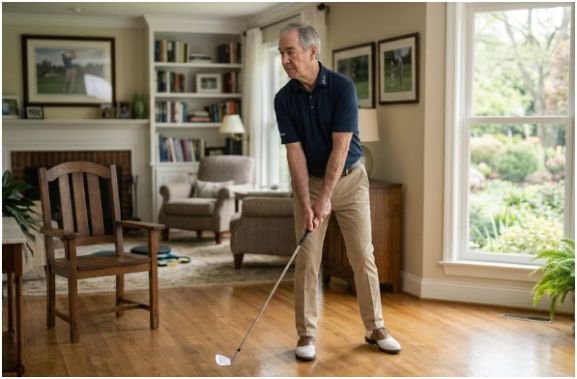
Take your normal address position without hitting a ball.
Move pressure gently toward your trail foot. Return to center, then shift toward your lead foot.
Complete eight slow cycles.
Keep your chest controlled. You should feel pressure changing under your feet without your whole upper body sliding sideways.
This is where general balance work starts becoming golf-specific.
Single-Leg Balance With Head Turns
Stand on one leg beside a counter. Look forward, then slowly rotate your head from side to side.
Start with a small range.
Head movement makes balance harder because your sensory systems must keep adjusting. NIA notes that some diagnosed balance problems may involve exercises using specific head and body movements.
If this exercise makes you dizzy, stop rather than trying to “push through” it.
Golf-Stance Rotations
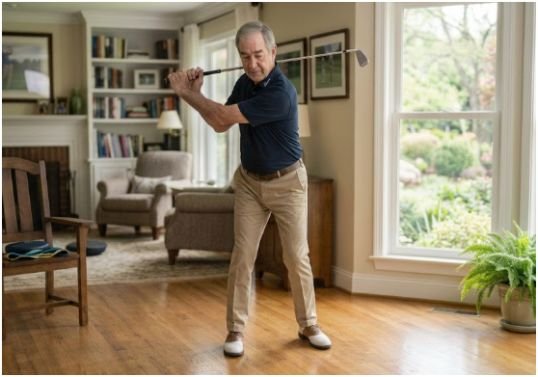
Take your address posture and place a golf club across your shoulders.
Rotate your chest slowly toward your backswing side, return to center, then rotate through.
Keep both feet grounded.
I use this movement to connect balance training with a broader golf fitness routine for golfers over 50 because it combines posture, rotation, and lower-body control.
My One-Variable Balance Progression Rule
The easiest way to make balance training unnecessarily risky is to change everything at once.
For balance exercises for senior golfers at home, I use three progression variables:
| Variable | Easier | Harder |
| Support | Full hand | Fingertip/no hand |
| Duration | 10 seconds | 20–30 seconds |
| Movement | Stationary | Head turn/rotation |
Change only one.
Suppose you can stand on one leg for 20 seconds while touching a chair with one finger. Your next progression should be using less finger support.
Do not simultaneously remove the support, increase the time, close your eyes, and rotate.
That one-variable rule is my preferred way to make progress measurable without turning balance practice into a stunt.
Senior Golf Strength and Stability Work
Balance also depends on having enough strength to control your joints and body position.
That is why I would not rely exclusively on one-legged holds. The CDC recommends older adults combine balance and muscle-strengthening activity.
Chair squats, calf raises, wall-supported exercises, and controlled hip work can complement balance exercises for senior golfers at home.
For a more structured strength session, a bodyweight workout for golfers over 50 can develop the legs and trunk while requiring little equipment.
How to Practice Balance Safely at Home
Practice beside something solid enough to grab immediately.
Clear away loose rugs, cords, golf bags, pets, and other trip hazards. Wear supportive footwear unless a qualified professional has advised otherwise.
The CDC emphasizes both balance activity and fall-risk reduction for older adults.
If you have experienced recent falls, unexplained dizziness, or significant instability while walking, speak with a healthcare professional before progressing your routine.
Pain is also a reason to stop rather than modify a movement aggressively.
How Often Should Senior Golfers Train Balance?
I would begin with about 5 to 10 minutes, two or three times each week.
Keep the same balance exercises for senior golfers at home long enough to notice genuine improvements. Changing exercises every session makes progress difficult to measure.
Track three things: how much support you require, how long you remain controlled, and whether you can complete the movement without excessive swaying.
Once those improve, progress one variable.
FAQs
1. What are the safest balance exercises for senior golfers at home?
Supported single-leg holds, heel-to-toe walking, chair sit-to-stands, and controlled weight shifts are practical starting exercises.
2. Can senior golfers improve balance without equipment?
Yes. Most beginner drills require only a sturdy chair, counter, wall, and enough clear floor space.
3. How long should senior golfers practice balance?
Five to 10 focused minutes can provide useful practice when performed consistently alongside other activity.
4. Should senior golfers do balance exercises before playing?
Light dynamic balance and weight-shift drills can fit a warm-up, while tiring strength exercises are better kept for another session.
Steadier Feet, Smoother Swings
Fancy equipment cannot replace control.
The best balance exercises for senior golfers at home start with stable positions and gradually introduce more demanding golf movements. You should earn each progression rather than forcing it.
Start with three moves: the supported single-leg hold, heel-to-toe walk, and chair sit-to-stand. Track them for several weeks.
When those become easy, change one variable. Your golf swing needs a dependable platform, not a circus act.