
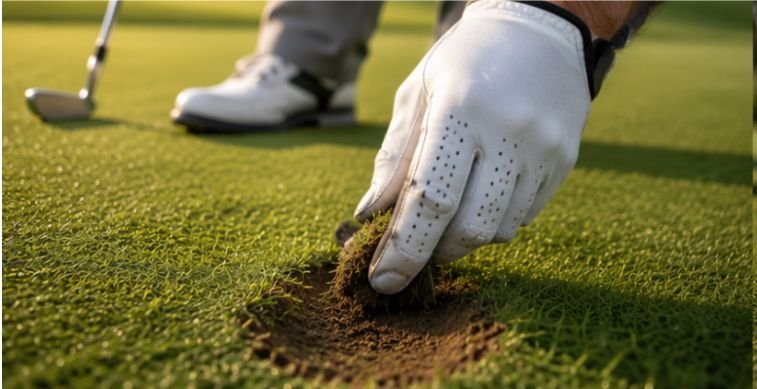
The biggest mistake golfers make with a pitch mark is trying to lift the dent back into place. That feels logical, but it can tear roots and leave a brown scar. If you want to know how to fix divots on green surfaces correctly, think sideways, not upward: move healthy turf from the rim toward the center, then flatten it gently.
A true divot is turf displaced by a club, usually in a fairway or teeing area. The crater made when a golf ball lands on a putting surface is more accurately called a ball mark or pitch mark. Golfers often use “divot” for both, so this guide focuses on damage made by a landing ball.
Why a Small Ball Mark Becomes a Bigger Green Problem
A fresh pitch mark can disrupt putting-surface smoothness, create raised turf vulnerable to mower scalping, and leave room for unwanted grasses. Purdue University researchers note that unrepaired ball marks reduce surface uniformity and may increase the chance of annual bluegrass encroachment. Purdue Turfgrass Science also tested repair methods on creeping bentgrass greens.
Conditions matter. Purdue compared firm and soft areas and found that tool choice and technique influenced recovery. A soft green can therefore react differently from a firm one after a high approach shot.
Recovery also slows when turf is not actively growing. Nebraska Turfgrass Science explains that winter traffic and play turfgrass can reduce surface uniformity and that damaged turf recovers poorly when growth is limited.
The Correct Repair Motion Is Inward, Not Upward
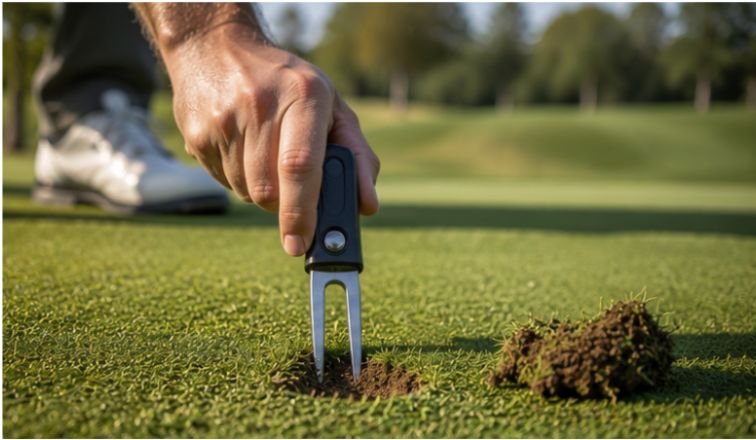
The USGA ball-mark repair guidance recommends inserting a repair tool near the edge, pushing surrounding turf toward the center, working around the perimeter, and gently tamping the spot with a putter. Lifting or twisting can damage roots.
Putting Alignment Drills for Beginners can complement this green-care routine by helping players develop a consistent setup, face alignment, and starting direction while practicing on a properly maintained putting surface.
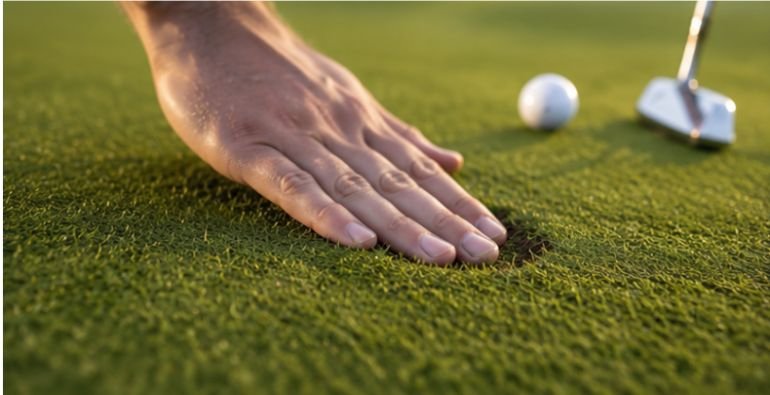
That motion is the key to how to fix divots on green areas without turning a temporary dent into longer-lasting damage.
A Five-Step Repair You Can Use During Any Round
- Find the outside edge instead of stabbing the center. Insert a normal ball-mark tool shallowly into the rim. A tee can work in a pinch, although Purdue found a wooden tee performed poorly in its trial compared with a correctly used traditional or short-tine tool.
- Angle the top of the tool toward the center. Nudge turf inward rather than levering soil upward.
- Work around the mark in several small movements so turf comes in evenly from all sides.
- Stop once the depression is closed. Extra digging can create more disturbance.
- Tap the repaired area level with the sole of your putter. Aim for a smooth surface, not a mound.
Quick Diagnosis: What Are You Actually Repairing?
| What you see | Best response | Avoid |
| Fresh ball mark | Push edges inward, then tamp | Prying upward |
| Deep, torn mark | Close gently; alert staff if severe | Repeated digging |
| Fairway divot | Follow the course’s divot policy | Green-repair technique |
| Aeration hole | Leave it unless a Local Rule applies | Treating it as player damage |
| Natural bare patch | Leave it during play | Altering the surface |
Under USGA Rule 13, players may reasonably repair ball marks, spike marks, old hole plugs, and certain equipment or animal damage on a putting green. Natural surface imperfections and normal maintenance conditions are different.
When a Repair Tool Is Not Enough
A badly torn, sunken, diseased, or repeatedly damaged patch may need professional turf work. The USGA has documented maintenance crews using colored sand and creeping bentgrass seed to smooth and help recover persistent ball-mark scars during championship preparation.
That is a maintenance practice, not something golfers should improvise with their own sand or seed. Cross-Handed Putting Grip can help golfers focus on consistent hand placement and a stable putting stroke while leaving turf repair and recovery to trained course-maintenance professionals.
Penn State researchers have also studied simulated ball-mark recovery in creeping bentgrass and annual bluegrass under putting-green conditions. The turfgrass research report shows why recovery is more than simply making the surface look flat: living turf still has to regrow after impact damage.
For golfers, the practical rule is simple: close a fresh mark cleanly, flatten it once, and leave major restoration to the course team.
The Rules Change Once Damage Is Off the Green

On the putting green, repair permissions are broad. In the general area, you generally may not alter the ground in a way that improves the conditions affecting your next stroke, including replacing a divot when doing so improves those conditions.
How to Practice Putting at Home Disc Golf can complement this rules knowledge by giving players a controlled space to work on putting technique, aim, and consistency without altering course conditions.
One useful exception: if a single identifiable ball mark is partly on and partly off the green, USGA interpretations allow the entire mark to be repaired.
Knowing that difference keeps good course etiquette from accidentally becoming a Rules issue.
Frequently Asked Questions
1. Can you fix a divot off the green?
For course care, follow the course’s divot policy. During play, do not repair ground if doing so improperly improves your lie, stance, swing area, or line under Rule 8.
2. How to repair a damaged golf green?
For a normal ball mark, push surrounding turf inward and tamp it flat. For torn, diseased, deeply sunken, or widespread damage, notify course staff instead of attempting a larger repair.
3. How to repair a pitch mark on a green?
Insert a repair tool around the edge, push turf toward the center from several sides, then flatten the spot gently with your putter. Never pry the center upward.
4. Can you repair a pitch mark if you are off the green?
Yes. You may repair damage on the putting green even when your ball is off it. A single mark partly on and partly off the green may also be repaired in full.
Conclusion
A ball mark may be small, but the repair technique affects everyone putting behind you. The useful habit is almost mechanical: find the rim, push inward from several sides, tamp once, and move on.
That is the safest answer to how to fix divots on green surfaces because it restores smoothness without unnecessarily disturbing the roots below. Carry a repair tool, fix your own mark promptly, and repair another nearby mark when pace allows. Good greens are not maintained by superintendents alone; golfers protect them too, one careful landing mark at a time. That tiny habit keeps putting surfaces better.