About 67% of Americans don’t consider golf a “real” sport. That number is wrong, and here’s why it matters to every golfer who’s ever had to defend their game at a cookout. The argument usually goes: you ride a cart, you wear khakis, how hard can it be? That question deserves a serious answer.
This piece walks through the physical demands, the competitive history, the Olympic record, and the athletic requirements of golf, so you can make the case clearly, or at least understand exactly what you’re arguing about.
Why Golf Is Considered a Sport by Every Credible Definition
A sport, by the most widely accepted definition, involves physical exertion, skill, and competition governed by rules. Golf checks every single one of those boxes. Why golf is considered a sport isn’t really a mystery once you strip away the country-club stereotypes and look at the structure of the game itself.
The Merriam-Webster definition of sport describes it as “a contest or game in which people do certain physical activities according to a specific set of rules and compete against each other.” Golf has 18 holes, a strict rulebook published by the USGA and R&A, professional tours on six continents, and world rankings updated every week. That structure alone earns it the classification.
Some people push back by saying skill-based activities like chess or darts are sometimes called sports too, which muddies the water. But golf’s physical requirements put it well beyond any debate about mental-only competition. Swinging a club at 110 miles per hour, repeating that motion under pressure for four hours, walking five-plus miles on uneven terrain, and doing it all with enough precision to land a ball on a green the size of a living room requires your body to perform. That’s not casual activity. That’s athleticism.
Why golf is considered a sport also comes down to its governance. The USGA, R&A, European Tour, PGA Tour, and DP World Tour are formal governing bodies with anti-doping policies, performance standards, and international rankings. You don’t build that infrastructure for a hobby.
History of Golf as a Sport
The history of golf as a sport goes back further than most people realize, and that timeline alone makes the “not a real sport” argument hard to sustain. Golf originated in 15th-century Scotland, with the earliest recorded reference appearing in a 1457 Scottish Parliament act that actually banned the game because it was distracting men from archery practice. That ban is, in its own way, a compliment. A leisure activity doesn’t get outlawed for being too popular.
Organized competition appeared by the 18th century. The Honourable Company of Edinburgh Golfers, founded in 1744, wrote the first formal rules of golf, and the first Open Championship was played in 1860 at Prestwick Golf Club. That makes professional tournament golf over 160 years old, which gives it a longer competitive history of golf as a sport than basketball (1891), American football in its modern form, or NASCAR.
The sport grew steadily through the 19th century as colonists and immigrants spread it to the United States, Australia, and beyond. By 1916 the PGA of America was founded, and the Masters Tournament began in 1934. Watching that arc, from a 15th-century Scottish field to Augusta National, it’s difficult to argue this is anything other than one of the world’s oldest formalized sports.
Is Golf an Olympic Sport?
Is golf an Olympic sport? Yes, and it took a century-long detour to get back there. Golf was part of the Olympic program in 1900 and 1904, then it was removed from the Games for over a hundred years. The International Olympic Committee reinstated golf for the 2016 Rio Olympics, and it has appeared at every Summer Games since, including Tokyo 2020 and Paris 2024.
The fact that is golf an Olympic sport even needs to be asked shows how long that gap in the record created confusion. But the IOC’s decision to bring it back was deliberate. Golf had a global participation base of roughly 60 million players in over 200 countries, according to data from the International Golf Federation, which made it one of the most widely played games not in the Olympics. That imbalance was corrected.
At the Paris 2024 Olympics, the golf competition drew 60 men and 60 women from dozens of nations, competing over 72 holes of stroke play. Scottie Scheffler won men’s gold. That’s the same Scottie Scheffler who holds the world number one ranking on the PGA Tour. Olympic golf isn’t a sideshow. It pulls the best players alive, which is exactly what Olympic competition is supposed to do.
Is Golf a Physical Sport? The Real Athletic Demands
Here’s where the debate gets interesting. People who say golf isn’t physical have almost certainly never played 36 holes in August in Georgia. The physical demands of playing golf are real, varied, and underestimated by almost everyone who doesn’t play regularly.
A walking round of golf covers between four and six miles depending on the course layout. Your lower body absorbs repeated rotational load through roughly 70 to 100 full swings per round, plus chips, putts, and practice swings. The golf swing itself generates enormous force through the core, hips, and shoulders. Studies published in the British Journal of Sports Medicine have documented that the lower back, wrist, and shoulder are the most commonly injured body parts in golfers, which tells you those joints are working hard.
Tour-level players routinely post clubhead speeds above 120 mph. Bryson DeChambeau has driven the ball over 400 yards. That kind of ball speed requires elite power generation through a kinematic sequence that starts at the ground and moves through the hips, torso, arms, and finally the clubhead in a fraction of a second. The physical demands of playing golf are not the same as running a 400-meter sprint, but they’re real and they’re specific, and training for them looks a lot like training for any other rotational sport.
So is golf a physical sport? Absolutely. The evidence isn’t subtle. Professional golfers with their amazing stories like Jon Rahm club foot now employ strength and conditioning coaches as a standard part of their teams. Tiger Woods changed the conversation permanently when he showed up at Augusta looking like an NFL safety and started winning majors by margins that hadn’t existed before. The modern tour player trains year-round for mobility, power, and endurance. That’s not what someone does to play a hobby.
| Sport | Avg. Calories Burned Per Hour | Avg. Heart Rate (bpm) | Injury Rate (per 1,000 hrs)
|
|---|---|---|---|
| Golf (walking) | 300 to 400 | 100 to 115 | 1.8 to 3.0 |
| Tennis | 400 to 600 | 130 to 150 | 2.0 to 3.5 |
| Cycling | 450 to 700 | 120 to 145 | 2.5 to 4.0 |
| Baseball | 250 to 370 | 90 to 120 | 3.0 to 5.0 |
Golf’s calorie burn and average heart rate during a walking round are comparable to doubles tennis and comfortably above baseball. The injury rate data, derived from sports medicine research, puts golf squarely in the range of other recognized competitive sports. These aren’t numbers you’d associate with a casual pastime.
Does Golf Require Athletic Ability?

Does golf require athletic ability? The honest answer is yes, though the type of athletic ability required is different from what you see in football or sprinting, and that difference is what confuses people. Golf rewards precision, coordination, spatial awareness, and controlled power over raw speed or size. Those are still athletic qualities. They’re just less cinematic than a linebacker hitting a running back.
Think about what a scratch golfer can do. They can stand over a 150-yard shot, visualize a ball flight, align their body, control their grip pressure, initiate a swing sequence that takes less than two seconds, and land the ball within 15 feet of a target they’re staring directly at. Repeat that across 14 clubs with varying distances and trajectories, under pressure, after four hours on your feet. Calling that non-athletic is a stretch that doesn’t hold up.
Elite golf also demands hand-eye coordination that ranks among the highest of any sport. A golf ball sits still, which some people think makes it easier to hit, but that stillness removes the tracking advantage that hitters in baseball or volleyball use. You create the entire motion from scratch, with no momentum borrowed from a moving ball. That’s harder, not easier.
Does golf require athletic ability? Yes, and to achieve that ability, professionals incorporate golf workout at home in their routine. Ask any former college athlete who picks up the game seriously at 30. Almost universally, they report that their raw athleticism does not translate the way they expected. Golf has its own specific athleticism, and it takes years to build it properly.
Is Golf a Team or Individual Sport?
Mostly individual, but the full picture is more interesting. Is golf a team or individual sport? In stroke play, you compete entirely on your own score. In match play, you face an opponent directly. But golf also has legitimate team formats that draw massive audiences and genuine national pride.
The Ryder Cup, held every two years between the United States and Europe, is one of the most watched sporting events in the world. Players compete as a team, and the emotional stakes are completely different from any individual tournament. Players who are cool under pressure on tour have cried on the 18th green at Ryder Cups. That’s not an individual result, that’s team sport producing team emotions.
The Presidents Cup, Solheim Cup (women’s equivalent), and college golf competitions all use team formats. So is golf a team or individual sport? It’s genuinely both, depending on the format, and that versatility is one of the things that makes it unusual among sports. You don’t often find something that works fully as an individual competition and fully as a team competition without changing the core game.
Is Golf Considered a Professional Sport?
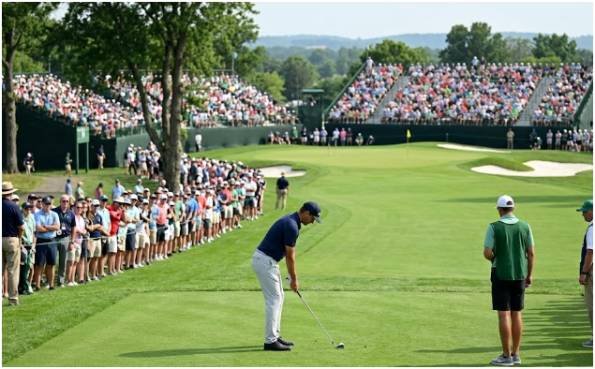
Is golf considered a professional sport? Without question. The PGA Tour alone generated over $1.9 billion in revenue in recent years. Prize money for a single major like the Masters now exceeds $18 million. Scottie Scheffler earned over $62 million in prize money in 2024 alone, making him one of the highest-paid athletes on earth in any sport for that calendar year.
Professional golf has broadcast deals with CBS, NBC, ESPN, and streaming platforms. It has sponsors that include some of the largest corporations in the world. It has a Commissioner, a Players’ Association, a world ranking system updated weekly, and an anti-doping program enforced by the World Anti-Doping Agency framework. That’s every structural marker of a major professional sport present and accounted for.
Is golf considered a professional sport? The market has already answered that question. You don’t build a $2 billion annual revenue tour around something that isn’t a legitimate professional sport. The economics are plain.
“People don’t understand how athletic tour players are now. The physicality of what these guys do, the rotation, the speed, the endurance over 72 holes, it’s comparable to a lot of other sports people never question.”
Gary McCord, CBS Sports golf analyst, speaking on the physical evolution of professional golf
McCord has been covering tour golf for decades, and his observation reflects a shift that’s been happening since the late 1990s. The modern professional golfer is a trained athlete who happens to play golf, not someone who golfs and calls it exercise. That distinction matters when you’re judging whether golf as a competitive sport belongs in the same conversation as other professional competitions.
Golf as a Competitive Sport: Is Golf Harder Than Other Sports?
Is golf harder than other sports? This is the argument I find most compelling, and I’ll tell you exactly where I land on it. Golf might be the hardest individual sport to become good at out of any mainstream competitive activity. Not the most physically punishing, not the fastest, but the hardest to master.
Golf as a competitive sport presents a difficulty curve that most other sports don’t match. In basketball, a raw beginner can still score occasionally. In soccer, a first-timer can kick the ball. In golf, a beginner regularly cannot make contact at all. The margin for error is measured in millimeters on a clubface that’s moving at 80 to 100 mph. Missing the sweet spot by half an inch turns a planned 200-yard shot into a 50-yard dribble into a pond.
Professional golfers practice putting for hours specifically because holing a four-foot putt under tournament pressure is not easy or automatic. No other sport requires you to be equally skilled at power (drives), precision (approach shots), touch (chipping), and psychological control (putting) simultaneously and without being able to warm up between each type of task. You hit a 300-yard drive, then you need to make a six-inch putt. The range of physical tasks involved in a single round is enormous.
Is golf harder than other sports? For raw difficulty of consistent execution, my honest take is yes, it belongs in the top three alongside hitting a baseball and Olympic archery. All three require you to repeat a precise motor pattern under pressure with almost zero margin for error. Golf just does it for four to five hours straight.
Golf as a competitive sport also punishes mental errors in a way most other sports don’t. A basketball player who has a bad quarter can make up for it in the fourth. In stroke play golf, a triple bogey on hole four is permanent. It stays on your scorecard forever, and you carry it for the next 14 holes. That psychological weight is a genuine competitive variable that serious golfers train specifically to manage.
Is Golf a Sport? A Checklist for the Skeptic
If you’re still on the fence, run through this checklist. Each item is a characteristic that separates sport from leisure activity, and golf clears every single one.
- Formal rules enforced by a governing body: The USGA and R&A publish a shared rulebook updated regularly, with decisions enforced during competition by official referees.
- Measurable physical exertion: Walking 18 holes burns 300 to 400 calories per hour, involves 4 to 6 miles of walking, and places significant load on the core, back, and shoulders.
- Skill acquisition that takes years: The average golfer takes two to three years of regular play to break 100, and most recreational players never break 90. Elite skill requires a decade or more of dedicated practice.
- Competitive structure with rankings: The Official World Golf Ranking system ranks players using a rolling 104-week points window across sanctioned events globally.
- Professional tier with compensation: The PGA Tour distributes over $600 million annually in prize money across its schedule. LIV Golf and other tours add hundreds of millions more.
- Olympic recognition: Golf has been included in the Olympic program since 2016 and is scheduled for Los Angeles 2028.
- Anti-doping enforcement: Tour golf conducts drug testing through WADA-compliant programs, including testing for performance-enhancing substances.
That’s seven characteristics, and golf has all seven. The “not a sport” argument doesn’t survive contact with the actual structure of the game.
How to Actually Defend Golf as a Sport in Any Conversation
You’ll run into this debate. Here’s how to handle it without getting flustered. Call this the PACE framework: Physical, Authority, Competition, and Economics. Use any one of these points and you win the argument. Use all four and you end the conversation.
Physical: Ask your skeptic to swing a club 80 times over four hours while walking six miles on uneven terrain in July. Then ask them how their back feels the next morning. The physical demands of playing golf are immediately obvious to anyone who actually tries the sport.
Authority: The International Olympic Committee, the World Anti-Doping Agency, and the sports departments of virtually every major university in America all classify golf as a sport. Disagreeing with all of them simultaneously takes a lot of confidence.
Competition: The Ryder Cup, the Masters, the U.S. Open, and the Players Championship are watched by tens of millions of people in dozens of countries. Competitive events at that scale don’t happen for non-sports.
Economics: Scottie Scheffler was the highest-paid athlete in the world by prize money in 2024. Endorsement deals in professional golf regularly reach nine figures. Markets don’t pay those numbers for leisure activities.
Is Golf a Sport? Final Take
The argument against golf being a sport has always been aesthetic, not logical. People look at the clothing, the quiet galleries, the deliberate pace, and they pattern-match to “country club hobby.” But strip all of that away and you have a 600-year-old competitive activity with formal rules, an Olympic place on the schedule, professional athletes earning eight-figure salaries, and physical demands that injure professionals at rates comparable to tennis and cycling.
Is golf a sport? The data says yes, the governing bodies say yes, the IOC says yes, and anyone who’s ever played 18 holes in the wind and tried to make a six-foot putt on the last green to break 90 would never say no. The next time someone tries to take this argument to the table at a party, hand them a seven-iron and ask them to hit a fairway from 175 yards. Let the experience answer the question for you.
Golf deserves its place in the conversation with the world’s great sports. The question worth asking now isn’t whether golf is a sport. It’s why so many people still haven’t figured that out. What do you think keeps the stereotype alive, and how do you personally make the case to doubters?