
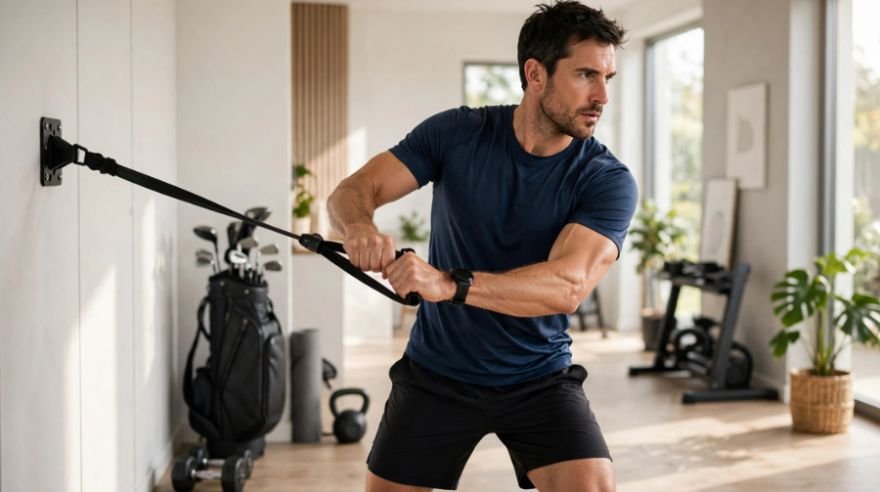
A stronger golf swing does not require a garage full of weights. When I structure a resistance band workout for golfers at home, I focus on three things: producing force, controlling rotation, and maintaining posture.
That combination matters more than simply copying the golf swing against a heavy band. Research has consistently linked strength and conditioning programs with improvements in golf performance, including clubhead speed.
My approach is simple: train power while fresh, build stability next, then strengthen the muscles that help you hold posture.
Why Resistance Bands Work So Well for Golfers
A golf swing transfers force from the ground through the hips, trunk, shoulders, arms, and club. Resistance bands let me train several parts of that chain without needing large machines.
Bands also become progressively harder as they stretch. That makes them useful for rotations, rows, presses, lateral movements, and anti-rotation exercises.
They are especially practical at home because I can change resistance by stepping farther from the anchor or selecting another band.
The American College of Sports Medicine’s 2026 resistance-training guidance specifically recognizes elastic bands and home workouts as effective forms of resistance exercise. ACSM also recommends training major muscle groups at least twice weekly for most healthy adults.
Golf-specific evidence supports the broader principle. A systematic review found resistance-training programs can improve clubhead speed and hitting distance, although results depend on exercise selection and programming.
What You Need Before Starting
I keep the setup deliberately basic. You need one long resistance band, a mini loop band, and a secure anchor point.
Never attach a band to unstable furniture. Check the band for cracks, thinning, or tears before pulling it toward your face or body.
Choose resistance that lets you maintain clean movement. More tension is not automatically better for golf.
If your shoulders feel restricted before training, add a few mobility exercises from golf stretches for tight shoulders before playing before starting the circuit.
The Resistance Band Workout for Golfers at Home
This resistance band workout for golfers at home uses six movements. Perform two or three rounds initially. Rest about 30 to 60 seconds between exercises when needed.
Banded Pallof Press
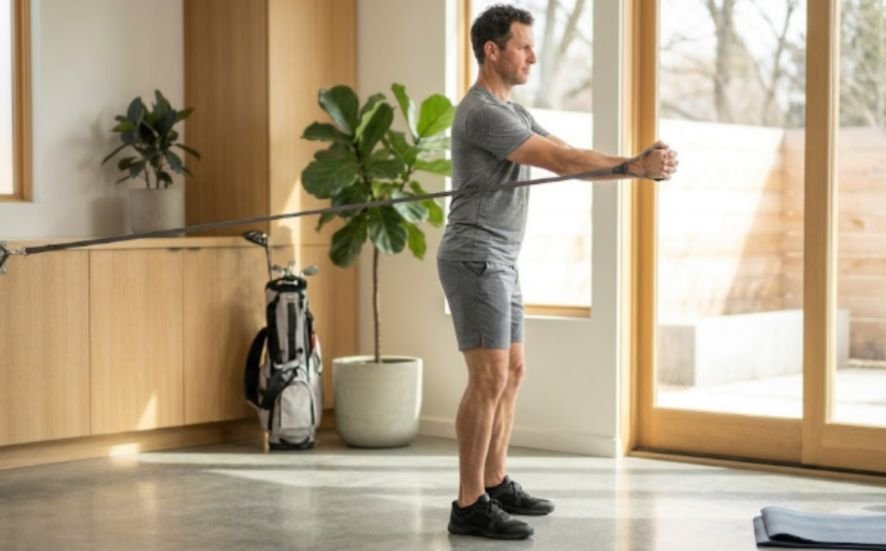
Anchor the band around chest height and stand sideways to it. Hold both hands at your sternum, brace your trunk, then press your arms straight forward.
Do not allow the band to rotate you toward the anchor.
Perform 10 to 12 controlled repetitions per side.
I like this exercise because golf does not only require rotation. The body must also resist unwanted movement while forces travel through the swing. Core training has been associated with improvements in golf-related physical qualities and driving performance.
Banded Wood Chop
Anchor the band above shoulder height. Stand in an athletic golf-like posture and pull diagonally across your body.
Perform 8 to 10 repetitions per side.
Move quickly but stay balanced. I would rather see eight crisp repetitions than fifteen slow, exhausted ones.
This is the power exercise of the workout, so I place it early. Current ACSM guidance recommends moderate resistance with fast concentric movement when power is the objective.
Banded Split Squat
Stand on the middle of a long band and hold the ends near your shoulders. Step into a split stance and lower the rear knee toward the floor.
Drive through the lead foot to stand.
Complete 8 to 10 repetitions per leg.
Golfers spend plenty of time thinking about rotation, but rotation needs a stable base. Split squats train each leg independently and expose side-to-side strength differences.
Lateral Band Walk
Place a mini band above your knees or around your ankles. Bend slightly at the hips and knees.
Take 10 to 15 controlled steps in one direction, then return.
Keep constant tension in the band and avoid allowing your knees to collapse inward.
I use lateral walks to train the hip muscles that help control the pelvis. They fit well before more demanding rotational work or as part of a warm-up.
Band Pull-Apart
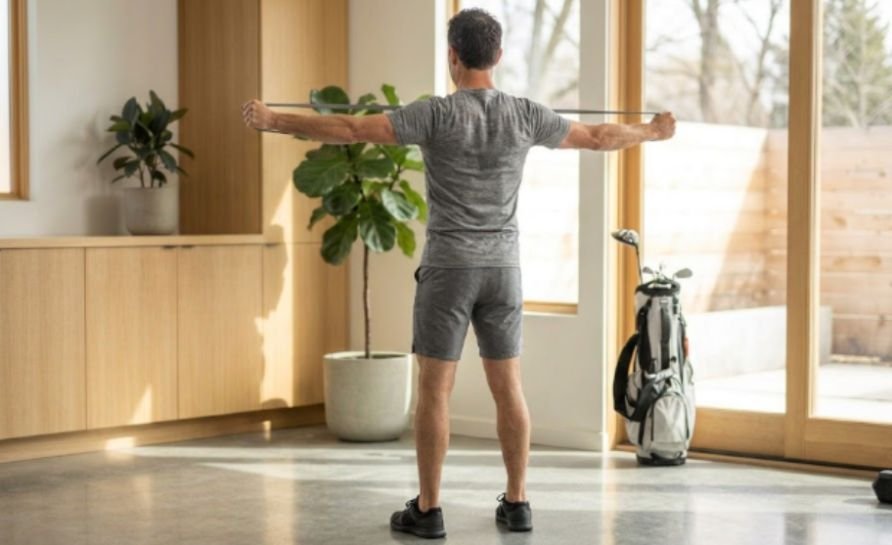
Hold a light band in front of your chest with straight arms. Pull your hands apart until your shoulder blades move toward each other.
Return slowly.
Complete 12 to 15 repetitions.
Golfers who spend hours sitting at work often appreciate this movement. It strengthens the upper back without requiring heavy equipment.
Single-Arm Resistance Band Row
Anchor your band between waist and chest height. Hold it with one hand and step backward until tension develops.
Pull your elbow toward your ribs while keeping your trunk stable.
Perform 10 to 12 repetitions per arm.
Rows strengthen the upper back and give the workout a pulling movement to balance the rotational exercises.
For days when bands are unavailable, I switch to a golf workout at home without equipment rather than skipping training entirely.
How I Structure This Golf Resistance Band Routine
My original Power–Stability–Posture framework keeps the session organized.
I start with wood chops because speed work suffers when fatigue rises. Then I move into Pallof presses, split squats, and lateral walks for stability. Pull-aparts and rows finish the posture section.
A practical session looks like this:
Wood chop: 8 reps each side
Pallof press: 10 reps each side
Split squat: 8 reps each leg
Lateral walk: 12 steps each way
Pull-apart: 15 reps
Single-arm row: 10 reps each arm
Complete two rounds as a beginner and three rounds once the routine feels comfortable.
That produces a focused session without turning golf fitness into an hour-long gym workout. For a slightly longer routine, I would pair it with a 20 minute golf workout at home on a separate training day.
How Heavy Should Your Resistance Band Be?
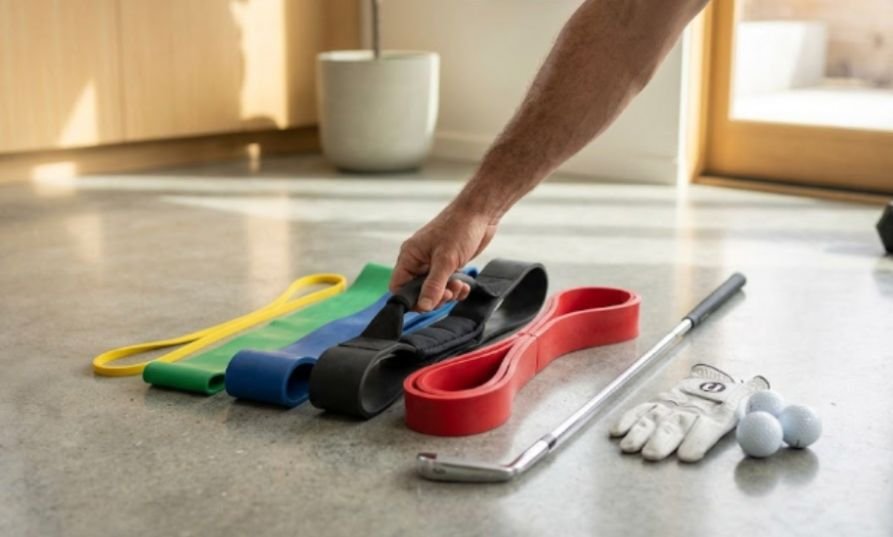
I use movement speed and technique instead of band color because resistance colors are not standardized across manufacturers.
For Pallof presses, split squats, and rows, the last few repetitions should feel challenging while form remains stable.
Power movements need a different rule.
If a band becomes so heavy that your wood chop turns into a slow grind, reduce the resistance. Power requires speed.
ACSM’s updated guidance also emphasizes that training to complete muscular failure is not required for most healthy adults.
That matters for golfers. The goal is better force production and movement quality, not crawling away from every workout exhausted.
Common Resistance Band Training Mistakes Golfers Make
The biggest mistake I see in golf fitness programming is treating every rotational exercise as a swing drill.
It is not.
A band changes the direction and magnitude of force acting on your body. Trying to perfectly reproduce your driver swing against heavy resistance may change your movement pattern.
I prefer exercises that train physical qualities behind the swing rather than forcing every strength movement to look exactly like golf.
Another mistake is rushing repetitions. Controlled strength work should remain controlled.
Power exercises are different. They should move fast, but speed cannot come at the cost of balance.
Finally, do not keep increasing band tension simply because you can. Progress can also mean better control, more range of motion, cleaner repetitions, or another set.
How Often Should Golfers Do Resistance Band Workouts?
For most recreational golfers, I would start with two sessions each week.
That aligns well with current resistance-training recommendations while leaving room for golf, practice, walking, and recovery.
Once you adapt, three weekly sessions can work if overall fatigue remains manageable.
Avoid a demanding session immediately before an important round if it leaves your legs or trunk tired.
Physical preparation should make golf feel more manageable, not create another source of pressure. Alongside strength work, learning how to reduce stress while playing golf can help you manage first-tee nerves, recover after poor shots, and stay focused throughout the round.
Consistency matters more than squeezing extra workouts into one week. ACSM’s 2026 evidence review analyzed 137 systematic reviews covering more than 30,000 participants and concluded that regular resistance training matters more than complicated programming for most adults.
Frequently Asked Questions
1. Can resistance band exercises increase golf swing speed?
They can contribute to greater strength and power, and resistance-training research in golfers has reported improvements in clubhead speed.
2. Is a resistance band workout for golfers at home suitable for beginners?
Yes. Beginners can start with light resistance, two rounds, controlled repetitions, and gradually increase difficulty.
3. What resistance band exercises are best for golf rotation?
Wood chops train rotational force, while Pallof presses train your ability to resist unwanted rotation.
4. Should golfers use resistance bands before playing?
Light band work can suit a warm-up, but save demanding strength sets for dedicated training sessions.
Your Swing Does Not Need Another Excuse
I like a resistance band workout for golfers at home because it removes nearly every excuse that makes golf fitness difficult. There is no commute, complicated machine, or oversized home gym required.
The same idea applies to skill development. On days when you cannot reach the course or driving range, learning beginner-friendly ways to practice golf at home can help you work on setup, putting, swing positions, and other fundamentals alongside your fitness routine.
But I would not chase exhaustion.
Build the hips. Train the trunk. Strengthen the upper back. Move explosively when the exercise calls for power, and slow down when control matters.
Do that twice each week before worrying about fancy equipment. Your driver can complain later.