

Most new golfers quit before their fifth round. Not because golf is impossible, but because nobody gave them a clear map before they walked onto the first tee. This guide fixes that. You’ll get every foundational piece you actually need: the right clubs, the basic rules, how scoring works, how to swing without embarrassing yourself, and exactly what to do the first time you play a real round. Work through this once and you’ll feel prepared instead of panicked.
Why Learning How to Play Golf Is Worth the Early Frustration
Golf has a reputation for being hard to pick up, and honestly, that reputation is earned. The swing alone takes months of deliberate repetition before it starts to feel natural. But here’s the payoff: once you have even a basic command of the game, it becomes one of the most social, competitive, and genuinely enjoyable outdoor activities you can do for the rest of your life.
According to the National Golf Foundation, over 41 million Americans played golf or golf-related activities in 2023, the highest participation number the sport has seen in two decades. That surge includes millions of brand-new beginners who started on a simulator, a driving range, or a par-3 course. The barrier to entry has never been lower.
The honest truth is that golf rewards patience. Players who commit to understanding golf basics for beginners before obsessing over their score tend to progress faster and enjoy the process more. Give yourself that foundation first.
Golf Basics for Beginners: The Core Concept of the Game

Golf is played on a course made up of either 9 or 18 holes. Each hole has a designated starting area called the tee box, a fairway (the mowed grass path toward the target), and a green with a flagstick marking a small cup in the ground. Your goal on every single hole is to get the ball from the tee into that cup in as few strokes as possible.
Each hole is assigned a par, which is the number of strokes a skilled golfer is expected to need to finish it. Par-3 holes are the shortest. Par-4s are mid-length. Par-5s are the longest. A typical 18-hole course plays to a par of 72, meaning a scratch golfer (someone with a 0 handicap) is expected to complete all 18 holes in 72 strokes total.
That basic structure is also why beginners should think beyond clubs and balls when preparing for a round. Depending on the conditions, choosing the right golf gear for playing in hot weather can make it much easier to stay comfortable and focused from the first tee to the final green.
That framing matters because understanding how golf scoring works is the thing that makes every other rule feel logical. Everything in the rulebook connects back to counting strokes fairly.
How Golf Scoring Works: Pars, Birdies, and Bogeys Explained
Golf scoring works on a relative-to-par system. Here is a quick breakdown of the standard terms:
| Score Name | Strokes vs. Par | Example on a Par-4
|
|---|---|---|
| Condor | 4 under par | Hole-in-one on a par-4 (extremely rare) |
| Albatross (Double Eagle) | 3 under par | 1 stroke on a par-4 |
| Eagle | 2 under par | 2 strokes on a par-4 |
| Birdie | 1 under par | 3 strokes on a par-4 |
| Par | Even | 4 strokes on a par-4 |
| Bogey | 1 over par | 5 strokes on a par-4 |
| Double Bogey | 2 over par | 6 strokes on a par-4 |
| Triple Bogey | 3 over par | 7 strokes on a par-4 |
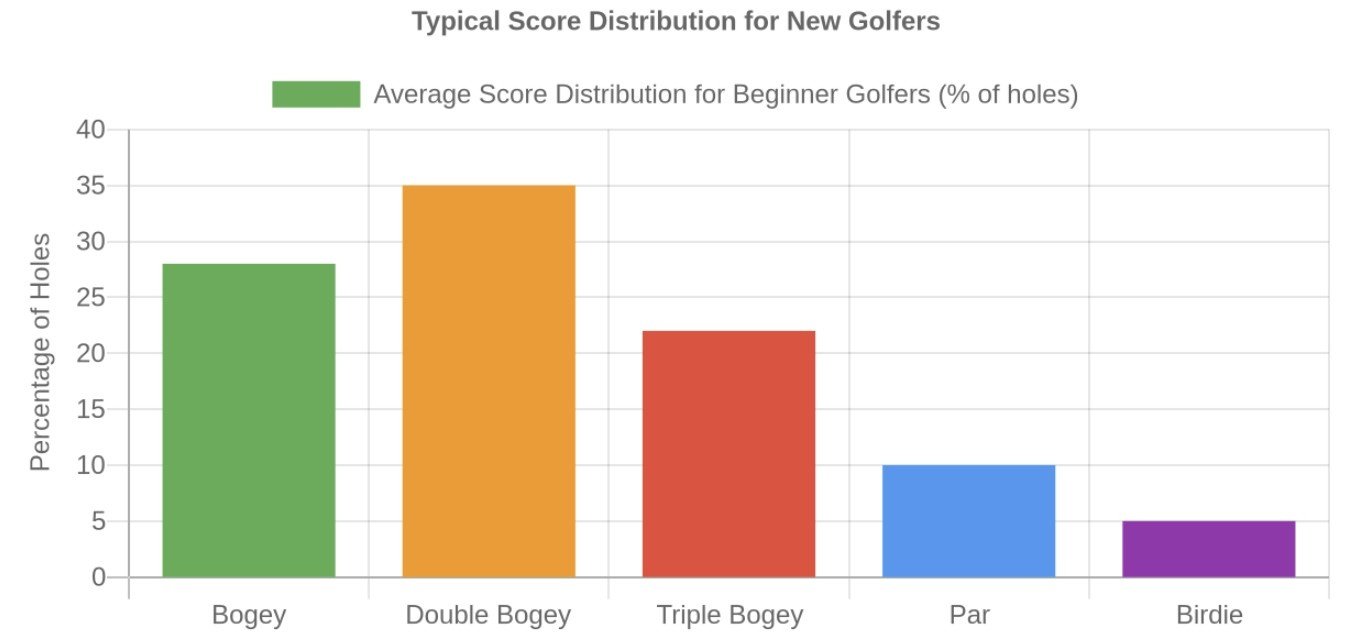
As a beginner, bogeys and double bogeys are completely normal. Shooting 100 on your first 18-hole round means you averaged about a double bogey per hole, and plenty of new players would love that score. The goal of understanding how golf scoring works right now isn’t to obsess over numbers. It’s so you can keep an honest count and participate in casual competitions with friends.
As you start playing more often or planning golf trips, practical equipment decisions matter too. For example, choosing the best golf travel bag for airline travel can help protect your clubs when you fly to play courses away from home.
One more thing worth knowing: stroke play means you count every stroke across the whole round and the lowest total wins. Match play is hole-by-hole, and the player who wins the most holes wins the match. Most casual rounds use stroke play, so that’s where your focus should be.
Basic Golf Rules for Beginners: What You Actually Need to Know
The official rulebook from the USGA is 208 pages long. You do not need to memorize it. For your first several rounds, these are the basic golf rules for beginners that will cover 95% of the situations you’ll face:
- Play the ball as it lies. Don’t move it to a better spot unless a specific rule allows it.
- Tee the ball up anywhere between the two tee markers, within two club-lengths behind them.
- If your ball lands out of bounds (marked by white stakes), you take a one-stroke penalty and replay from where you last hit.
- If your ball is lost (you can’t find it within three minutes), same penalty applies: one stroke and replay from the original spot.
- If your ball lands in a penalty area (marked by red or yellow stakes), you have options: play it as it lies, drop back on a line behind the hazard for one stroke, or replay from the previous spot for one stroke.
- On the green, mark your ball with a coin when other players are putting, then replace it before your turn.
- The player farthest from the hole always hits first, both on the fairway and on the green.
These basic golf rules for beginners won’t make you an expert, but they’ll keep you from slowing down play or accidentally cheating without knowing it. The full USGA Rules of Golf are freely available online if you want to go deeper on any specific situation.
What Clubs Do Beginners Need? Start With Less
You’re allowed to carry up to 14 clubs in your bag during a round. As a beginner, carrying 14 clubs is actually counterproductive. More options mean more decisions, and decision fatigue is real when you’re already thinking about 15 other things at once.
My honest recommendation for what clubs do beginners need: start with seven clubs and build from there as your game develops.
- A driver (for teeing off on longer holes)
- A 3-wood or 5-wood (for long fairway shots or when the driver feels too aggressive)
- A 5-iron or 6-iron (your mid-range workhorse)
- An 8-iron or 9-iron (for approach shots closer to the green)
- A pitching wedge (for short approach shots and chipping)
- A sand wedge (for bunkers and tight chips)
- A putter (for the green)
A quality starter set from brands like Callaway, Cleveland, or Wilson runs between $200 and $500 new, or under $150 used. The Golf.com gear section has solid, frequently updated buying guides if you want specific model recommendations with current pricing.
Forgiving clubs matter more than premium clubs at this stage. Look for cavity-back irons (they have a hollowed-out back, which widens the sweet spot) and a driver with at least 10.5 degrees of loft. Both make off-center hits far more manageable, and trust me, you’ll be hitting plenty of those early on.
How to Swing a Golf Club: The Four Fundamentals

The golf swing is complex enough to fill its own book, but four fundamentals cover the majority of what beginners get wrong. Getting these four things reasonably right will put you far ahead of someone who just walks up and starts hacking.
Grip
Hold the club in your fingers, not your palm. Your top hand (left hand for right-handed golfers) wraps around the grip so the club runs diagonally across your fingers, not straight across. The most beginner-friendly grip style is the overlapping (Vardon) grip, where the pinky finger of your bottom hand sits on top of the index finger of your top hand. Grip pressure should feel like you’re holding a tube of toothpaste without squeezing any out.
Stance and Alignment
Feet roughly shoulder-width apart. Knees slightly flexed. Back relatively straight with a forward tilt from the hips, not a hunched spine. Your feet, hips, and shoulders should all be parallel to your target line, not pointed directly at the target (that’s a common early mistake). Think of it like standing on a railroad track: your body is on one rail, the ball and target are on the other.
The Backswing
Turn your shoulders away from the target while keeping your lower body relatively stable. Your lead arm (left arm for right-handers) stays straight but not stiff. At the top of your backswing, your back should be facing the target. If it’s not, your rotation is short and your power will be too.
The Downswing and Follow-Through
This is where knowing how to swing a golf club gets counterintuitive. Don’t think about hitting the ball. Think about rotating through the ball. Start the downswing with your hips turning toward the target, not your arms pulling down. The arms follow the hip rotation, not the other way around. Finish with your weight fully on your front foot, your belt buckle facing the target, and the club up behind your head.
“The golf swing is a chain reaction. If you start the chain in the right order, from the ground up, everything else has a chance to work. If you start with the hands and arms, the chain breaks before it even begins.” This sentiment is widely shared by instructors and was expressed by noted teacher Butch Harmon during multiple coaching sessions documented in Golf Digest’s instructional archives.
Learning how to swing a golf club is best done in person with a PGA teaching professional for at least one or two lessons before you develop habits that take years to undo. A single one-hour lesson typically costs $75 to $150 and is the single highest-return investment a new golfer can make.
Golf Course Etiquette for Beginners: The Unwritten Rules That Matter
Golf has a culture. That culture has expectations. Violating them won’t get you thrown off a course usually, but it will make you the person nobody wants to play behind. Solid golf course etiquette for beginners is honestly as important as solid mechanics in terms of how you’re perceived on the course.
The biggest one: keep up with the pace of play. A round of 18 holes should take roughly four hours for a foursome. If your group is consistently falling behind the group ahead of you, pick up your ball after a reasonable number of strokes (most casual rounds use a maximum of double par per hole) and move on. Nobody remembers the score you made on hole seven. They do remember spending six hours in the heat.
Beyond pace, here’s what solid golf course etiquette for beginners looks like in practice:
- Stay silent and still when someone is hitting. No talking, no movement in their peripheral vision.
- Repair your divots on the fairway by replacing the chunk of turf or using the sand/seed mix in the cart.
- Fix your ball mark on the green. When your ball lands on the green, it leaves a small indent. Repair it with a divot tool.
- Rake the bunker after you play out of it, smoothing your footprints and the mess your shot left.
- Never drive a cart onto the fringe or green. Stay on the cart path near the green.
- Let faster groups play through if you’re looking for a lost ball or falling behind. Wave them up, step aside, and let them pass.
Golf Terms Beginners Should Know Before Their First Round

Nothing kills confidence faster than standing on the tee box while your playing partner says “hit from the forward tees” and you have zero idea what they mean. Here are the golf terms beginners should know before stepping foot on a real course:
- Tee box: The designated starting area for each hole, marked by colored tee markers.
- Fairway: The closely mowed strip of grass between the tee and the green.
- Rough: The longer grass on either side of the fairway.
- Green: The putting surface where the cup and flagstick are located.
- Flagstick (pin): The pole in the cup that helps you identify the hole from a distance.
- Handicap: A numerical measure of a golfer’s playing ability. Lower is better. It allows players of different skill levels to compete fairly.
- Lie: The position your ball is resting in after it lands.
- Loft: The angle of the clubface, which controls how high the ball travels.
- Fore: The shout golfers use to warn others that an errant shot is heading their way. If you hear it, cover your head.
- Mulligan: An informal do-over, not permitted under official rules but common in casual play.
Knowing these golf terms beginners should know also helps you follow along when more experienced players are talking strategy, which is half the fun of playing in a group.
How to Start Playing Golf: A Step-by-Step On-Ramp
The most common mistake new players make when figuring out how to start playing golf is going straight to a full 18-hole course. That’s like learning to drive by merging onto a highway. Here’s a better on-ramp that actually builds confidence instead of crushing it.
Step 1: Hit the Driving Range First
Spend your first three to five sessions at a driving range. Buy a small bucket of balls (usually $8 to $15) and work through your irons. Don’t start with the driver. Start with a 7-iron or 8-iron and just make contact. Solid contact with a short iron is more satisfying and more instructive than thin-topped drives going sideways.
Step 2: Take at Least One Lesson
Book a beginner lesson with a PGA professional. Even one 45-minute session will tell you more about your swing than five hours of unguided range time. Many golf courses offer beginner group clinics for $30 to $50, which are a solid budget option.
Step 3: Play a Par-3 Course
Par-3 courses are short-hole layouts where every hole is a par-3, usually ranging from 50 to 200 yards. They’re casual, fast, cheap (often under $20), and a perfect bridge between the range and a full course. You’ll use mostly irons and your putter, which is exactly where your skills will be at this stage.
Step 4: Play 9 Holes Before 18
When you’re ready for a real course, play 9 holes first. A half-round keeps the time commitment under two hours, your energy stays higher throughout, and the mental load is half of a full round. Most public courses offer 9-hole rates.
Step 5: Track Your Progress, Not Your Score
For the first several rounds, measure success by how many shots you make solid contact on, not what number you write on the scorecard. That mental reframe takes a ton of pressure off and actually leads to lower scores faster.
How to Play Your First Round of Golf: A Pre-Round Checklist
Knowing how to play your first round of golf is partly about what you do before you even get to the first tee. Use this checklist the morning of your first real round:
- Arrive at the course at least 30 minutes before your tee time. Rushing is the enemy of good swings.
- Hit a small bucket at the range to warm up. Don’t try to fix your swing here. Just find a rhythm.
- Spend five minutes on the practice putting green. Distance control on putts matters more than any long game skill on your first round.
- Know the tee box color you’ll play from. Beginners should use forward tees (often red or gold). There is zero shame in this. The course is designed for those tees to be playable.
- Bring enough balls. You’ll lose some. Pack at least six for a 9-hole round, twelve for 18.
- Set a maximum stroke limit per hole before you start (double par is a good default) so you never slow the group behind you.
- Carry a divot tool, a few tees, and a ball marker (a coin works fine).
- Keep your phone in your bag. Check it between holes only.
Following these steps will make how to play your first round of golf a genuinely enjoyable experience rather than a stressful survival exercise.
Beginner Golf Practice Routine: Build Skill Without Burning Out
Random range sessions produce random results. A structured beginner golf practice routine produces a golfer who actually improves. The key insight most beginners miss is that putting and short game account for roughly 65% of strokes in a typical round, yet beginners spend 90% of their practice time beating drivers.
Here’s a practical beginner golf practice routine for someone hitting the range twice a week:
Session One: Full Swing Focus (60 minutes)
Start with 10 minutes of easy chips and pitches with your wedge just to get loose. Move to your 7-iron for 20 minutes, focusing on making solid contact and consistent ball flight direction. Spend 15 minutes on your fairway wood. Finish with 15 minutes of driver work. Never spend more than 30% of your session on the driver, no matter how tempting it is.
Session Two: Short Game Focus (60 minutes)
25 minutes on putting. Work on three-foot putts first (make 10 in a row before moving back), then practice 15-footers for distance control. Spend 20 minutes on chipping from off the green edge, trying to land the ball on a specific spot. Finish with 15 minutes on pitch shots from 30 to 50 yards. These half-swing wedge shots will save you more strokes than anything else in your bag.
Both the PGA of America’s instructional resources and independent research on motor learning consistently show that deliberate, goal-oriented practice with immediate feedback produces skill gains two to three times faster than undirected repetition. Spend your range time with a specific intention on every single shot.
How to Play Golf With a Handicap System
Once you’ve played enough rounds to establish a handicap index through the World Handicap System (WHS), the game opens up in a new way. Your handicap is calculated based on your best recent scores relative to each course’s difficulty rating, and it allows you to compete fairly against golfers of any skill level.
In the United States, you establish a handicap through the USGA’s official platform or a registered golf club. You need a minimum of 54 holes (three 18-hole rounds or equivalent) to generate an initial handicap. The system updates automatically as you post more scores.
The practical effect: if your handicap is 24 and your playing partner’s is 8, they give you 16 strokes across the round in a net stroke play format. You subtract those strokes from your gross score to get your net score. Playing with a handicap is one of the things that makes golf uniquely fair across massive skill gaps, and it’s one more reason understanding how to play golf beyond just the mechanics pays off long-term.
How to Play Golf on a Real Course: The Mental Game

Every beginner eventually hits the wall where their physical skills are okay but their head is getting in the way. You hit a bad shot on hole two and carry it through holes three, four, and five. The technical term for this is playing one shot at a time, and it’s a skill, not just a platitude.
Pre-shot routines help enormously. Before every shot, pick a specific target (not “the fairway” but a specific tree or landmark), take one or two practice swings, step up to the ball, and go. A consistent routine anchors your attention to the present shot instead of the last one. Tour professionals spend years perfecting theirs. Yours doesn’t need to be elaborate; it just needs to be consistent.
Accept that your score will be high for a while. The average 18-hole score for all golfers in the United States is around 100 according to NGF data, and that includes people who’ve been playing for years. You’re not supposed to be shooting par. You’re supposed to be learning how to play golf while enjoying a few hours outdoors, and those two things are not in conflict.
Common Beginner Mistakes That Are Easy to Avoid
I’d rather tell you about these now than let you discover them the slow way on the course.
Swinging too hard is the most universal beginner mistake. Power in golf comes from rotation and timing, not from muscling the club. Grip it at about 70% of maximum tension and swing at 80% of your perceived maximum. The ball will go farther and straighter every time.
Looking up too early is the second most common one. Players lift their head to see where the ball went before they’ve even made contact, causing them to top the ball. Keep your eyes on the back of the ball until after impact. The ball isn’t going anywhere in the fraction of a second it takes your follow-through to bring your head up naturally.
Using the wrong tee box is the third, and it’s a pride thing. Playing from tees that are too long makes every par-4 feel like a death march. Play the forward tees until you’re consistently breaking 100. Literally nobody who knows anything about golf will judge you for it. They will judge you for holding up play on a 6,800-yard course while hitting your seventh provisional ball.
Resources to Keep Learning How to Play Golf
Books, apps, and YouTube channels have made self-directed golf improvement more accessible than ever. A few resources genuinely worth your time:
The Golf Channel’s free content library covers every aspect of the swing with PGA instructors. YouTube channels like Me and My Golf and Rick Shiels Golf offer beginner-to-intermediate instruction with clear, jargon-free explanations. The Arccos Caddie app (available on iOS and Android) tracks your shots automatically via sensors on your grips and generates data-driven insights on exactly where your strokes are being lost. It’s the most practical feedback tool a self-taught beginner can use between lessons.
And keep coming back to communities like Reddit’s r/golf, where real players at every level share their honest experiences learning the game. You’ll find out quickly that every golfer, at every stage, is still figuring things out.
Your First Steps Into the Game Start Today
Golf is a game you learn in layers. You don’t need to master every layer before you step onto a course. You need to understand how to play golf at a basic level, know the essential rules, carry the righta clubs, respect the people around you, and keep the ball moving forward. Everything else comes with time and repetition.
The golfers who stick with it and genuinely grow are not the most naturally talented ones. They’re the ones who stay curious, practice with intention, and don’t let a few ugly holes define their relationship with the game. That description can be you starting this week.
Book a range session. Take one lesson. Play a par-3 course. Then play nine holes with a friend who knows the basics. That sequence is how to start playing golf in a way that actually builds toward something. The rest of it will fill in as you go. So what’s stopping you from booking that first tee time?