
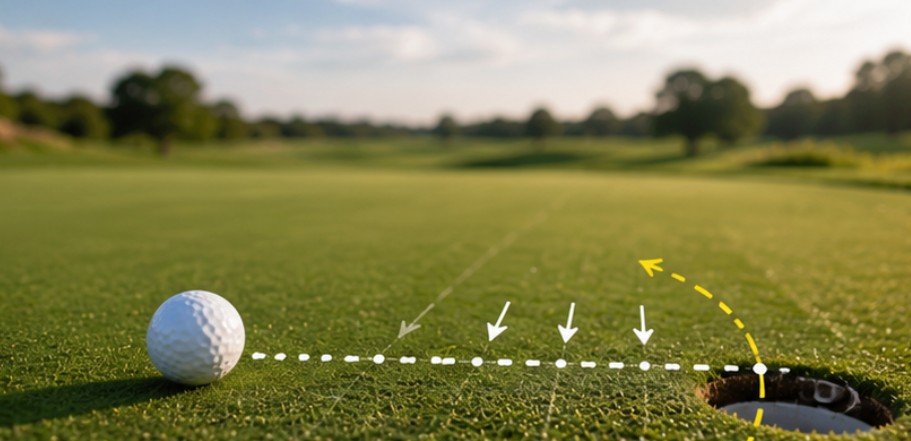
Tour players do not rely on visual guesswork to read greens anymore, and the reason comes down to basic human physiology. Your eyes lie to you on a golf course due to optical illusions created by surrounding hills, horizon lines, and lawnmower stripes. Your inner ear and the soles of your feet, however, act as biological inclinometers that cannot be tricked by perspective.
Enter the aim point green reading method, a vector-based green reading system that replaces visual estimation with physical sensation and repeatable geometry. Originally developed by former software engineer Mark Sweeney, this approach treats a putting green like a three-dimensional plane with a measurable tilt. By shifting the reader’s primary sensor from the eyes to the feet, it converts slope into precise spatial offsets.
For tech enthusiasts, videographers, and photographers who think in terms of camera focal lengths, sensor tilts, and spatial geometry, this method feels immediately familiar. It is the athletic equivalent of spatial mapping.
The Kinesthetic Physics of Reading a Green
Visual green reading fails because the human brain actively corrects optical perception based on background context. If a green sits on the side of a mountain, a flat putt will visually appear to slope heavily away from the peak—an illusion known as the “poured horizon” effect.
This distortion is especially common on a links golf course, where dune-shaped land and few surrounding trees remove the usual visual reference points golfers rely on.
The human vestibular system (the balance mechanism in the inner ear) working alongside plantar proprioceptors (pressure sensors in your feet) operates independently of visual context.
Research published through the National Center for Biotechnology Information demonstrates how proprioceptive feedback allows humans to detect surface inclinations as subtle as 0.5 degrees without visual cues.
When you stand on a green, gravity pulls your center of mass downward, creating a subtle shift in weight distribution across your feet. A 2% grade shifts pressure noticeably toward the downhill foot. By calibrating what a 1%, 2%, or 3% slope feels like underfoot, a golfer establishes a reliable biological measurement system.
How the AimPoint Express Technique Translates Sensing into Aiming

The simplified iteration of this system—known widely as AimPoint Express—takes these subtle body sensations and converts them into precise target lines using simple physical reference points.
Here is the exact step-by-step framework used to calculate break lines:
- Locate the Midpoint: Walk halfway along the putt’s path. Slope severity can change across a long trajectory, so measuring at the midpoint yields the average grade of the putt.
- Straddle the Line: Stand facing the hole with the line of the putt passing directly between your feet. Keep your stance shoulder-width apart to ensure consistent pressure baseline readings.
- Isolate Weight Bias: Feel where the weight settles across the soles of your feet. The heavier foot indicates the low side, which tells you the direction the ball will break.
- Quantify the Slope Grade: Assign a numeric value from 1% to 5% based on physical feedback:
- 1% Slope: Barely detectable; a slight sensation of weight shifting toward one side.
- 2% Slope: Clear, comfortable weight shift toward the downhill foot.
- 3% Slope: Strong pressure change; requires slight core engagement to feel balanced.
- 4–5% Slope: Severe incline; feels like standing on an obvious side-hill bank.
- Calibrate the Arm Extension: Walk behind the ball, align your body with the cup, and extend your arm fully with your hand raised toward the hole.
- Project the Target Point: Hold up the number of fingers matching your slope grade (e.g., 2 fingers for a 2% slope). Place the inside edge of your index finger on the center of the cup. The outside edge of your fingers now marks the exact aiming point where gravity will pull the ball into the hole.
[ HOLE ]
| <– Inside Edge of Index Finger
[ ✌️ FINGERS ] (e.g., 2% Slope Measurement)
| <– Outside Edge = EXACT AIM POINT
:
: (Ball Path Curves Here)
:
[ BALL ]
Why Spatial Framing Matters: The Photographer’s Advantage

Photographers and cinematographers often master the aim point green reading method rapidly because they already understand visual parallax and focal distances.
For players who want a digital cross-check alongside feel-based reading, some models among the best golf GPS watches for beginners now include green contour mapping, which can help verify a foot-based slope read before committing to the aim point.
When holding your hand out to measure break, your arm functions as a fixed focal distance. If your arm is bent at 80% extension on one putt and 100% on the next, the angular size of your fingers relative to the cup changes, introducing calibration errors.
+——————-+——————————–+——————————–+
| Slope Grade (%) | Physical Sensation (Feet) | Target Offset (Aim Point) |
+——————-+——————————–+——————————–+
| 1% Slope | Slight weight imbalance | ~1 Finger Width Outside Cup |
| 2% Slope | Clear, comfortable pressure | ~2 Finger Widths Outside Cup |
| 3% Slope | Strong downhill weight bias | ~3 Finger Widths Outside Cup |
| 4% Slope | Severe side-hill tilt | ~4 Finger Widths Outside Cup |
+——————-+——————————–+——————————–+
Editor’s Note: For visual documentation, this relationship is best visualized as a scatter-plot chart showing linear break distance scaling against slope percentage at various stimp speeds.
Biomechanical research from USGA Turfgrass and Environmental Research Online highlights that green speed (stimp rating) acts as a multiplier on slope effect. On a fast green (Stimp 12), a 2% slope breaks significantly more than the same 2% slope on a slow green (Stimp 8). Adjusting your distance from your eye to your hand allows you to calibrate for varying green speeds before your round.
Limitations and Common Misconceptions

While mathematically sound, the system relies on human input, which introduces potential points of failure:
Relying purely on feel without ever cross-checking your reads against results is a subtle version of practicing the wrong golf skills repeating a flawed calibration on every putt reinforces the error rather than correcting it.
- Sensing Double-Breakers: On S-shaped putts with multiple slope transitions, taking a reading from a single midpoint fails. You must break the putt into segments and average the readings.
- Improper Arm Extension: Failing to lock your elbow creates inconsistent angular scale, rendering finger measurements inaccurate.
- Ankle Instability and Footwear: Heavy, thick-soled shoes or poor ankle mobility can dampen tactile feedback from the ground. Organizations like the National Science Foundation fund research into human tactile sensitivity, proving that footwear density directly alters ground-reaction perception.
- Calibration Missteps: The method assumes a consistent putting speed. If your stroke speed fluctuates wildly, the ball will not match the calculated break line.
Frequently Asked Questions
1. How does Scottie Scheffler read greens?
Scottie Scheffler works closely with his caddie using the AimPoint Express method. They feel the slope percentage with their feet at the midpoint and use finger-width calibration behind the ball to confirm precise aim lines.
2. What’s the 70/30 rule in golf?
The 70/30 rule suggests that 70% of a putt’s break occurs in the final 30% of its travel distance. As the ball loses forward velocity near the hole, gravity exerts a greater relative lateral force on its trajectory.
3. What is the best way to read a putting green?
The best way combines tactile slope assessment using your feet (to measure inclination) with visual confirmation of grain and turf conditions. Removing optical illusions yields the most reliable, repeatable read.
4. How does the AimPoint putting method work?
It converts slope percentage (felt underfoot) into an aiming target. By holding fingers up at arm’s length aligned with the cup, the hand’s outer edge reveals the exact break target needed for the ball’s speed.
De-Coding the Green
Mastering green reading is not about possessing artistic intuition; it is about gathering clean data and eliminating visual distortion. By relying on your body’s natural balance sensors rather than easily deceived eyes, you turn green reading into an engineering problem with an exact solution. Put your feet to work, trust the geometry, and let physics roll the ball into the back of the cup.