

A basic new golf cart will run you anywhere from $4,000 to $15,000, and a fully loaded luxury model can push past $30,000 without blinking. That’s a massive range, and if you’re shopping without a roadmap you’ll either overpay or end up with something that doesn’t fit your actual needs. This guide breaks down every major pricing tier, from budget used rides to street legal golf cart builds, so you know exactly what you’re walking into before you swipe a card or sign a financing agreement.
How Much Does a Golf Cart Cost? A Tier-by-Tier Breakdown
The average price of a golf cart sits right around $9,000 to $11,000 for a new, standard two to four-seat model in 2024, according to industry data tracked by the National Automobile Dealers Association. But that middle number hides a lot. Here’s how the full pricing spectrum actually stacks up.
| Cart Category | Typical Price Range | Best For
|
|---|---|---|
| Used, entry-level | $2,000 to $5,000 | Budget buyers, occasional use |
| New, standard electric | $6,000 to $12,000 | Regular golfers, neighborhood use |
| New, standard gas | $7,000 to $13,000 | Hilly terrain, long distances |
| Street legal / LSV | $10,000 to $20,000 | Community commuters, resort drivers |
| Luxury / custom | $18,000 to $35,000+ | High-end buyers, collectors |
New Golf Cart Prices: What You’re Actually Paying For
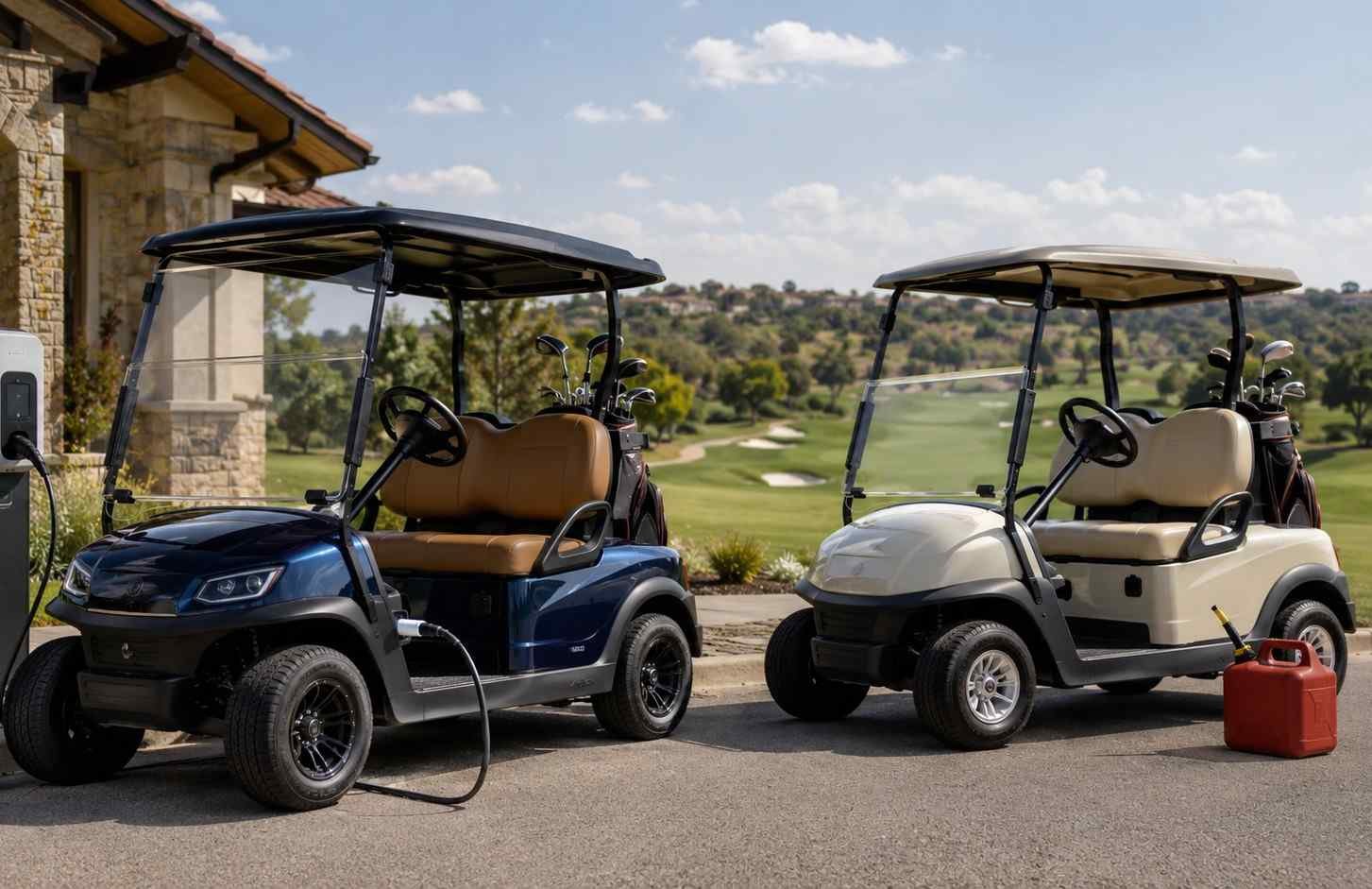
New golf cart prices start at roughly $6,000 for a bare-bones electric two-seater and climb fast once you start adding passenger seats, upgraded batteries, custom bodywork, or lifted suspensions. The majority of new carts sold in the U.S. fall between $8,500 and $12,500 for a four-passenger model with a standard feature set. That price gets you a factory warranty, a fresh battery pack (on electric), and the peace of mind that nothing has been run into a tree by a rental fleet.
New golf cart prices vary considerably by what the manufacturer includes as standard versus optional. Some brands charge extra for a windshield or a USB charging port. Others bundle them in. Always ask for an itemized quote, not a sticker price, before you compare dealers. Even golfers who usually invest in practical gear such as the best golf shoes for walking may find that cart accessories and upgrades can add far more to the final bill than expected.
My take: if you’re buying new and plan to keep the cart for six-plus years, spend the extra $1,000 to $1,500 on a lithium battery upgrade upfront. It pays for itself by year three in reduced charging time and zero battery replacement costs during that window.
Used Golf Cart Prices and Where the Real Deals Hide
Used golf cart prices range from $2,000 for a beat-up fleet cart to $9,000 for a lightly used, low-hour private cart that’s basically new. The sweet spot most buyers land on is $3,500 to $6,000, which gets you a three to five year old cart with reasonable battery life and cosmetic wear you can live with.
Fleet carts are the ones to be cautious about. Golf courses run them hard, and the maintenance records are often spotty. Private seller carts, especially those coming out of 55-plus communities where the primary use is puttering to the mailbox and back, tend to be in significantly better shape for the same price tag.
Used golf cart prices also depend heavily on battery condition. A $4,500 cart with a degraded lead-acid pack that needs replacement is really a $5,800 to $6,500 cart once you factor in a fresh set of batteries (roughly $900 to $1,500 depending on type). Always check battery manufacture date, which is stamped on each unit, before you finalize a deal.
“The single biggest mistake used golf cart buyers make is not testing the battery pack under load. A cart that drives fine in a parking lot can die on the first hill if the batteries are masking a capacity problem.” — Steve Steinbring, certified golf cart technician and contributor to Golf Cart Resource
Electric Golf Cart Cost vs. Gas Golf Cart Cost
This is the question golfers argue about in every forum thread, and honestly, the answer depends on what you’re doing with the cart. Here’s the honest breakdown.
Electric golf cart cost upfront is slightly lower than gas at comparable trim levels, usually by $500 to $1,000. Operating costs are where electric really wins. Charging a 48-volt lead-acid cart costs roughly $0.50 to $1.25 per full charge depending on your local electricity rate. If you ride 18 holes three times a week, you’re spending maybe $150 to $250 per year on power. The electric golf cart cost over a five-year period including battery maintenance typically runs $1,800 to $3,500 total in operating expenses.
The gas golf cart cost picture looks different. Gas carts average about $0.20 to $0.35 per mile in fuel costs, and if you’re putting serious mileage on a cart in a hilly neighborhood or on a large property, that adds up to $400 to $900 per year in fuel alone. Add oil changes every 125 hours of operation (roughly $40 to $80 each), air filter replacements, and spark plug swaps, and the gas golf cart cost over five years in maintenance can hit $2,500 to $4,500.
Gas wins on one dimension: range and power on grades above 15 degrees. If you have serious hills and need to pull a loaded utility bed, gas holds the edge. For everything else, electric is the smarter buy and the quieter ride.
Street Legal Golf Cart Price: The LSV Upgrade Path

A street legal golf cart price starts around $10,000 and runs to $20,000 for a purpose-built low-speed vehicle (LSV) that meets Federal Motor Vehicle Safety Standards. These carts are legally allowed on public roads with speed limits of 35 mph or less in most U.S. states, and they require features like headlights, turn signals, seat belts, rearview mirrors, and a Vehicle Identification Number.
You can also convert a standard cart into a street legal unit. Conversion kits run $1,500 to $4,000 depending on what your state requires, but you’ll also need to register the vehicle and carry liability insurance, which adds to your ongoing golf cart ownership costs. Some states are stricter than others; Florida and Arizona have well-established LSV frameworks, while states like Massachusetts and New York have more restrictive policies. The National Conference of State Legislatures maintains a current breakdown of LSV laws by state.
The street legal golf cart price premium is real, but for someone living in a planned community or resort town where the cart doubles as actual transportation, it’s often worth every cent.
Golf Cart Price by Brand: Who Charges What
The golf cart price by brand landscape is dominated by four major manufacturers, but there are meaningful differences in what you get per dollar. Here’s a snapshot of where the big names land.
| Brand | Entry Electric | Mid-Range | Premium
|
|---|---|---|---|
| Club Car | $7,500 | $10,500 | $14,000+ |
| EZGO | $7,000 | $9,800 | $13,500+ |
| Yamaha | $7,200 | $10,200 | $14,500+ |
| Star EV | $6,200 | $8,900 | $12,000+ |
| Garia (Luxury) | $18,000 | $24,000 | $35,000+ |
The golf cart price by brand split between Club Car, EZGO, and Yamaha is tighter than most buyers expect. All three are proven, parts-abundant, and dealer-supported across the U.S. The real differentiator is dealer proximity and local service reputation, not brand logo. Star EV is worth a look if you’re cost-sensitive and live near a dealer; the build quality has improved substantially since 2020.
Luxury Golf Cart Prices: The $20,000-Plus World
Luxury golf cart prices occupy a genuinely different tier. Brands like Garia, Finn, and heavily customized Club Car or EZGO builds from boutique shops command $18,000 to $35,000 and up. What are you paying for? Think hand-stitched leather seating, premium audio from brands like Rockford Fosgate, lithium iron phosphate battery packs, suspension systems borrowed from off-road UTVs, custom paint with automotive-grade clear coat, and in some cases, full climate control.
Luxury golf cart prices have climbed nearly 22% since 2021 according to market data published by IndustryARC, driven partly by pandemic-era demand from resort communities and partly by genuine innovation in lithium battery systems. If you’re buying for a private course or a lifestyle property, the luxury segment makes sense. For a guy who wants to ride 18 holes three times a week, a $10,000 Yamaha Drive2 does the same job for a third of the price.
Golf Cart Financing Cost: What Dealers Won’t Always Tell You
The golf cart financing cost reality is that most buyers aren’t paying cash. Dealer financing on golf carts typically runs at 6.9% to 12.9% APR depending on your credit score and whether you’re financing through the manufacturer’s captive lender or a third party. On a $10,000 cart with a 60-month term at 8.9% APR, your monthly payment is roughly $207 and your total golf cart financing cost over the life of the loan is about $12,420, meaning you pay $2,420 in interest.
A few things worth knowing before you sign anything:
- Manufacturer promotions sometimes offer 0% financing for 12 to 24 months, especially around late fall when dealers clear inventory. Timing your purchase in October or November can save you hundreds.
- Credit unions almost always beat dealer financing rates by 1 to 3 percentage points. Check your credit union first.
- Some lenders classify golf carts as recreational vehicles, which opens different loan products with longer terms and sometimes better rates.
- A shorter loan term hurts your monthly cash flow but saves real money on total interest paid. A 36-month term on a $10,000 cart at 8.9% costs $317 per month but only $1,417 in total interest versus $2,420 on 60 months.
Golf Cart Ownership Costs Beyond the Sticker Price
The price you pay on day one is only part of the story. Golf cart ownership costs add up steadily over time, and buyers who ignore them often feel sticker shock a few years in. Here’s what you should budget for annually once you own a cart.
Golf cart ownership costs for a standard electric cart over a typical year look something like this: electricity for charging runs $150 to $300, routine maintenance (terminal cleaning, water top-offs for flooded lead-acid, tire pressure) runs $50 to $150, and registration fees (if street legal) run $50 to $200 depending on state. If you have a lead-acid pack and it’s approaching the five to six year mark, budget $800 to $1,500 for a replacement set. Comprehensive insurance on an LSV runs $150 to $450 annually depending on coverage limits and state.
Gas cart owners can expect $400 to $900 in annual fuel, plus $120 to $300 in routine service including oil changes, filters, and belts. Engine repairs are infrequent but more expensive when they happen, with a carburetor rebuild running $150 to $350 and a starter replacement hitting $200 to $400.
Total annual ownership cost for a standard electric cart: roughly $400 to $900 in a typical year, spiking in battery replacement years. Gas: $600 to $1,300 annually. That spread, over six years, is one of the clearest arguments for electric if you’re doing the math honestly.
How Much Does a Golf Cart Cost After Customization?
Factory specs rarely stay factory specs for long. Golf cart owners are some of the most modification-happy buyers in the powersports world, and the aftermarket reflects it. Common upgrades and what they add to your total outlay:
- Lift kit (3 to 6 inch): $400 to $1,200 installed
- Larger all-terrain tires and wheels: $600 to $1,800 depending on size
- Lithium battery upgrade from lead-acid: $1,200 to $3,500
- Custom full-body wrap or paint: $800 to $2,500
- Premium audio system: $500 to $2,000
- Rear seat flip kit (2-seater to 4-seater conversion): $350 to $700
- Street legal conversion kit: $1,500 to $4,000
It’s genuinely easy to spend $4,000 to $8,000 in modifications on a cart you bought for $8,000. I’ve seen buyers end up with a $16,000 cart they could have bought finished from a luxury brand for the same money. If you know going in that you want a lifted, custom-painted, lithium-powered street legal build, price the finished product first. You might be surprised how close a turnkey custom option lands compared to DIY-ing it over 18 months.
The Decision Framework: Which Cart Fits Your Budget
Here’s a practical way to approach the decision based on your actual use case, not what sounds good in a showroom.
Step 1: Define primary use. Pure golf course use, neighborhood transportation, or property/utility work each point toward different price points and powertrain choices.
Step 2: Set a realistic total budget, not just a sticker price budget. Include your expected first-year ownership costs and any modifications you know you want.
Step 3: Decide new vs. used based on how long you’ll keep it. If you’re a three-year owner who resells and upgrades, used makes more financial sense. Keeping it a decade? Buy new with a warranty.
Step 4: Compare electric golf cart cost vs. gas golf cart cost using your specific terrain. Mostly flat with a round trip under 25 miles? Electric wins. Steep grades with heavy utility loads? Gas deserves serious consideration.
Step 5: Get at least three dealer quotes with itemized pricing. The variance between dealers on the same cart from the same brand can be $500 to $1,500, entirely due to margin flexibility.
Step 6: Check financing options before you walk into the dealership. Show up with a pre-approved rate from your credit union so the dealer knows you’re not a captive financing customer.
Step 7: Factor in the street legal golf cart price premium only if you’ll genuinely use road access. Don’t pay for LSV compliance if you’re staying on a private course or gated property where it’s not required.
The Average Price of a Golf Cart Versus What You’ll Actually Spend
The average price of a golf cart across all categories sold in the U.S. in 2023 was approximately $9,700 according to dealer association data. But averages lie to you here. That number blends $3,000 fleet retreads with $25,000 custom LSVs, so it’s not especially useful for planning your specific purchase.
A more useful frame: the average price of a golf cart for a new four-passenger electric model from a major brand with standard features sits right at $9,500 to $10,500. If you’re buying in this range, you’re squarely in the mainstream of the market, which means good parts availability, established resale value, and easy dealer access for service.
Budget below $5,000 and you’re in the used market full stop. Budget above $15,000 and you’re adding features or buying a street legal build. Everything in between is negotiation territory.
Your specific number depends on five things: new versus used, electric versus gas, whether you need street legal status, how much you’re willing to spend on ownership per year, and which brand has the strongest dealer network in your area. Get those five answers locked in before you start shopping and you’ll spend a lot less time confused on a lot than you otherwise would.
The golf cart market is bigger and more varied than most first-time buyers realize. Just as there are golf accessories beginners do not need, there are also golf cart upgrades and extras that can push the price higher without adding much practical value. Go in with your numbers clear, and you’ll find the right cart at the right price. What’s driving your interest in a golf cart right now, and has the cost side of the decision been holding you back?