
Here’s the honest answer most courses won’t tell you: a 9-hole round typically runs between 1.5 and 2.5 hours, and that gap is enormous when you’re planning your morning. The variance depends on whether you’re walking or riding, playing alone or in a group of four, and whether the course is packed or practically empty.
If you’ve ever blocked out two hours and found yourself still on the 8th green as your afternoon falls apart, you already know this matters. This guide breaks down the actual time you should expect for every combination of group size, transport, and skill level, so you can plan your round with real confidence.
How Long Does It Take to Play 9 Holes of Golf: The Core Numbers
The average time for 9 holes of golf lands right around two hours for a typical two-player group riding a cart on a moderately busy course. That’s the baseline most golfers should use when scheduling a round. But “typical” hides a lot of variation, so let’s get specific.
According to data compiled by the United States Golf Association’s pace of play guidelines, a well-managed 18-hole course expects players to complete 18 holes in about four hours with a cart. That projects each nine holes at roughly two hours under ideal conditions. Real-world play routinely runs 15 to 30 minutes longer.
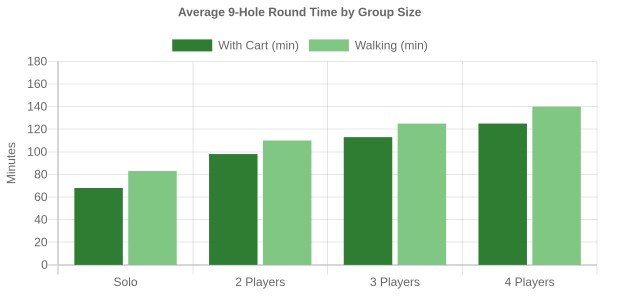
The table below gives you the numbers organized by group size and format, based on widely published course expectations and golfer community reporting.
| Scenario | With Cart | Walking
|
|---|---|---|
| Solo player | 60 to 75 minutes | 75 to 90 minutes |
| Two players | 90 to 105 minutes | 100 to 120 minutes |
| Three players | 105 to 120 minutes | 115 to 135 minutes |
| Four players | 115 to 135 minutes | 130 to 150 minutes |
How Long Does Solo 9 Holes Take?
How long does solo 9 holes take? If you get on an empty course first thing in the morning, you can realistically finish in 60 to 75 minutes with a cart. Walking solo, plan for 75 to 90 minutes. That’s genuinely the best-case golf scenario most of us ever get.
Solo play moves fast because you’re making one decision per shot instead of three or four, there’s no waiting for someone to mark their ball or line up their putt for the fifth time, and you can move to your ball the moment your club is back in the bag. I genuinely think every golfer should play at least a few solo rounds per season. You’ll find out exactly how your own pace compares to your group’s pace, and the answer is often revealing.
The one catch: many courses will pair solo players with other groups during busy periods, which immediately moves your time into the two-player or three-player column. Calling ahead and asking about the tee sheet before you show up alone is worth the two-minute phone call.
How Long Does 9 Holes Take for Two Players?
Two players hit a sweet spot. You still have someone to talk to, the competition stays interesting, and you’re not spending three extra minutes per hole watching a third or fourth player hit. If you and a buddy tee off before 8:00 a.m. on a weekend with a cart, finishing in 90 minutes flat is absolutely doable. That leaves you the rest of the morning and costs you almost nothing in terms of schedule disruption.
The main time killers for two-player rounds are searching for lost balls (which costs you five minutes per search if you’re following the rules, or two minutes if you’re playing ready golf) and slow greens where both players three-putt repeatedly. More on how to fix both of those below.
How Long Does 9 Holes Take for Four Players?

How long does 9 holes take for four players is where the honest answer starts to stretch. You’re looking at 1 hour 55 minutes to 2 hours 15 minutes minimum with two carts and a reasonably clear course. On a busy weekend, that same foursome could easily take 2 hours 30 minutes to 2 hours 45 minutes.
Four players generate four times the shot decisions, four separate routines, four separate pre-shot processes. On a par-4 hole with a 400-yard carry to the green, a foursome might stand on the tee for four to six minutes before the last player hits. Multiply that by nine holes and you’ve added 36 to 54 extra minutes compared to a solo round. That math is why slow play on packed courses is almost always a foursome problem, not a course design problem.
The good news is that foursomes can actually play efficiently when everyone commits to ready golf. Playing when you’re ready, instead of by strict honor order, shaves 15 to 25 minutes off a nine-hole round. The PGA of America has published specific pace guidance confirming that ready golf is now officially encouraged in recreational play, and most public courses support it explicitly.
Walking vs Cart 9 Hole Time: What the Difference Actually Costs You
The walking vs cart 9 hole time gap is real but smaller than most people expect. Riding a cart typically saves you 15 to 25 minutes over nine holes compared to walking, depending on course layout and how spread out the holes are. On a tight, compact layout, that gap shrinks to 10 minutes. On a links-style course where the holes zigzag across wide terrain, the cart advantage grows closer to 30 minutes.
What makes the difference isn’t just travel speed. Carts let you drop one player at their ball while the other drives ahead, which is a genuine time multiplier. Two players in a cart playing efficiently essentially create a mini-assembly line of shots. Walking players have to converge at each ball sequentially, which adds up.
That said, I’d still walk when I can. You think more clearly, your rhythm is better, and the round feels more like golf and less like a shuttle service. If your goal is maximum speed, take the cart. If your goal is the best golf experience in a reasonable window, walking a nine-hole course at a smart pace is my preference every time.
9 Hole Golf Time for Beginners
9 hole golf time for beginners is the scenario where the time estimates expand the most. A beginner foursome on a public course could take 2 hours 45 minutes to 3 hours 15 minutes for nine holes, and that’s not unusual or embarrassing. It’s just physics. More shots per hole equals more time per hole.
A beginner might take six, seven, or eight shots on a par-4 hole where a mid-handicapper takes five. That extra one or two shots per hole across nine holes adds 15 to 30 minutes to the round. Add in the learning curve for cart operation, reading yardage markers, and figuring out green speed, and the time grows further.
The practical fix for beginners is picking up once you hit a score of double par on any hole. If the hole is a par 4, pick up after 8 shots. You’re protecting the course’s pace, you’re protecting your own enjoyment, and you’re still learning the game. The Rules of Golf explicitly allow maximum score formats in recreational play for exactly this reason. No shame in using them.
“The single biggest thing a beginner can do for pace of play is be ready to hit when it’s their turn. Walk to your ball while others are hitting. Know your yardage before you reach your ball. Make one practice swing, not three. That alone cuts 20 minutes off a round.”
Mike Hebron, PGA Master Professional and Golf Digest Top Teacher, speaking on beginner pace of play strategy in published instructional content.
Factors Affecting 9 Hole Round Time

The factors affecting 9 hole round time fall into categories that are either within your control or completely outside it. Knowing which is which helps you stop blaming the wrong thing.
Course traffic is the biggest external factor. A course running one tee time every 7 minutes will back up into 2.5-hour nine-hole rounds by midmorning. A course running tee times every 10 minutes stays cleaner. Tee time spacing is a management decision you can’t change once you’re on the course, but you can choose when you play.
Course design matters more than most people realize. Long walks between greens and next tees, forced carries that create high ball-loss rates, and blind shots that require extra surveying all inflate your time. A 3,200-yard nine-hole layout with compact routing plays 20 minutes faster than a 3,600-yard course with wide spacing between holes, even at the same skill level.
Other significant factors affecting 9 hole round time include:
- Weather conditions, since wind and rain slow every decision and every shot by a noticeable margin
- Green speed and slope, because faster greens cause more three-putts and more time reading lines
- Ball-striking consistency across the group, since fewer off-target shots means fewer searches and faster progression
- Pre-shot routine length, which is the single most controllable personal factor and the one most golfers never examine honestly
How Long Is a 9 Hole Round When the Course Is Busy?
Asking how long is a 9 hole round on a crowded Saturday morning is a different question than asking the same thing on a quiet Tuesday. Course congestion can add 30 to 60 minutes to your total time compared to an empty course, and there’s very little you can do about it once you’re sandwiched between two slow groups.
The 9-hole golf pace of play breaks down during peak hours because each group backs up against the group ahead. Even if your foursome plays efficiently, if the group in front takes 25 minutes per hole, you will take 25 minutes per hole too. You should still replace divots on the golf course promptly without delaying the group behind. The only real defense against major backups is choosing your tee time strategically.
Early morning tee times, specifically the first or second slot of the day, are your best bet for a quick round. Twilight rounds starting in the late afternoon work well too, especially on weekdays. Midmorning weekend tee times almost always mean congestion. That’s not a complaint about other golfers. It’s just how demand works on a finite piece of land.
How to Play 9 Holes Faster: A Practical System
Knowing how to play 9 holes faster isn’t really about rushing. It’s about eliminating the dead time that accumulates without you noticing. Here’s the system I’d hand to any golfer who wants to cut 20 to 30 minutes off their nine-hole time without sacrificing their enjoyment.
The Ready Golf Protocol for a Nine-Hole Round
- While others are hitting, walk directly to your ball. Do not stand and watch every shot if your ball is 80 yards away. Get there.
- Determine your club and yardage before you arrive at your ball, using the cart’s GPS or a rangefinder in your pocket during transit.
- Limit your pre-shot routine to one practice swing maximum. Study after your round, not before each shot.
- On the green, read your putt while others are putting. Do not begin reading when it’s your turn.
- When someone hits out of bounds or loses a ball, immediately offer to play a provisional from the tee instead of walking forward and then walking back. Nine holes of lost balls at two provisional skips per search saves you 10 to 15 minutes alone.
- Leave the flagstick in and putt out continuously when you’re close. Walking back and forth to replace the flag on every short putt costs 45 seconds per hole across nine holes. That’s almost 7 minutes total for nothing.
- After putting out, walk directly to the next tee. Do not stop at the cart to record scores. Record them while riding or at the next tee while others are teeing off.
These aren’t tips for people who play badly. Tour professionals use variations of every one of them. The difference is that at the recreational level, nobody enforces the discipline, so it disappears. Pick two of these and apply them consistently, and your average time for 9 holes of golf will drop noticeably within a single round.
How Long Does It Take to Play 9 Holes of Golf: The Right Expectation by Format

To close the loop on how long does it take to play 9 holes of golf in every format you’ll actually encounter, here’s the quick reference summary you can bookmark.
Solo with a cart on an open course: 60 to 75 minutes. Solo walking: 75 to 90 minutes. Two players with a cart playing ready golf: 90 to 105 minutes. Two players walking: 100 to 120 minutes. Four players with two carts on a moderately busy course: 115 to 140 minutes. Beginners in a group of four: plan for 150 to 195 minutes and enjoy the process instead of watching the clock.
The 9 hole golf pace of play that courses aim for is typically around two hours for a standard group. That’s what course staff are tracking, and it’s a reasonable community standard. Falling within that window keeps everyone behind you happy and keeps the course running smoothly for the rest of the day.
And understanding how long does 9 holes take for two players versus four players, walking versus riding, beginner versus experienced, is really about respecting your own time as much as anyone else’s. You can get a genuinely great golf experience in 90 minutes. You don’t need four hours to feel like you played real golf. Nine holes is real golf.
Final Thought
Golf doesn’t have to eat your entire day. A nine-hole round, played with a little awareness of your own pace and the group around you, fits into a morning, a lunch break, or the hour before sundown. The number that matters most isn’t the one on the scorecard.
The real question is whether your group is moving in a way that lets everyone on the course, including you, enjoy the time they carved out. So: how long does your nine-hole round actually take, and how much of that is dead time you could take back starting this weekend?
Check out the Tappers Golf blog for more practical round-by-round golf advice, gear guides, and course strategy content that helps you play better and smarter every time you tee it up.