

There is a funny thing about golf: you can walk off the 18th green feeling like you played well and still wonder where those extra strokes came from. Maybe the driver felt solid, your irons looked better than usual, and you even made a few clutch putts. Yet the scorecard tells a slightly different story. Memory is not always the best statistician, especially after a round filled with good shots, bad breaks, and a few “I swear that went farther yesterday” moments.
That is where golf shot tracking becomes useful. Instead of relying on what you remember, you can look at what actually happened. GPS apps, club sensors, and other tracking tools can record shot location, club choice, distance, and outcomes. Over several rounds, those details start forming a picture of your game. More importantly, they can show you what deserves your attention next.
What Your Golf Data Can Reveal

The biggest benefit of tracking is not having more numbers to stare at. It is discovering patterns that are easy to miss while playing.
Your Actual Club Distances
Most golfers have a “best-ever” number for almost every club. That one perfect 7-iron that flew 165 yards becomes the number they remember when standing over the next shot. The problem is that your best golf shot is not necessarily your normal shot.
Tracking gives you a more realistic picture of your performance average. You can see how far a club usually carries, how much distance varies, and whether certain clubs have gaps that make course decisions harder.
That changes club selection. If your 7-iron normally carries 148 yards rather than 160, choosing it based on the bigger number could leave you short more often than you realize. Reliable distances are far more useful than impressive ones.
Your Real Dispersion Pattern
Distance is only half the story. You also need to know where the ball tends to finish.
A golfer might describe their driver as having a slice, for example, when their actual pattern is more specific. Maybe most misses start slightly right and finish farther right, while their irons tend to miss short and left. Those are two different problems and should not be treated as one.
Shot tracking can turn those tendencies into a visual pattern. Seeing where your shots cluster helps you understand your normal landing zone instead of focusing on one unusually good or bad shot.
That information can also change how you aim. Rather than automatically aiming at the center of every fairway or firing directly at every flag, you can account for your normal miss and choose targets that leave more room for error.
Find Out Where You’re Actually Losing Strokes
A scorecard tells you how many strokes you used. It does not always explain why.
This is where strokes gained becomes particularly useful. The system compares the value of your shots against a benchmark and breaks performance into areas such as driving, approach, short game, and putting. The PGA TOUR uses the same broad framework to evaluate professional performance.
For an everyday golfer, the idea is simple: you may think putting is destroying your score because you remember those three-putts, but your approach play might actually be costing you more.
Imagine making several long putts during a round but missing greens from distances where you should be giving yourself better birdie or par opportunities. Your putting numbers might look memorable, but the larger issue could be your approach shots.
That is why golf shot tracking for improvement works best when you use it to diagnose the cause rather than simply count mistakes.
Turn Your Data Into Better Practice
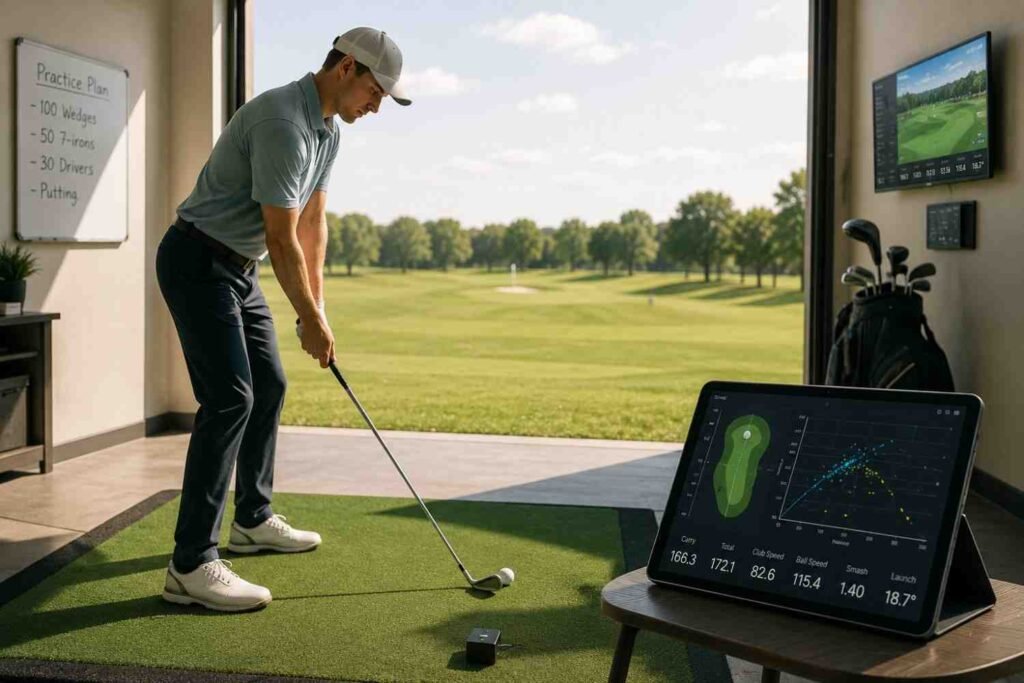
Once you know where the problem is, practice becomes much easier to plan.
Instead of spending 45 minutes hitting every club in your bag, look at what repeatedly costs you strokes. If your approach shots from 150 to 175 yards are consistently short, spend more time working on distance control in that range. If your driver dispersion is wide, work on a more reliable tee-shot pattern rather than chasing another five yards.
The same idea applies around the green. If you regularly need two chips to reach putting range, that is more useful information than simply knowing your total number of putts.
The goal is data driven golf improvement, where your practice responds to evidence instead of whatever part of your swing happens to feel frustrating that day.
Give the Data Enough Time
One round can be misleading. Wind, unusual lies, course setup, nerves, and simple bad luck can all distort your numbers.
Look for patterns across multiple rounds before making major changes. A bad driving day does not automatically mean your driver needs replacing. A great putting day does not necessarily mean you have suddenly become an elite putter.
The more shots you record, the easier it becomes to separate a genuine tendency from a random result.
Shot Tracking Can Improve Course Strategy, Too
Not every improvement comes from changing your swing.
Your data can also show whether you are making poor decisions. Maybe you regularly choose an aggressive club when a safer option would leave you with a better angle. Maybe you attack pins that bring trouble into play. Or perhaps your numbers show that your reliable miss is different from what you assumed.
Weather adds another layer. If you frequently struggle when the wind picks up, tracking those rounds can help you understand how much distance and direction change in different conditions. Combining that information with golf techniques for windy conditions can help you make smarter club and target choices instead of simply swinging harder.
Good course management often means accepting that your safest shot is not always the most exciting one.
You Don’t Need to Track Everything

It is easy to get carried away with golf technology. Once you see a dashboard filled with statistics, every number can suddenly feel important.
It isn’t.
Start with a few measurements that answer useful questions:
- How far do I actually hit each club?
- Where do I normally miss?
- Where am I losing the most strokes?
- Which situations create the most trouble?
You can track these manually through a smartphone app or use systems that automatically capture shots through sensors and GPS. The right option depends on how much detail you want and how much effort you want to spend recording your rounds.
The important part is consistency. A simple system you actually use is more valuable than sophisticated technology that sits unused after two rounds.
When Your Golf Game Starts Telling the Truth
Golfers naturally build stories about their own games. We know which club we “usually hit well,” which hole always ruins the round, and which missed putt we cannot stop thinking about. Sometimes those stories are accurate. Sometimes they are based on a handful of memorable shots. Tracking gives you a chance to replace those assumptions with a broader view of what is really happening.
Over time, the useful patterns become harder to ignore. You may discover that your driver is not the problem you thought it was, that your approach distances deserve more practice, or that a few avoidable decisions are quietly adding strokes. That is the real value of tracking. It turns improvement from a vague goal into something you can observe, test, and adjust.
Better golf does not always require more practice. Sometimes it starts with knowing exactly what to practice.
Frequently Asked Questions: Golf Shot Tracking for Improvement: What Your Data Reveals
1. What is golf shot tracking?
Golf shot tracking records information about your shots, such as club used, distance, location, and outcome. Depending on the technology, the information can be recorded manually or captured automatically using GPS, sensors, or other tracking systems.
2. Can golf shot tracking really lower my score?
It can help you identify patterns that are difficult to recognize from memory alone. When you use those patterns to improve practice, club selection, target selection, and course management, tracking can support better scoring.
3. How many rounds should I track before analyzing my data?
There is no universal number, but several rounds will provide a more useful picture than one. Focus on recurring patterns rather than reacting to a single unusually good or bad round.
4. What golf statistics should beginners track first?
Start with club distances, fairway or tee-shot tendencies, greens hit, short-game results, putting, and common misses. Once you become comfortable with those numbers, you can explore more detailed metrics such as strokes gained and dispersion.