

Jon Rahm was born with a club foot on his right side, and most kids with that condition are steered away from athletic careers before they even pick up a sport. Rahm went the other direction. He became World No. 1, won the Masters, captured the U.S. Open, and built one of the most recognizable swings on tour, all with a physical condition that visibly shortened his right leg follow-through and shaped every single mechanical choice he has ever made at address.
This article breaks down what the jon rahm club foot actually is in golf-mechanical terms, how it influences his setup and tempo, and what every serious golfer can learn from watching how he plays around a structural limitation rather than pretending it doesn’t exist.
What the Jon Rahm Club Foot Actually Means for His Golf Mechanics

A club foot is a congenital condition where the foot is rotated inward and downward at birth. Rahm had corrective treatment as a child, which is standard practice, but residual effects on ankle mobility, foot rotation, and leg length perception remain throughout life. You can actually see this when you watch Rahm walk the fairway at Augusta or Torrey Pines. His right foot has a subtly different plant than a player with two fully symmetrical feet.
In a golf swing, your trail foot (right foot for a right-handed player) is the anchor of your backswing. It needs to accept weight, allow hip rotation, and then transfer force forward during the downswing. When that foot has restricted mobility, the entire kinematic chain adjusts. Jon Rahm’s swing adapted around this reality.
His backswing is notably short by tour standards. He doesn’t get the club parallel to the ground at the top. That’s not a flaw he never corrected; it’s the mechanical ceiling his right foot and ankle impose. But his transition is explosively fast, his hip speed through impact is elite, and his lag retention is extraordinary.
He generates clubhead speed that ranks consistently among the top 20 on the PGA Tour despite the abbreviated arc. According to PGA Tour ShotLink data, Rahm has regularly averaged over 119 mph of clubhead speed with his driver, a number that would be considered excellent for a player with a textbook full swing.
The jon rahm club foot essentially forced him to build power through speed and rotation rather than through width and arc length. Most amateurs try to lengthen their swing to add distance. Rahm’s entire career proves that’s not the only route.
How Jon Rahm Built a World-Class Game Around a Physical Reality
 Image Source: Wikipedia
Jon Rahm grew up in the Basque Country of Spain, a region with a deep golf culture centered on work ethic and ball striking precision. He came through the collegiate system at Arizona State University, where he was coached by Tim Mickelson and became the No. 1 ranked amateur in the world. Through all of it, the jon rahm club foot was a constant variable, not an excuse but a real constraint he engineered around.
His setup reflects this engineering clearly. Rahm plays with a slightly wider stance than most tour players his height. He flares his right foot out more than average, which is a direct compensation for reduced internal rotation at the ankle and lower leg. By pre-rotating the foot, he creates the hip turn he needs without demanding maximum ankle mobility mid-swing.
“He has one of the most efficient swings I’ve ever analyzed. The clubhead speed he generates from that short arc is a product of incredible sequencing. There’s very little wasted motion.” This assessment from renowned swing analyst and Golf Digest contributor Brandel Chamblee summarizes what coaches have noted for years about Rahm’s movement efficiency, as discussed in detail on the Golf Digest swing analysis feature covering his peak form.
The wider stance also lowers his center of gravity slightly, which adds stability to a swing that relies more on rotational torque than on a massive weight shift. Watch his right heel during the backswing. It barely comes off the ground. That’s the club foot influencing his trail side weight management in real time.
The Swing Mechanics Table: Rahm vs. Tour Norms
| Swing Attribute | Jon Rahm | Tour Average | Primary Cause
|
|---|---|---|---|
| Backswing Length | Below parallel (~80% of parallel) | Parallel or slightly past | Restricted trail ankle mobility from club foot |
| Stance Width | Wider than average for height | Shoulder-width | Stability compensation for trail foot |
| Right Foot Flare | 25 to 30 degrees | 10 to 20 degrees | Pre-rotation to allow hip turn without ankle strain |
| Trail Heel Lift | Minimal in backswing | Moderate lift common | Limited dorsiflexion in right ankle |
| Clubhead Speed (driver) | ~119 mph | ~113 mph | Rotational speed compensates for shorter arc |
| Hip Rotation Speed | Top 10 on tour | Median | Primary power source given arc limitation |
Sources for this table draw from PGA Tour official statistics and published swing analysis work from the 2022 and 2023 seasons.
What Golfers Can Actually Take From Watching Jon Rahm

Here’s where the conversation shifts from observation to application. The jon rahm club foot story isn’t just inspiring in an abstract sense. There are three concrete mechanical lessons in his game that any golfer, regardless of physical limitation, can study and apply.
Rotation beats arc length for most amateurs.
The majority of recreational players try to get the club parallel at the top because they saw it on television. Rahm gets nowhere close to parallel and still outdrives 95% of club golfers. If your backswing is shorter than you’d like due to flexibility, age, or physical structure, focus on hip rotation speed through impact instead. That’s the Rahm lesson.
Foot position is a dial, not a fixed setting.
Rahm flares his right foot to unlock the hip turn he needs. You can experiment with this. Try moving your trail foot from 10 degrees of flare to 20 to 25 degrees and notice how much easier your backswing feels. This single adjustment unlocks rotation for millions of golfers who have tight hips and never understood why.
A wider stance buys stability at the cost of lateral motion.
Rahm’s wider base means he doesn’t slide as much laterally as some big hitters. That keeps his impact position consistent. If you’re a player who comes over the top or loses your spine angle, trying a slightly wider stance could anchor your rotation and clean up your path.
Jon rahm didn’t stumble into these solutions. They were worked out methodically over years of elite coaching, and they make total sense once you understand the structural reason behind each one.
Jon Rahm’s Major Wins: Performance Through Adaptation
Jon rahm has won the U.S. Open at Torrey Pines in 2021, one of the most demanding setups in major championship golf, where long grass and narrow fairways punish inconsistency more than almost anywhere else. He won the Masters in 2023, shooting a final round 69 at Augusta National under Sunday pressure. Both courses demand sustained precision, not just occasional brilliance.
The argument that the jon rahm club foot somehow limited his ceiling is completely dismantled by that record. At the time of his Masters victory, Rahm had 22 professional wins worldwide, including two major championships, a World No. 1 ranking, and a Ryder Cup career in which he was nearly unbeaten in singles play.
His stat profile at those major wins is worth a close look:
- 2021 U.S. Open: 67-75-72-67, finishing at 6 under, the only player in the field to break 70 in both the first and final rounds on that setup.
- 2023 Masters: 65-69-71-69, a four round total of 274, 12 under par, with a consistent ball striking average that led the field in greens in regulation over the week.
- Ryder Cup 2023 in Rome: Rahm went 5-0-0 at Marco Simone Golf Club, the most dominant individual performance in that team competition in years.
None of that happens without a swing and a mindset specifically engineered to perform under pressure. The jon rahm club foot is part of that engineering story, not a footnote to it.
A Practical Checklist: Applying the Rahm Framework to Your Own Game
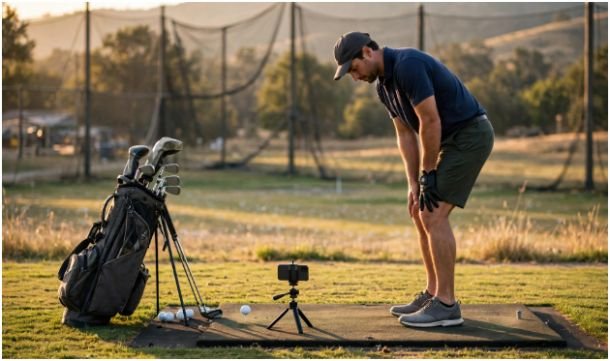
The “Rahm Adaptation Framework” is what I’d call the system he’s built, and it has five practical checkpoints you can run through on the range the next time you’re working on your ball striking.
- Check your trail foot angle first. Before you even grip the club, look down and confirm your right foot is flared out enough to permit a full hip turn. If your foot is pointed too much at the ball, your hip rotation will stall before you reach the top. Golf stretches for tight hips can help your hips rotate without causing soreness to your body.
- Set your stance width deliberately. Take your normal stance, then move each foot out one inch. Notice if your balance improves and your center of gravity drops slightly. Many golfers find this one adjustment alone tightens their impact position.
- Stop chasing parallel at the top. Film your swing from the face-on view and check where the club is at the top. If you’re already at 80 to 90% of parallel, you have enough arc. Additional length from forcing it past that point often costs you a solid pivot.
- Focus the downswing thought on hip speed, not arm speed. Rahm’s transition is a hip-led explosion. Try a drill where you consciously fire your left hip toward the target as your first downswing move. Let the arms follow. This is where most of his power is generated.
- Monitor your trail heel in the backswing. If your right heel is flying up high before you reach the top, your stance may be too narrow or your foot flare too limited. A slightly grounded heel generally means a more stable pivot and better sequencing into transition.
How the Golf World Responded to Rahm’s Physical Story
When Rahm first drew widespread attention during his Arizona State years and early PGA Tour starts, commentary about the Jon Rahm club foot was surprisingly limited in mainstream golf media. Most coverage treated it as a brief biographical detail rather than a central part of his mechanical story. That changed as analysts began looking closer at why his swing looked so different from the standard tour model.
The golf coaching community, particularly the biomechanics-oriented coaches who publish on platforms like MySwingEvolution and GolfWRX forums, began documenting the connection between his foot condition and his setup choices around 2019 and 2020.
The discussion threads on GolfWRX, one of the internet’s most respected technical golf communities, noted clearly that his right foot setup was unlike almost any other top-ranked player, and that the explanation traced directly to his congenital condition and the compensations built over a lifetime of elite practice.
What you see in that community consensus is respect, not pity. Golfers who study the game mechanically tend to admire efficient adaptation more than textbook perfection. Rahm gives them plenty to admire.
Does Adapting Around a Limitation Actually Make You a Better Ball Striker?
This is a question worth sitting with seriously. There’s a reasonable argument that adapting around a constraint forces you to build a fundamentally more efficient motion, because every inefficiency becomes costlier when your margin is smaller. Rahm can’t afford to waste rotation or lose lag because he doesn’t have the arc length to recover distance lost from poor sequencing. So his sequencing became elite.
Compare this to players with elite flexibility and length who sometimes develop sloppy transitions because raw physical gifts paper over mechanical errors. Jon Rahm’s entire career suggests that building precision around a real constraint produces a more durable skill set under pressure.
His short game is also exceptional, which makes sense. When you can’t guarantee a certain carry distance on every driver swing, you become obsessed with controlling what you can, and that mindset tends to produce a very fine touch around the greens.
You don’t need a club foot to apply this principle. Any golfer who does drills and pre and post-round golf stretching, and identifies a real limitation in their game, age-related flexibility loss, a shoulder restriction, a shorter left arm, and then engineers around it rather than fighting it, is following the same playbook that produced two major champions.
Jon Rahm Club Foot: The Takeaway Every Golfer Should Carry
The jon rahm club foot story is ultimately about the relationship between physical reality and mechanical creativity. Rahm didn’t choose his starting conditions. But every choice he made from his right foot position, to his stance width, to his commitment to rotational speed as a power source, reflects a golfer who studied his own body honestly and built something specific rather than something generic.
Jon rahm is currently competing on the LIV Golf Tour after a headline-grabbing move in late 2023, and his game remains at the elite level it’s occupied for the better part of a decade. The swing is the same. The foot is the same. The results continue to follow.
Next time you’re on the range, set up in front of your phone camera, film your trail foot position and your backswing length, and ask yourself honestly whether you’re working with your actual physical structure or working against it. The answer to that question, more than any tip or drill, is what separates persistent improvers from golfers who stall at the same level for years. Rahm figured that out early. You can start figuring it out today.