

If Saturday is your main golf day, Friday should not feel like leg day. A golf fitness routine for weekend golfers should build strength, mobility, balance, and rotational control without leaving you stiff when the score actually counts.
I prefer a simple rule: build Tuesday, sharpen Thursday, prime Saturday. It gives the body enough training to improve while keeping the weekend round at the center of the plan.
Why Weekend Golfers Need a Different Fitness Plan
The challenge for most recreational players is not finding harder exercises. It is placing the right exercises on the right days.
A demanding lower-body session late Friday can make Saturday rotation feel slow. At the other extreme, doing nothing all week means your first explosive movement may happen while swinging a driver.
That is why I build a golf fitness routine for weekend golfers around three jobs: improve usable mobility, strengthen key movement patterns, and arrive at the course feeling fresh.
Golf research supports including dynamic movement. A systematic review found that dynamic and resistance-based warm-ups tended to improve golf performance measures. Static-only stretching was less useful immediately before play.
Another study found dynamic stretching produced higher clubhead and ball speeds than static stretching or no stretching.
Quick-Reference Weekly Golf Fitness Plan
| Day | Focus | Time | Intensity |
| Tuesday | Strength + mobility | 30–40 min | Moderate |
| Thursday | Balance + rotation | 20–30 min | Light–moderate |
| Saturday | Dynamic warm-up | 5–10 min | Progressive |
| Sunday | Recovery/walking | Optional | Easy |
This Build–Sharpen–Prime format is the original element I use to keep training from competing with golf.
Tuesday: Build Golf Strength and Mobility
Tuesday is the main workday in my golf fitness routine for weekend golfers. I want enough resistance to challenge the legs and trunk, without chasing soreness.
Mobility Preparation
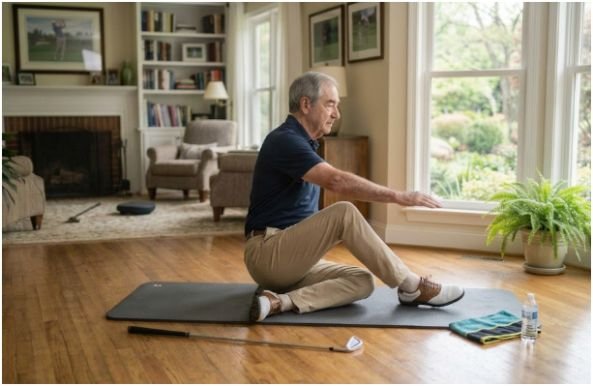
Start with 90/90 hip transitions for six controlled repetitions per side. Then perform thoracic open books and a hip-flexor lunge with rotation.
These movements prepare two important areas for golfers: the hips and upper back.
Mayo Clinic notes that the golf swing requires coordinated hip and upper-back rotation. Restricted movement can make the lower spine compensate for missing rotation.
Spend five minutes here. The goal is smoother motion, not forcing your joints into extreme positions.
Strength and Stability
I would then choose four movements:
- Glute bridge
- Squat or split squat
- Single-leg Romanian deadlift
- Bird dog
Perform two or three sets of roughly 6–12 controlled repetitions. On bird dogs, use slower repetitions instead of chasing a high number.
Stop each strength set while your technique still looks clean. Weekend golfers rarely need a bodybuilding-style session that leaves them struggling with stairs for three days.
For a simpler equipment-free variation, easy golf exercises for seniors at home can provide useful alternatives to loaded lower-body movements.
Golf-specific resistance training has been proposed as a way to support swing performance, physical fitness, and injury-risk management in recreational players.
Thursday: Balance and Rotational Training
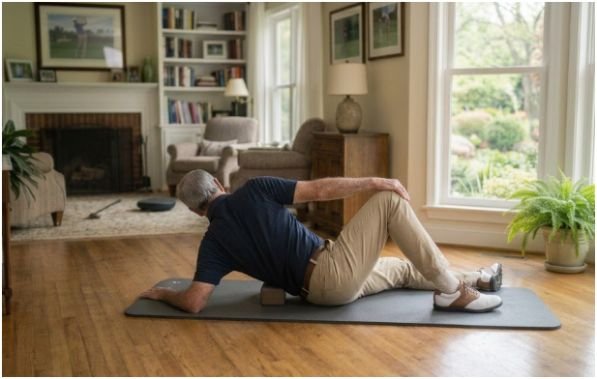
Thursday is different. This part of my golf fitness routine for weekend golfers should make you feel sharper rather than exhausted.
Keep the session to about 20–30 minutes.
Golf Balance Exercises
Start with single-leg balance reaches. Stand on one leg and reach the free foot forward, sideways, and slightly behind you.
Perform five controlled reaches in each direction.
You can then add single-leg RDLs without weight. The objective is control through the foot, ankle, hip, and trunk.
For golfers who need a more gradual progression, balance exercises for senior golfers at home fits naturally here.
Balance training is especially relevant as golfers age. ACSM notes that structured exercise can help older adults maintain strength and balance.
Rotational Core Training
Next, use Pallof presses and light resistance-band rotations.
For Pallof presses, stand sideways to an anchored band. Press your hands away from your chest without allowing the torso to turn.
Then perform controlled band rotations from an athletic golf-style stance.
I use two sets rather than turning Thursday into another heavy workout.
A useful golf fitness routine for weekend golfers teaches the body both to create rotation and resist unwanted rotation.
Mobility Exercises for a Better Golf Swing
Golf mobility does not mean becoming as flexible as possible. I care more about movement you can control.
For the hips, I favor 90/90 transitions and lunges with rotation. For the thoracic spine, I use open books or standing club rotations. For the shoulders, controlled arm circles and wall slides work well.
Long static stretches can fit after exercise or during separate mobility sessions. Immediately before golf, I prefer movement-based preparation.
Mayo Clinic advises warming muscles with light activity before deeper stretching and recommends roughly five to ten minutes of warm-up before a golf round.
Building Golf Strength Without Weekend Soreness

More work is not automatically better work.
The hardest part of programming a golf fitness routine for weekend golfers is managing fatigue. Your training has failed its practical purpose if Thursday destroys Saturday.
I use a simple readiness test: Thursday’s session should leave you feeling more coordinated when you finish than when you started.
Golfers who recover more slowly can reduce sets, use bodyweight variations, or move the harder session earlier in the week.
Players who want more age-specific modifications can use the golf fitness routine for golfers over 50 for additional strength, mobility, and recovery options.
Pain is different from normal exercise effort. Persistent back, hip, knee, or shoulder pain warrants individual assessment rather than simply adding more stretching.
The 5-Minute Pre-Round Golf Warm-Up
Saturday is not another training session. It is the “prime” phase of the golf fitness routine for weekend golfers.
Start with one minute of brisk walking and relaxed arm swings. Then perform eight bodyweight squats and six standing rotations per side.
Add a few controlled hip-opening steps.
Finish with five practice swings. Begin around half speed and gradually build toward your normal playing tempo.
A systematic review found dynamic warm-ups generally performed better than static-only stretching for golf performance.
The progression matters. I do not want the first full-speed swing of the morning happening over a golf ball.
What Weekend Golfers Should Avoid
I would avoid high-volume leg training immediately before the round. The same applies to repeated maximal jumps, exhausting rotational circuits, or turning Friday into a personal-record session.
That does not make squats, deadlifts, or power exercises bad. Their placement matters.
I would also avoid making long passive stretching your entire pre-round routine. Dynamic movement has stronger golf-specific support before performance.
A sustainable golf fitness routine for weekend golfers should complement your golf schedule rather than compete with it.
Your Weekend Scorecard Starts Midweek
The gym does not hand out birdies.
My Build–Sharpen–Prime approach keeps the purpose clear: Tuesday develops capacity, Thursday improves control, and Saturday prepares you to swing.
Run the golf fitness routine for weekend golfers consistently for six to eight weeks before adding more exercises. Progress gradually by improving control, adding a few repetitions, or using slightly more resistance.
Your next step is simple: put the Tuesday and Thursday sessions on your calendar before your next weekend round. Your Saturday legs may thank you.
FAQs
1. What is the best golf fitness routine for someone who plays on weekends?
Use one moderate strength session early in the week, one lighter balance and rotation session later, then a dynamic warm-up before your round.
2. How many times per week should a weekend golfer exercise?
Two focused midweek sessions are a practical starting point, especially when combined with a short pre-round warm-up.
3. Should golfers lift weights the day before playing?
I generally avoid demanding strength sessions the day before golf because unnecessary fatigue can interfere with movement quality.
4. What should I do before a Saturday morning golf round?
Spend five to ten minutes on brisk movement, dynamic mobility, bodyweight squats, rotations, and progressively faster practice swings.