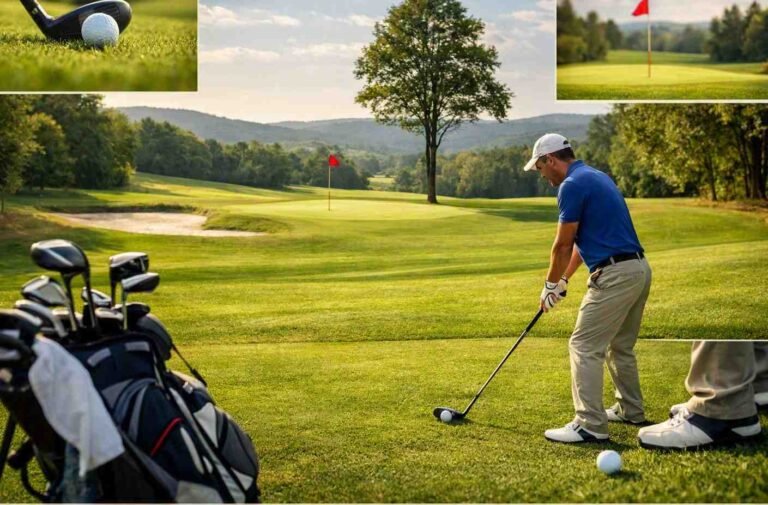
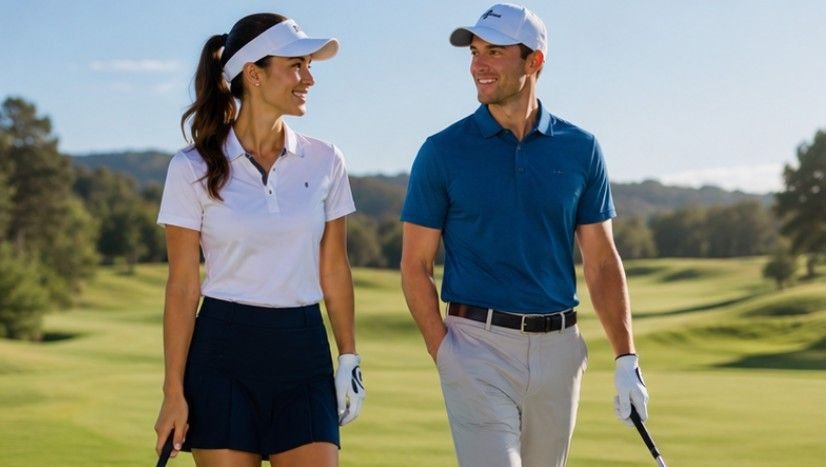
You do not need a closet full of golf brands for your first tee time. The bigger mistake is wearing clothes that restrict your swing, trap heat, or conflict with the course’s policy. If you searched what to wear golfing beginner, use this formula: a collared or course-approved top, tailored pants or knee-length shorts, clean closed-toe shoes, and one weather layer.
Most beginners can build that outfit from clothes they already own. Always check the course dress code before leaving.
The Safest First-Time Golf Outfit
For a typical U.S. public course, a polo with chinos, golf pants, or tailored shorts is the lowest-risk choice. Look for some stretch because a golf swing asks your shoulders, hips, and torso to rotate.
Women can follow the same principle: an approved golf top with pants, tailored shorts, a skirt, or a skort. Private venues may specify collars, sleeves, skirt length, or whether shirts must be tucked in, so check the individual club before playing.
Course dress expectations are local policies, not one nationwide wardrobe rule. Even USGA championship venues can publish event-specific standards. The USGA’s championship guidance, for example, shows how detailed a host club’s expectations can be.
What Clothes Actually Work on the Course?
A golf outfit has two jobs: help you move and keep you acceptable at the venue.
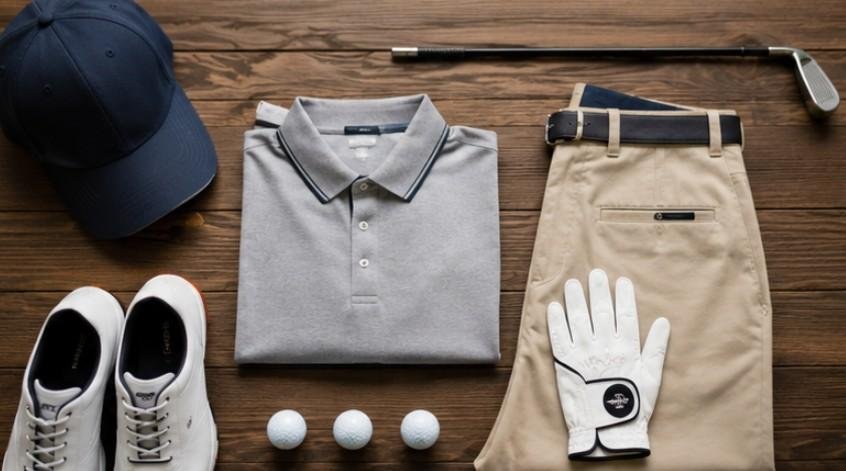
A polo works because it satisfies many traditional dress codes while staying practical outdoors. In hot weather, the CDC recommends lightweight, loose, light-colored clothing that supports air circulation and sun protection. The CDC’s sun-exposure guidance notes that tightly woven and UV-protective clothing can reduce exposure.
For bottoms, chinos, golf trousers, tailored shorts, skirts, and skorts are safer choices than denim, sweatpants, cargo shorts, or loose gym shorts. They also give you room to bend, rotate, walk, and squat to read putts.
| Item | Safe beginner choice | Better to avoid |
| Top | Polo or approved golf top | Tank top or overly casual tee |
| Bottom | Chinos, golf pants, tailored shorts, skort | Jeans, sweatpants, gym shorts |
| Shoes | Spikeless golf shoes or clean sneakers | Sandals or unstable open-toe shoes |
| Extra layer | Quarter-zip or light windbreaker | Heavy, restrictive jacket |
Do Beginners Need Golf Shoes?
Not necessarily. Clean athletic sneakers with a stable, fairly flat sole are often practical for a first round at a relaxed public facility for a golf swing sequence. USGA spectator guidance has recommended comfortable shoes such as sneakers for walking golf venues, although playing requirements are set by each course.
Spikeless golf shoes become useful if you play regularly because their outsoles add traction without traditional metal spikes. Spiked models can provide more grip in wet conditions, while many facilities no longer allow metal spikes because they can damage putting surfaces.
Try this before tee day: take five slow practice swing contact drills on grass. If your feet slide, your heels move unpredictably, or the sole feels tall and unstable, choose another pair.
Dress for Four Hours Outside, Not Five Minutes at the Clubhouse

Beginners often focus on etiquette and forget exposure. A round can keep you outdoors for hours, so sun and heat matter as much as collars and belts.
Check the EPA UV Index before leaving. The EPA recommends added protection as UV rises, including protective clothing, hats, sunglasses, and sunscreen.
On hot days, use the National Weather Service heat-safety advice as another check; loose, light-colored clothing and sun protection are practical choices. A baseball cap is convenient, but it leaves the ears and neck exposed. If sun protection is a priority, choose coverage that suits the day.
The 60-Second “Can I Golf in This?” Test
Before buying anything, test what you own. Make one full backswing and follow-through; your shirt should not pull across the shoulders. Squat as if reading a putt; your bottoms should stay comfortable and secure. Walk briskly for one minute in your shoes. Finally, check the course website for “dress code,” “attire,” or “guest policy.”
If all four checks pass, your outfit is probably ready. That matters more than matching a head-to-toe golf brand. Penn State Extension’s sun-safety guidance also recommends UV-protective clothing, a broad-brimmed hat, sunglasses, and sunscreen.
Where the Usual Advice Does Not Apply

Driving ranges, municipal courses, resorts, private clubs, charity outings, and competitive events can have different standards. A standalone range may allow a T-shirt and athletic shorts; an upscale club may reject the same outfit.
Weather also changes the answer. In rain, a waterproof shell may beat a sweater. In cold weather, thin layers usually preserve movement better than one bulky coat. Stay within the venue’s rules, but dress for the conditions you will actually play in.
Frequently Asked Questions
1. What should I wear my first time playing golf?
Wear a polo or approved golf top, tailored pants or shorts, clean closed-toe sneakers or spikeless golf shoes, and a light layer. Check the course dress code first.
2. What is the 70/30 rule in golf?
It is not an official Rules of Golf rule. The phrase is used for different coaching ideas, commonly a 70% short-game/30% long-game practice split, so context matters.
3. What not to wear when golfing?
Avoid clothes the course prohibits, commonly denim, sweatpants, very casual gym wear, sandals, or clothing that restricts movement. Private-club requirements can be stricter.
4. What can I wear to golf if I don’t have golf clothes?
Use a clean polo, chinos or tailored shorts, athletic socks, and stable sneakers. Add a belt and lightweight jacket if needed. You do not need golf-branded clothing.
Conclusion
Your first golf outfit should remove distractions, improve weight transfer not create another problem to solve. Start with a neat polo or approved top, tailored bottoms, stable closed-toe shoes, and a light layer, then adapt for heat, sun, wind, or rain. Check the venue before buying anything, because a public course and a private club may expect very different levels of formality.
Most beginners already own enough clothing to build a perfectly workable first-round outfit. Pass the swing, squat, walking, and dress-code tests, and you are ready. The goal is simple: feel comfortable enough to forget your clothes and focus on the next shot.