Most beginners walk onto a golf course knowing exactly one thing about scoring: lower is better. Beyond that, the words get confusing fast. Par, bogey, birdie, eagle. Nobody tells you what any of it actually means until you’re already on the first tee looking embarrassed. So here’s the short answer right now: what does par mean in golf is simply the number of strokes an expert golfer is expected to need to complete a hole or an entire course. That’s the golf par definition in one sentence. The rest of this article explains every layer underneath it, from how individual holes are rated to what your score actually says about your game.
The Golf Par Definition, Broken Down to Its Basics

Par is a target, not a punishment. The United States Golf Association, which you can read more about at usga.org, defines par as the score that a scratch golfer (someone with a zero handicap) would be expected to make on a hole under normal course conditions. That means one or two putts are already baked into the number, along with a reasonable assumption about how far a skilled player hits the ball.
Understanding how par works in golf starts with understanding that it operates on two levels. Every individual hole has its own par value, and the course has a total par that equals the sum of all 18 holes. A standard 18-hole course typically plays to a par of 70, 71, or 72.
Par is also the foundation for every other scoring term you’ll hear on the course. You can’t understand birdie, bogey, or eagle without understanding par first. Think of par as the anchor number that everything else swings around.
What Is Par on a Golf Hole? Par 3, Par 4, Par 5 Explained
Every hole on a golf course gets assigned a par value based primarily on its length. Here’s the breakdown of par 3 par 4 par 5 explained in practical terms:
|
Par Value |
Typical Men’s Yardage | Typical Women’s Yardage | Expected Stroke Breakdown |
|---|---|---|---|
| Par 3 | Up to 250 yards | Up to 210 yards |
1 tee shot + 2 putts |
|
Par 4 |
251 to 470 yards | 211 to 400 yards | 1 tee shot + 1 approach + 2 putts |
| Par 5 | 471 yards and beyond | 401 yards and beyond |
1 tee shot + 2 shots to green + 2 putts |
A par 3 hole is the shortest type. You’re expected to reach the green in one shot and two-putt from there. These are often the most visually dramatic holes on a course, sometimes featuring island greens or severe elevation changes, but the yardage is short enough that one well-struck iron should get you there.
A par 4 hole is the most common hole type on any course. Two-thirds of most courses consist of par 4s. You drive the ball off the tee, hit an approach shot onto the green, then two-putt. Miss one of those steps and you’re already chasing par.
A par 5 hole gives you three shots to reach the green before you start putting. Longer hitters can sometimes reach a par 5 in two shots. That’s called going for it in two, and it opens the door for eagle (two under par). Most recreational golfers are just happy to reach it in three and two-putt for par.
This is the core of understanding what is par on a golf hole. Every number flows from distance and the assumption that two putts close out the hole.
How Is Golf Course Par Determined?

Course designers and rating officials don’t just eyeball a hole and pick a number. How is golf course par determined involves a structured process managed by the USGA and affiliated golf associations. A team of trained course raters walks each hole and measures effective playing length, factoring in obstacles like forced carries over water, uphill climbs, and prevailing wind.
The yardage thresholds in the table above are guidelines, not absolute rules. A 470-yard par 4 that plays steeply uphill into a headwind might legitimately be rated as a par 5 for women. A 470-yard par 5 that plays dramatically downhill with a tailwind could reasonably stay as a par 4 for men.
The Golf Course Rating System, outlined in detail at the USGA’s World Handicap System page, considers ten obstacle factors per hole including topography, trees, rough, out of bounds, water hazards, and green surface difficulty. Each factor gets a numerical weight. Those weights feed into both the course rating and the slope rating, two numbers you’ll see printed on every scorecard.
So when you ask how is golf course par determined, the real answer is: by trained professionals who measure every yard and every obstacle, not by the course architect’s gut feeling.
What Does Even Par Mean, and Why Should You Care?
Finishing a round at even par means your total number of strokes exactly equals the course’s par rating. If the course is a par 72 and you shoot 72 strokes, you’re even par. You matched the expectation for a scratch golfer on every hole, combined.
In practice, what does even par mean varies wildly by golfer. For a tour professional, finishing even par on a major championship course is a disappointment. For the average recreational golfer, it would be a career round. According to the USGA handicap data, the average male golfer in the United States carries a handicap index of around 14, which means their typical round runs about 14 strokes over par, not even par.
Even par is symbolized as “E” on scoreboards and leaderboards. You’ll see it sitting between negative numbers (under par) and positive numbers (over par). It’s the dividing line.
What Is Under Par in Golf? The Good Side of the Ledger
What is under par in golf means you completed a hole or a full round in fewer strokes than the par number. Fewer strokes is better in golf, so under par is always good. Here’s how the specific terms break down per hole:
- Birdie: One stroke under par on a hole (e.g., finishing a par 4 in 3 strokes).
- Eagle: Two strokes under par on a hole (e.g., finishing a par 5 in 3 strokes).
- Albatross (Double Eagle): Three strokes under par on a hole. Extremely rare. Hole-in-one on a par 4 qualifies.
- Condor: Four strokes under par. This has happened fewer than a handful of documented times in golf history.
On a full round, if a player’s total score is three strokes fewer than the course par, they’re said to be three under par, or minus-3. On leaderboards, this appears as “-3.” The more negative the number, the better the performance.
For beginners working on par scoring for beginners, making your first birdie is a genuine milestone. Many recreational golfers play for years before recording one. Don’t rush it. Focus on par first. If you’re still learning how to play golf, building a solid understanding of scoring is a good place to start.
What Is Over Par in Golf? Understanding the Common Reality

Most golfers, on most rounds, finish over par. That’s just the reality of the sport. What is over par in golf means your stroke total exceeded the hole’s or course’s par number. Here’s the scoring vocabulary:
- Bogey: One stroke over par on a hole.
- Double Bogey: Two strokes over par.
- Triple Bogey: Three strokes over par.
- Quadruple Bogey (or worse): Four or more strokes over par. Most amateur scorecards have seen these.
On a full round scorecard, if your total is eight strokes above the course par, you’re said to be eight over par, displayed as “+8.” In casual rounds, some golfers agree to a maximum score per hole (called a pick-up rule or a net double bogey limit in handicap play) to keep the round moving.
Understanding what is over par in golf is really just math, but it shapes how you think about strategy on every hole. If you’ve already hit into the water twice, chasing par on that hole often costs you more strokes than accepting a bogey and moving on.
Par vs Bogey in Golf: How They Shape Your Scoring Strategy
This is where things get genuinely useful. The contrast of par vs bogey in golf defines how most recreational golfers should actually approach a round.
Tour professionals play to make birdies and minimize bogeys. That’s their job. But for a golfer shooting in the 90s or 100s, the most productive goal is bogey golf. A clean bogey on every hole produces a score of 90 on a par-72 course. That’s 18 over par, and it’s a realistic, achievable target that improves most golfers’ rounds immediately.
“For the recreational golfer, bogey golf is the equivalent of par golf for professionals. It’s the standard worth chasing, and chasing it with discipline is what actually lowers your handicap.” This perspective, widely shared among PGA-certified teaching professionals, reflects how instruction-focused organizations like the PGA of America frame realistic scoring goals for club-level players.
In the par vs bogey in golf conversation, the real insight is this: par isn’t always the right target for you. Smart course management often means accepting a bogey on a hard hole in order to avoid a triple. The golfer who shoots 88 instead of 95 usually got there by dropping the ego and playing to bogey on five or six tough holes.
What Does Par Mean in Golf for Your Handicap?
Your handicap index is tied directly to how you score relative to par. The World Handicap System, adopted by the USGA and the R&A in 2020, calculates your handicap based on your score differentials, which measure the difference between your adjusted gross score and the course rating. The course rating itself is set relative to par.
In simple terms: the better you score relative to par, the lower your handicap index. A player who consistently shoots 10 over par will have a handicap around 10. A player who shoots 20 over par on average will carry a handicap near 20.
This is why understanding how par works in golf at the course level matters for tracking improvement. Par is the baseline every handicap calculation references. Every stroke you shave off your score relative to par is a real, documented improvement in your game.
A Practical Framework: The Par Awareness System for New Golfers
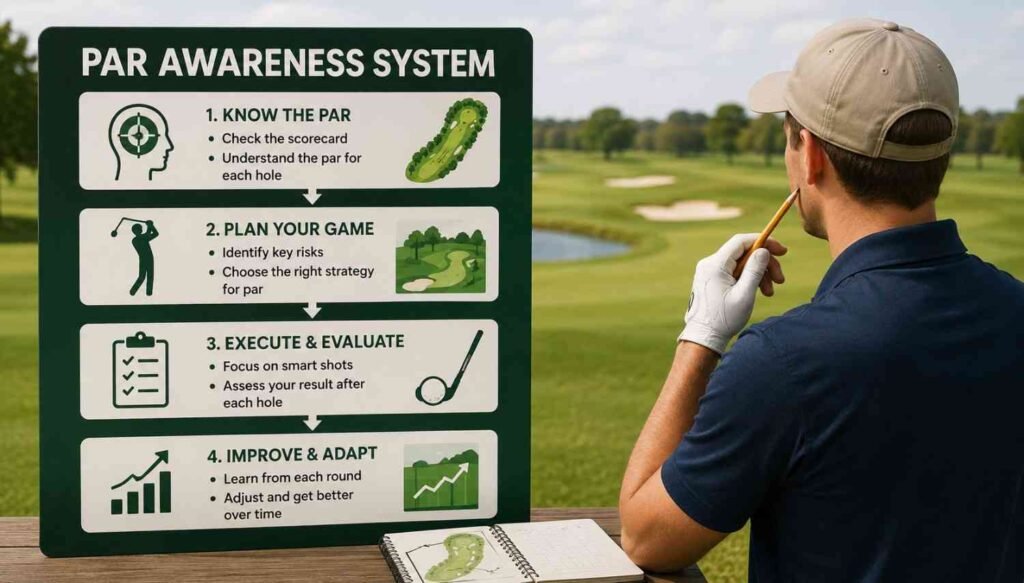
Here’s a framework I’d call the Par Awareness System, built specifically for golfers in their first two years of playing. It’s three-stage, and each stage builds on the one before it.
Stage 1: Know the par before you swing. Know the par before you swing. Before every hole, look at the scorecard and confirm whether it’s a par 3, par 4, or par 5. This single habit changes how you plan the hole. A golf ball position guide can also help you make better setup decisions before each shot, depending on the club and type of shot you’re facing. On a par 3, you know you need to reach the green on your first swing or you’re already behind. On a par 5, you have room to miss a shot and still save par or bogey.
Stage 2: Count your strokes against par in real time. As you play, keep a running idea of where you are on each hole relative to par. Not obsessively, but enough that you know when to take a risk and when to play safe. If you’re on a par 4 and you’ve already hit three shots without reaching the green, accepting a double bogey and moving on is the smarter play than going for a miracle.
Stage 3: Set a par scoring goal for your round by hole type. Say to yourself before the round: “I want to make par on at least two of the par 3s today.” That’s a concrete, achievable anchor. Over time, shift the target. This approach turns par scoring for beginners from an abstract concept into a round-by-round game you can actually win.
How Par Works in Golf: A Checklist for Reading Any Scorecard
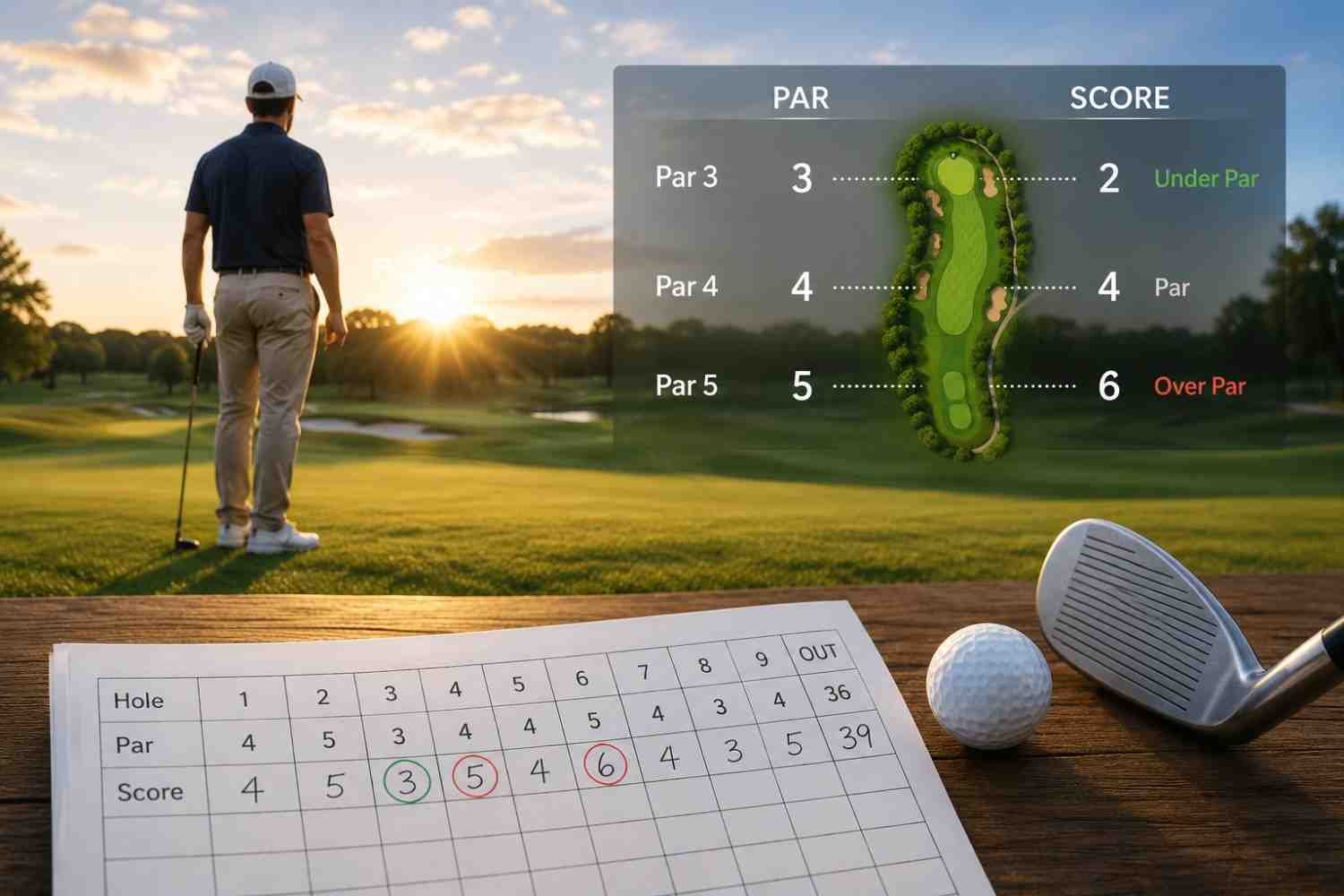
Every golf scorecard contains all the par information you need before you play a single shot. Here’s how to read one in under two minutes:
- Locate the “Par” row on the scorecard. This row lists the par value (3, 4, or 5) for each of the 18 holes.
- Add up the par values for holes 1 through 9. This is your front nine par total, usually 35 or 36.
- Add up holes 10 through 18. That’s your back nine par total.
- The two totals combined give you the course par, typically 70, 71, or 72 for 18 holes.
- Check the “Course Rating” and “Slope Rating” also printed on the card. These numbers feed into your handicap calculations.
- Note which holes are rated the hardest (handicap 1) and easiest (handicap 18). These ratings tell you where a player receives strokes in match play with a handicap.
- Track your score vs par hole by hole: circle a number if you beat par, put a square around it if you go over, and leave it plain if you match par.
Most par 72 courses are built around four par 3 holes, ten par 4 holes, and four par 5 holes. That ratio is common but not universal. Some courses run par 70 with six par 3s and no par 5s. Always check the scorecard rather than assuming.
What Does Par Mean in Golf When You’re Keeping Score Casually?
Plenty of recreational rounds don’t involve strict stroke play. Scrambles, skins, match play, and bingo-bango-bongo all have their own scoring structures, but par still anchors them. In match play, each hole is won, lost, or halved, and the comparison is always against par or against your opponent’s score on that hole. In skins games, a player who makes par while everyone else makes bogey wins the skin for that hole.
Even in formats where you’re not writing down every stroke, knowing what does par mean in golf on each hole tells you when you’re in a good position and when you need to be aggressive. Understanding situations such as the lost ball rule in golf can also help you make quicker scoring decisions when a shot goes off course. It’s the invisible ruler every golfer carries.
Par scoring for beginners in casual rounds often looks like picking a “personal par” system. Some instructors suggest playing to a personal par of one over the actual par on every hole. That means your personal target on a par 4 is a 5, and on a par 5 is a 6. This removes the pressure of chasing an unrealistic standard while still giving you a meaningful benchmark to measure against.
Par Across the Majors: Why Even Tour Players Respect the Number

Augusta National, the home of The Masters, plays to a par of 72. During the 2023 Masters Tournament, the winning score by Jon Rahm was 18 under par, 54 strokes below the course par total across four rounds. That level of sustained scoring below par is what separates elite professionals from everyone else.
But here’s what’s telling: even at Augusta, finishing even par for the day is considered a solid round. The course plays hard enough that par earns respect from the field. Plenty of competitors in major championships have missed the cut while shooting 10 over par, which on a less demanding layout might look embarrassing but at Augusta reflects a brutal setup.
This context matters for your own game. Par is not a fixed achievement level. It’s always relative to the course you’re playing. A round of 82 on a par 72 course rated at 73.5 is genuinely better golf than a round of 82 on a course rated at 67.5. The golf par definition holds constant, but the difficulty that surrounds it changes every time you play somewhere new.
Common Misconceptions About Par Worth Clearing Up
A lot of new golfers think par is the score an average player should shoot. That’s not right. Par is the target for a scratch golfer, which is a player in roughly the top 5% of all golfers by ability. The average recreational player finishes significantly over par, and that’s completely normal.
Another misconception: that par 5 holes are always easier to score on than par 4 holes. Not necessarily. A tight, 440-yard par 4 can be far easier to make par on than a 520-yard par 5 with a forced carry over a lake on the approach. The par value reflects the number of expected strokes, not the difficulty ranking. Hole difficulty is listed separately on the scorecard under “handicap stroke index.”
One more: some beginners think that making bogey on every hole is bad. It’s not. Consistent bogey golf, as noted earlier, produces a 90 on a par-72 course. For most golfers who play fewer than twice a month, bogey golf is a genuine accomplishment worth celebrating.
Conclusion: Par Is the Map, Not the Destination
Understanding what does par mean in golf is the foundational literacy every golfer needs. Once you know the golf par definition, you can read a scorecard, understand your handicap, make smarter decisions during a round, and set goals that actually match your current skill level.
Par 3 par 4 par 5 explained, how par works in golf, what does even par mean, what is under par in golf, what is over par in golf, par vs bogey in golf, and par scoring for beginners all connect back to this one central concept: par is the professional baseline, and your job is to measure your progress against it honestly.
The golfers who improve fastest aren’t the ones obsessed with making par on every hole. They’re the ones who understand what par means, accept where they are relative to it, and make smart decisions from that honest starting point. So next time you’re on the first tee, look at the card, find the par for hole one, and play to that number with everything you’ve got. The scorecard will tell the rest of the story.