
Despite what Saturday morning golf foursomes might claim, the average male amateur carries his driver significantly under 220 yards. According to telemetry collected from millions of tracked swings on modern optical launch monitors, the average golf driver distance by age peaks much earlier than most players care to admit, declining by roughly seven to ten yards every decade after age thirty.
For photographers, videographers, and tech-minded players used to capturing motion at high frame rates, a golf swing is pure mechanical physics a rotating lever transferring kinetic energy through an impact window lasting less than half a millisecond.
When you analyze golf through the lens of sensor data rather than ego, a clear picture emerges about how age, rotational velocity, and impact efficiency interact on the tee box.
The Biomechanics of Rotational Loss: Why Distance Fades
The human body functions much like a mechanical camera rig. In your twenties, high muscular elasticity and spinal mobility allow for a rapid kinetic sequence.
You rotate your shoulders around a fixed axis, store torque in your core, and release that energy with peak head speed.
As the body ages, natural physiological changes alter this mechanics chain. Studies indexed by the National Institutes of Health show that adults gradually lose fast-twitch muscle fibers (type II muscle fibers) along with spinal flexibility. This physiological slowdown reduces shoulder turn and hip rotation speed.
When your rotational velocity drops, your clubhead speed follows. A loss of just 3 mph in swing speed translates to roughly eight to ten yards of lost total distance off the tee.
Furthermore, research highlighted by Harvard University indicates that joint stiffness alters swing path consistency, making center-face impact harder to repeat reliably.
Decoding the Numbers: Driver Distance Across Age Groups

Large-scale shot-tracking telemetry from sensor manufacturers like Arccos Golf and Shot Scope provides an unfiltered view of amateur distance. By stripping out downhill bounces and wind-assisted outliers, we get true median driving numbers across different demographics.
+——————-+—————————-+
| Age Bracket | Average Driving Distance |
+——————-+—————————-+
| Junior (Age 8) | 150 – 160 yards |
| Junior (Age 12) | 190 – 200 yards |
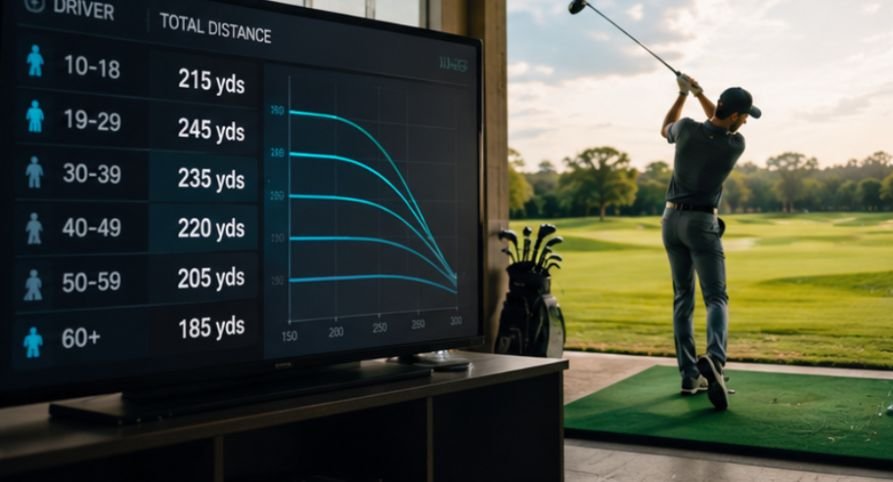
| 20 – 29 Years | 239.7 yards |
| 30 – 39 Years | 233.7 yards |
| 40 – 49 Years | 225.9 yards |
| 50 – 59 Years | 215.4 yards |
| 60 – 69 Years | 204.5 yards |
| 70+ Years | 190.4 yards |
+——————-+—————————-+
Editor’s Note: For visual publishing, this dataset is best formatted as a horizontal multi-series bar chart comparing age brackets on the X-axis against median yards on the Y-axis.
Notice how junior golfers experience the reverse effect. As an eight-year-old grows and refines their rotational coordination, their drive increases from ~150 yards up to nearly 200 yards by age twelve. Distance peaks during a golfer’s twenties at roughly 240 yards before beginning its steady linear regression.
Skill vs. Age: Why Contact Quality Trumps Raw Speed
While age creates a natural speed ceiling, skill level often overrides birth years. Data compiled by the United States Golf Association demonstrates that smash factor the ratio of ball speed to clubhead speed dictates distance far more than raw muscle.
This is especially true on a links golf course, where firm, undulating fairways often reward a well-struck low shot over a longer, higher one.
A 65-year-old single-digit handicap golfer frequently outdrives a 25-year-old high handicapper. How? The skilled senior hits the exact center of the clubface with a square face angle and an upward angle of attack.
Think of it like camera focus. Throwing maximum power into a swing with an off-center strike is like shooting a photo at maximum shutter speed with an out of focus lens the energy is wasted.
High speed camera footage reveals that striking a driver just half an inch off-center reduces ball speed by up to 10 mph, stripping away 20 yards instantly.
The Launch Monitor Self-Assessment: Finding Your Efficiency Ratio

If you want to evaluate your own tee shots without relying on guesswork, visit a simulator bay equipped with high speed photometric cameras or Doppler radar sensors. Follow this three-step diagnostic test:
For tracking that data out on the course rather than just in the bay, it’s worth comparing the best golf GPS watches for beginners to see which one fits your game.
- Calculate Your Smash Factor: Divide your ball speed by your clubhead speed. A perfectly struck driver yields a smash factor around 1.48 to 1.50. If your ratio sits below 1.42, you are leaving 15 to 20 yards on the table through off-center hits alone.
- Measure Your Launch Angle: Modern low-spin driver heads perform best at launch angles between 11 and 14 degrees. Older swingers with lower swing speeds actually need higher launch angles (14–16 degrees) to maximize carry.
- Check Rotational Mobility: Work with fitness guidelines from the National Strength and Conditioning Association to test your thoracic spine mobility. If your shoulder turn is restricted, lightweight shaft options or increased driver loft can instantly reclaim lost launch height.
Guidelines from wellness organizations like the Mayo Clinic emphasize that targeted rotational stretching and core stability training can help golfers retain athletic flexibility well into their sixties and seventies.
Frequently Asked Questions
1. How many golfers can drive 250 yards?
According to shot-tracking data from Shot Scope, only about 29% of amateur golfers average over 250 yards off the tee. Only 4% of players consistently hit drives exceeding 300 yards.
2. How far should a 55 year old man hit a driver?
The average 55-year-old male golfer drives the ball approximately 215 yards. However, a low-handicap player in this age group with good strike quality can routinely carry the ball 230 to 240 yards.
3. What is Scottie Scheffler’s average drive distance?
PGA Tour player Scottie Scheffler averages around 308 to 311 yards off the tee on tour, placing him among the long, highly controlled hitters in professional golf.
4. Is a 248 yard drive good?
Yes, a 248-yard drive is well above average for amateur golfers. Hitting 248 yards puts you in the top 30% of all male recreational players across all age groups.
Rethinking Your Game Beyond Raw Yardage
Understanding the average golf driver distance by age shifts your mindset from chasing vanity metrics to optimizing functional performance on the course.
While biological aging gradually reduces rotational speed, golf remains unique because precision, center-face impact, and strategic course management can easily neutralize a loss in raw distance.
Before adding more range sessions chasing extra yardage, it’s worth learning how to stop practicing the wrong golf skills, since effort spent on the wrong drills rarely shows up on the scorecard.
Rather than swinging harder and compromising your contact quality, lean into modern launch monitor tech to optimize your launch angles and spin rates.
Moving up a tee box or upgrading to a lighter, properly fitted shaft isn’t admitting defeat it’s smart telemetry-driven play. Focus on efficiency over force, keep the ball in play, and let the numbers work in your favor.