

I used to think a repeatable golf swing meant making every swing look exactly the same. After watching enough good and bad shots, I realized that was the wrong target. Even solid players make small changes from swing to swing. What stays consistent is the setup, rhythm, balance, and general sequence that give the club a reliable chance to return to the ball.
I also found that trying to fix several swing positions at once usually made things worse. The more I thought about my takeaway, backswing, wrist angle, downswing, and impact position, the less natural the motion felt. A better approach is to build a few dependable checkpoints and let the swing develop around them. That is where tempo and balance become especially useful.
What Makes a Golf Swing Repeatable?

A repeatable golf swing is not a perfect swing. It is a motion that gives you similar conditions often enough to produce predictable shots. Practicing Golf Swing Contact Drills can reinforce that consistency by helping golfers develop a repeatable strike, centered contact, and reliable clubface control.
That starts before the club even moves. Your grip, posture, ball position, alignment, and distance from the ball create the starting point for everything that follows. If those pieces change dramatically from one shot to the next, your body has to make different compensations each time.
Good players can have very different-looking swings, but the fundamentals tend to give their motion structure. Golf instruction from PGA professionals often puts more emphasis on balance, sequencing, and posture than forcing every golfer into identical positions.
That distinction matters. You are not trying to build a swing that looks perfect on video. You are trying to create one you can reproduce when the pressure of an actual round starts to creep in.
Start With a Setup You Can Repeat
Before working on tempo, make your setup boring.
Place the club behind the ball, establish your grip, set your feet, and create the same general posture every time. Your weight should feel centered through your feet rather than pushed heavily toward your heels or toes.
Your spine should tilt naturally from the hips while staying relatively neutral. Avoid rounding your upper back or excessively arching your lower back. A neutral posture gives your body room to rotate without forcing extra compensations. Titleist instruction also emphasizes neutral posture and balanced weight distribution as important foundations for an efficient swing.
Alignment deserves the same attention. Pick your target, choose a spot a few feet in front of the ball, and use that intermediate point to organize your clubface and body alignment. A consistent pre-shot setup gives your swing the same starting conditions instead of asking it to solve a new problem every time.
If your biggest problem is the club moving outside or behind you during transition, learning how to stop coming over the top in golf can also help you understand how setup and sequencing affect your swing path.
Let Tempo Create the Rhythm

Tempo is often misunderstood as simply swinging slowly. It is really about the relationship between the different parts of your motion.
A golfer can have a fast swing and still have excellent tempo. Another golfer can swing more slowly and have equally good rhythm. The goal is to find a pace that allows your backswing, transition, and downswing to flow without a sudden rush.
One useful test is to make practice swings at roughly 70 percent effort. Notice whether you can finish in balance without feeling like you had to save the shot with your hands.
The transition deserves particular attention. Many inconsistent swings become rushed at the top because the golfer starts the downswing before the backswing has finished. A brief pause drill can expose that habit. Make a normal backswing, pause for about a second, and then swing through. You do not need to use that pause during normal play. It simply teaches your body what an unhurried transition feels like.
Build Balance Into the Swing
Balance is one of the easiest ways to judge whether your motion is organized.
Try the feet-together drill with a mid-iron. Put your feet close together, make smooth half swings, and gradually build toward a fuller motion. Because your stance is narrow, excessive swaying becomes obvious. The PGA of America recommends this drill specifically for developing balance, centered movement, and more even tempo.
The goal is not to hit the ball far. It is to finish without stumbling, falling backward, or throwing your body toward the target.
Once that feels comfortable, return to your normal stance and notice the difference. Your feet should feel connected to the ground, while your upper body rotates without excessive lateral movement.
This type of practice can also improve your awareness of where the club is contacting the ground. If your iron shots regularly strike behind or above the ball, simple drills for more consistent iron contact can complement the balance work and help you connect the swing motion with better low-point control.
Practice the Motion Instead of Chasing Every Miss

A repeatable swing needs repeatable practice.
Hitting 100 balls while changing your swing after every poor shot can teach your body that inconsistency is normal. Instead, choose one focus for a practice session. That might be tempo, balance, setup, or contact.
Start with several slow rehearsal swings. Then hit a few short shots before gradually increasing the length. This lets you carry the same movement into a fuller swing instead of immediately asking your body to perform at maximum speed.
A towel drill can also help with rhythm. Grip a small towel like a club and make smooth swings, listening for the towel to create its fastest whoosh near the bottom. The PGA of America uses this type of drill to help golfers reconnect with a smoother tempo rather than forcing the club through impact.
Another useful habit is finishing every practice swing in balance. Hold the finish for two or three seconds. If you cannot stay stable, reduce the effort and try again.
Take the Same Process Onto the Course
Range practice only matters if you can use it during a round.
On the course, reduce your swing thoughts. You might check your setup, make one rehearsal focused on tempo, and then commit to the target. Once the club starts moving, avoid trying to correct your mechanics in the middle of the swing.
Your pre-shot routine should also take roughly the same shape for every shot. Stand behind the ball, pick the target, approach the ball, set the clubface, establish your stance, and swing.
That routine creates familiarity. When a shot matters, you are not inventing a new process under pressure.
Common Mistakes That Break Repeatability
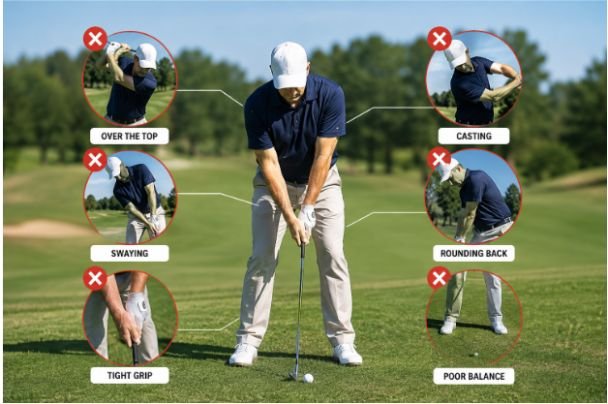
The biggest problem is usually not a lack of information. Golfers often know too much and try to apply everything at once.
Changing your grip every week, chasing a new backswing position, swinging harder after a poor shot, and judging every swing by the result can quickly destroy a stable pattern.
Instead, look for trends. If your balance keeps breaking down, work on balance. If your contact point moves around, check your setup and low point. If your transition gets rushed, work on tempo.
You may also find that your best swings feel surprisingly easy. That is a good sign. Efficient movement does not always feel powerful while you are making it.
FAQs: How to Build a Repeatable Golf Swing With Better Tempo and Balance
How long does it take to build a repeatable golf swing?
There is no fixed timeline. Regular practice with the same fundamentals can gradually make your setup, tempo, and movement more automatic.
Should I swing slowly to improve consistency?
Not necessarily. Focus on smooth sequencing and balanced movement rather than simply reducing swing speed. A controlled full swing is more useful than an artificially slow one.
Why do I lose balance during my golf swing?
Poor setup, excessive sway, rushing the transition, or trying to generate too much speed can all affect balance. Feet-together practice can help identify the issue.
How many swing thoughts should I have?
One simple cue is usually easier to repeat than several technical instructions. Choose the thought that addresses your biggest current weakness and let the rest of the motion happen naturally.
Why a Simple Swing Is Easier to Trust
A repeatable golf swing comes from reducing unnecessary variables. When your setup stays familiar, your tempo has a recognizable rhythm, and you can finish in balance, you give your body a much clearer task. You do not need to copy a professional’s swing or manufacture perfect positions. You need a motion that works for your body and produces a predictable pattern often enough to trust it.
That trust grows through focused repetition. Build the fundamentals, practice with purpose, and let consistency develop instead of trying to force it into every swing.