
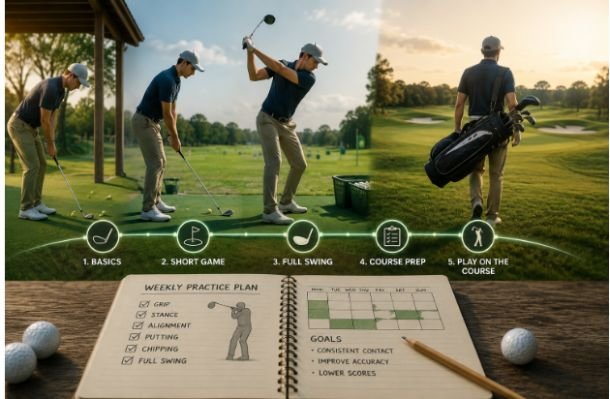
I used to think beginner golf practice was mostly about getting to the driving range and hitting enough balls until the swing started to feel natural. That approach can be fun, but it does not always tell you what you are actually improving. Once I started looking at practice as a sequence rather than a bucket of balls, the difference became obvious. A little structure makes each swing more useful.
I also found that beginners often rush toward the driver because it feels like the most exciting part of golf. There is nothing wrong with wanting to hit longer shots, but the early stages are better spent building contact, balance, putting speed, and basic control.
A good golf practice plan for beginners should gradually connect those skills so the range starts preparing you for the course, not just helping you hit balls.
Start With a Simple Practice Goal
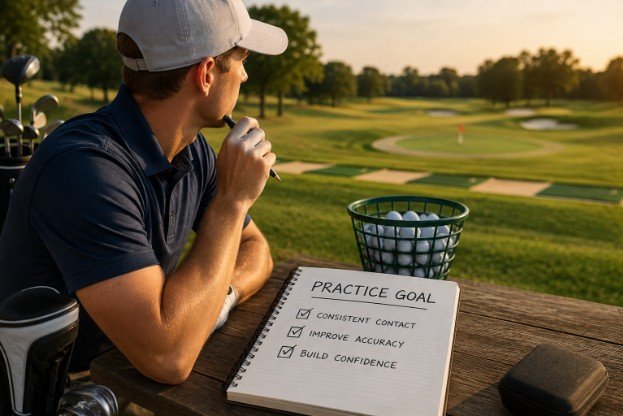
Before picking up a club, decide what you want from the session. That goal does not need to be complicated. You might want to improve iron contact, start putts on a better line, or become more comfortable with your driver.
A focused goal also prevents one bad shot from taking over the entire session. If you are working on contact, for example, you do not need to change your grip, stance, backswing, and swing speed after every poor shot. Pick one area and give yourself enough swings to understand what is happening.
PGA guidance on purposeful practice makes a similar point: practice should have a plan, use specific targets, and reflect the shots you actually face during a round.
For a beginner, 60 minutes is plenty. You do not need to hit 100 balls to have a productive session.
A 60-Minute Golf Practice Plan for Beginners
A simple session can move from preparation to short shots, then into the full swing and finally toward course-style practice, while developing Golf Short Game Consistency through focused, repeatable practice.
5 minutes: Warm up and find your setup
Start with a few minutes of dynamic movement for your shoulders, hips, and core. Then take several slow practice swings without worrying about distance.
Move into 5 to 10 half-swings with a wedge. Feel the clubhead, keep your balance, and let the motion gradually become larger. This is a better starting point than immediately trying to swing a driver at full speed.
Use these early swings to check three basics: grip, posture, and alignment. Your hands should hold the club securely without excessive tension, your posture should allow you to rotate comfortably, and your body should be aligned with the intended target line.
The goal is not to fix your entire golf swing during the warm-up. It is simply to prepare your body, establish a repeatable setup, and create a solid foundation for Improving Driver Swing Speed without sacrificing balance or consistency.
15 Minutes of Putting

Putting deserves attention even when the full swing feels more important. A beginner can hit a good approach shot and still lose strokes through poor distance control on the green.
Start with short putts. Place two tees slightly wider than your putter head and create a small gate a few inches in front of the ball. Roll several putts through the gate without touching either tee. This helps you pay attention to the starting line and the path of the putter. PGA instruction commonly uses variations of the gate drill for developing putting consistency.
Spend the second half of your putting block on distance control. Try putts from roughly 10, 20, and 30 feet, focusing less on making the putt and more on leaving the ball close enough for a comfortable second putt.
That distinction matters. Beginners often judge putting practice by how many balls they hole. Distance control is usually a better early target.
15 Minutes of Chipping
Move to the practice green and use one wedge. Choose a landing area instead of simply aiming at the hole.
Start with straightforward chips from a similar lie. Try to land the ball in the same general area several times, then notice how far it rolls. Once you become comfortable, change the landing spot and adjust the amount of carry.
Keep the motion simple. You are trying to learn clean contact and predictable rollout, not create a perfect highlight-reel chip.
A useful way to approach this block is to picture the shot you would actually face during a round. Maybe your imaginary ball is just short of the green with plenty of putting surface available. Choose the landing point, make the shot, and evaluate the result.
This kind of purposeful repetition is more useful than hitting the same chip toward the same hole without a target. It also builds what many golfers eventually recognize as The Simple Approach to Better Golf Practice Efficiency, because every shot has a reason behind it.
20 Minutes of Full Swing Practice

Now move to the range. Start with a short or mid-iron instead of immediately reaching for the driver.
Hit a few half-swings, then three-quarter swings. Focus on balance and solid contact. If you cannot finish under control, reduce your speed. More effort does not automatically create a better swing.
Once you feel comfortable, begin alternating targets. Instead of hitting 15 balls toward one flag, pick a left target, then a right target, then another target farther away. Go through your normal pre-shot routine before each ball.
PGA practice advice recommends choosing specific targets and mixing up shots rather than repeatedly hitting the same club toward the same target. That approach makes range practice more closely resemble the decisions required on the course.
You can also rotate clubs during this section. Hit a few 7-irons, then a hybrid or fairway wood, then return to an iron. The objective is to reset before each shot instead of falling into a rhythm where every swing becomes automatic.
How Often Should a Beginner Practice?
Consistency matters more than trying to squeeze everything into one long session. Two or three focused practice sessions each week can be more useful than one exhausting trip to the range every couple of weeks.
Not every session needs to last an hour. If you only have 30 minutes, keep the same basic order but shorten each section. You could spend five minutes warming up, eight minutes putting, seven minutes chipping, and 10 minutes on the full swing.
You can also use short sessions to work on one specific skill. Ten minutes of putting at home can help maintain distance-control practice between range visits.
As your swing becomes more reliable, your practice should gradually become less mechanical and more variable. Start introducing different targets, clubs, lies, and imagined situations. The goal is to take the skill you developed through repetition and learn how to use it when the situation changes.
Track Progress Without Overcomplicating It

Beginners do not need a spreadsheet full of swing statistics. A few simple observations are enough.
Pay attention to whether your contact is becoming more consistent, whether your common miss is changing, whether you can start the ball closer to your intended line, and whether you feel more comfortable choosing a club.
You can also track how many putts you take during casual rounds or how often you leave chips within a comfortable putting distance. These numbers give you something concrete to compare from week to week.
Most importantly, judge practice by quality rather than quantity. Twenty intentional swings can teach you more than 60 rushed ones.
FAQs: Golf Practice Plan for Beginners: From First Swings to the Course
How many times a week should a beginner practice golf?
Two or three focused sessions per week are a good starting point. Even short 20- to 30-minute sessions can help when practice has a clear purpose.
Should beginners practice driving first?
Not usually. Start with wedges and short irons to establish contact, balance, and tempo. Add the driver after you feel comfortable with your basic swing.
How many golf balls should a beginner hit?
There is no magic number. Focus on deliberate swings with a target rather than trying to finish a large bucket. Stop if your technique and concentration start breaking down.
Should beginners practice putting?
Yes. Putting should be part of regular practice because distance control and short-putt confidence directly affect scoring. Even 10 to 15 minutes can be productive.
Why Consistent Practice Beats Occasional Marathon Sessions
A beginner’s biggest advantage is having enough time to build good habits before bad ones become deeply established. A structured routine gives each session a purpose while still leaving room to experiment and learn.
Over time, the practice green, driving range, and course start to connect. You stop thinking about practice as simply hitting balls and start using it to prepare for specific shots, decisions, and situations.
The best routine is the one you can repeat. Keep it simple, stay patient, and let consistency turn those first swings into a game you can actually trust.