Finishing the 18th hole does not mean your body has finished working. After hours of walking, bending, gripping, and rotating, I prefer to spend a few extra minutes bringing those hard-working areas back toward a relaxed position.
The best golf cool down stretches after playing focus on the hips, upper back, shoulders, hamstrings, wrists, and forearms. Your muscles are already warm, making controlled static stretching a practical choice after the round.
Why Your Golf Cool Down Matters
A golf swing repeatedly asks your body to rotate through the hips and thoracic spine while your hands maintain control of the club. Add several miles of walking, and tightness can build across the lower and upper body.
That is why I structure golf cool down stretches after playing differently from a pre-round warm-up. Before golf, movement should prepare you to swing. After golf, the goal shifts toward relaxing tight muscles and restoring comfortable mobility.
For example, dynamic stretches for golfers before playing belong before the first tee because they use controlled movement. Post-round stretching can be slower and more relaxed.
The Mayo Clinic’s golf stretching guidance also highlights mobility work for areas commonly involved in the golf swing.
Quick Reference: Post-Round Golf Stretching Routine
I use the following sequence because it moves from larger rotational muscles toward the smaller muscles of the hands and wrists.
| Stretch | Main Area | Simple Setup | Hold |
| Torso stretch | Upper back, lats | Club extended forward | 5–6 breaths |
| Couch hip flexor | Hips, front thigh | Rear foot elevated | 5–6 breaths each side |
| Chest opener | Chest, shoulders | Elbows drawn backward | 5–6 breaths |
| Hamstring stretch | Back of thighs | Heel forward, hip hinge | 5–6 breaths each side |
| Wrist release | Forearms, wrists | Arm straight, guide fingers | 5–6 breaths each position |
This keeps golf cool down stretches after playing simple enough to complete beside the clubhouse, at home, or near your car.
Five Static Stretches for Golf Recovery
Torso and Upper Back Stretch

The thoracic spine plays a major role in golf rotation. After repeated swings, I start the cool down by giving the upper back and lats room to relax.
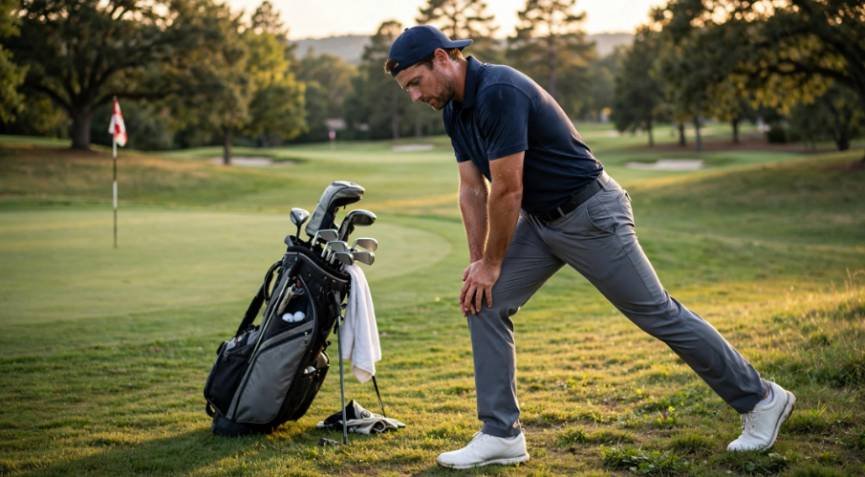
Stand with your feet about shoulder-width apart. Hold a golf club vertically or horizontally with your arms extended. Hinge forward from your hips until your torso approaches a right angle.
Keep your spine long. Then gently shift your hands toward one side until you feel tension through the opposite lat and side of your torso. Repeat on the other side.
Avoid forcing extra range. These golf cool down stretches after playing should create mild tension, not pain.
Couch Hip Flexor Stretch
Golf posture and prolonged walking can leave the front of the hips feeling tight. The couch stretch targets the hip flexors and front of the thigh.
Place the top of one foot on a bench, chair, couch, or secure golf-cart step. Move the opposite foot into a split stance.
Stay tall and gently squeeze the glute on the trailing leg. Allow your hips to shift forward slightly without arching your lower back.
This is also why I separate recovery from a golf warm up routine before a morning round. Before playing, I want active hip movement. Afterward, I want a comfortable static hold.
Hold for five or six slow breaths before switching sides.
Chest and Shoulder Opener
Several hours in golf posture can encourage the shoulders to roll forward. Gripping and swinging also keep the chest and shoulder muscles active.
Place your hands behind your head or lightly interlock your fingers. Keep your neck relaxed.
Take a slow breath in. As you breathe out, move your elbows backward and gently draw your shoulder blades together.
Do not crank your arms behind you. Think about opening the chest rather than forcing the shoulder joint.
Among my preferred golf cool down stretches after playing, this is one of the easiest to perform almost anywhere.
Hamstring Stretch
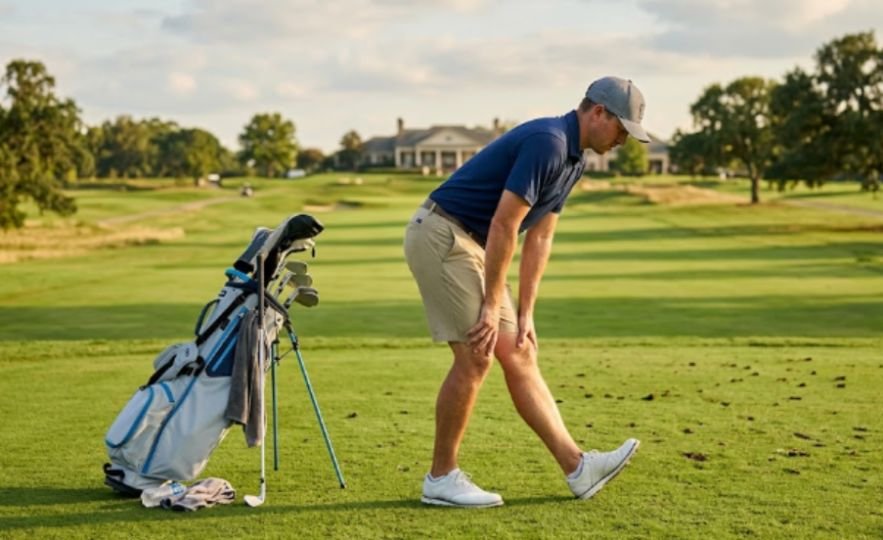
Tight hamstrings can make a comfortable golf posture harder to maintain. They can also leave your legs feeling noticeably stiff after a walking round.
Place one heel slightly in front of you with your toes pointing upward. Soften the knee of your supporting leg.
Hinge forward from your hips while keeping your back flat. Stop when you feel a mild stretch along the back of the extended thigh.
Avoid rounding your spine just to reach farther. The range does not matter as much as placing the stretch where you want it.
Forearm and Wrist Release
Your hands may be small compared with your hips and torso, but they work during every shot.
Extend one arm in front of you with your elbow straight and palm facing down. Use the opposite hand to gently guide your fingers toward the floor.
Then rotate the palm upward and gently draw the fingers back.
This stretches both sides of the forearm. It can be especially useful after a range session followed by 18 holes.
Grip-related overuse can irritate the forearm tendons, so I keep this movement gentle rather than aggressive.
My Five-Breath Reset for Post-Round Recovery

My favorite way to organize golf cool down stretches after playing is what I call the five-breath reset.
Instead of staring at a phone while counting 30 seconds, take five controlled breaths. Inhale slowly through your nose. Exhale without rushing.
During each exhale, allow the muscle to relax naturally. Do not use the breath as permission to push deeper.
After the fifth breath, return to a neutral position and compare both sides of your body. If one side still feels much tighter, repeat one comfortable round rather than forcing a longer stretch.
This is not a medical protocol. It is simply a practical consistency tool that makes a post-golf routine easier to remember.
Common Cool Down Mistakes to Avoid
The biggest mistake I see in post-round routines is treating stretching like another competition.
More range is not automatically better. Bouncing, forcing your joints, or stretching through sharp pain defeats the purpose.
Keep golf cool down stretches after playing comfortable and controlled. Mild muscular tension is expected. Sharp pain, numbness, significant swelling, or symptoms that persist should not be stretched through.
Hydration and a normal meal also matter after a long round. Stretching cannot compensate for poor recovery habits.
Recovery can help your body feel ready for the next round, but equipment should also match how you currently swing.
If generating clubhead speed has become more difficult, choosing the best driver for slow swing speed can help you prioritize launch, forgiveness, and easier distance without forcing a harder swing.
Before your next tee time, switch back to active preparation. A 5 minute golf warm up before tee time can make more sense than repeating long static holds immediately before swinging.
Frequently Asked Questions
1. How long should golf cool down stretches after playing take?
About five to ten minutes is enough for a simple routine covering your hips, back, shoulders, hamstrings, and forearms.
2. Should golfers stretch immediately after a round?
You can stretch while your muscles are still warm, provided the movements feel comfortable and you are not dealing with an acute injury.
3. Are static or dynamic stretches better after golf?
Static stretching generally fits the post-round recovery goal, while dynamic movements are more useful when preparing to play.
4. What should I stretch after walking 18 holes?
Prioritize your calves, hamstrings, hip flexors, upper back, chest, shoulders, forearms, and any area that feels unusually tight.
Your Round Is Not Finished at the 18th Green
I think of the final putt as the end of the scorecard, not the end of the physical routine. Five extra minutes can make the transition from golf back to normal movement far more comfortable.
Use golf cool down stretches after playing as a short reset rather than an intense flexibility workout. Start with your upper back, open your hips, release your shoulders and hamstrings, then finish with your wrists and forearms.
And remember the easiest rule: five stretches, five slow breaths, zero need to turn recovery into another competition.