
Most golf cart buyers never think to ask for a title, and that single oversight can cost them hundreds of dollars and weeks of headaches later. Here is the honest answer: whether golf carts have titles depends almost entirely on how the cart is classified and what your state requires. A basic off-road cart used only on private property or a golf course typically does not need one. A street-legal cart or low-speed vehicle almost always does. The line between those two worlds is finer than most people realize, and crossing it without the right paperwork leaves you stuck. This guide walks you through exactly what triggers the title requirement, how state laws differ, and what to do if you bought a used cart with no documentation at all.
Do Golf Carts Have Titles in the First Place?
The short answer is: sometimes. Standard golf carts are not classified as motor vehicles under federal law, which means manufacturers are not required to assign a Vehicle Identification Number or produce a title the same way an automaker would. That is why you can walk into a dealership, buy a brand-new Club Car or EZ-GO, and drive off with nothing more than a receipt and a bill of sale.
But that changes fast the moment your cart crosses a public road. Once a cart is modified or factory-built to meet LSV title requirements under the National Highway Traffic Safety Administration’s low-speed vehicle standard, it becomes a regulated vehicle. According to NHTSA’s low-speed vehicle classification, an LSV must travel between 20 and 25 mph and meet specific safety equipment standards including seat belts, headlights, turn signals, and rearview mirrors. At that point, most states mandate full vehicle registration, a title, and often insurance.
So the answer to “do golf carts have titles” is not a flat yes or no. It is a question of what the cart is and where you plan to take it.
Golf Cart Title Requirements by Use Case
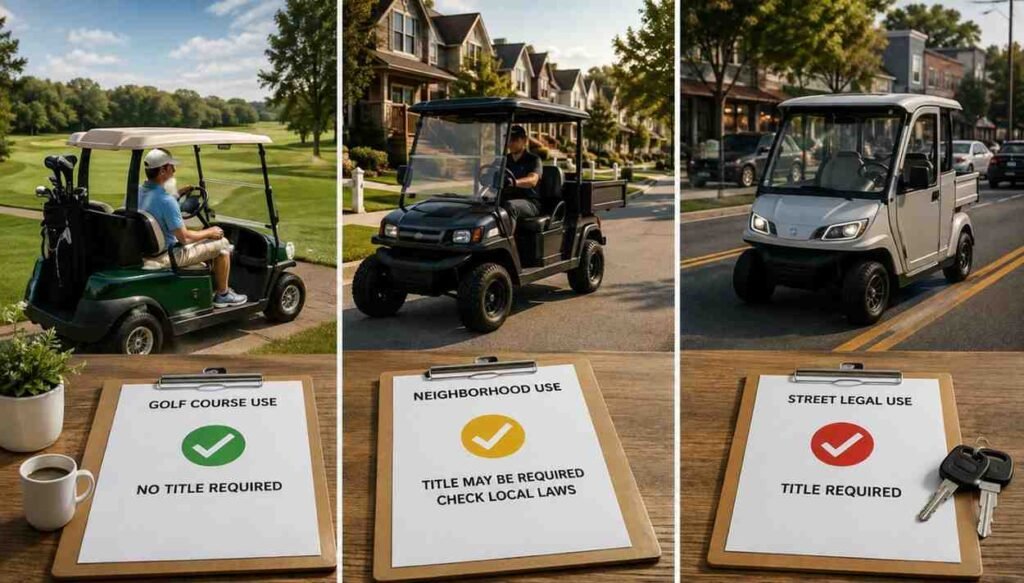
Think of golf carts on a spectrum. On one end you have a basic gas or electric cart used exclusively on a private course or a gated community’s internal paths. On the other end you have a fully outfitted LSV with lights, mirrors, and a top speed of 25 mph driven on public streets. The paperwork burden scales with how far toward the street-legal end you sit.
|
Cart Type |
Typical Title Needed? | Registration Required? | VIN Required? |
|---|---|---|---|
| Standard course/private property cart | No | No |
No |
|
Street-legal golf cart (neighborhood EV, 20 mph max) |
Varies by state | Often yes | Sometimes |
| LSV (20 to 25 mph, NHTSA-compliant) | Yes, in nearly all states | Yes |
Yes |
|
Modified cart exceeding 25 mph |
Yes (classified as motor vehicle) | Yes |
Yes |
The table above reflects general patterns. Your specific state may be stricter or more lenient. Arizona, Florida, and South Carolina are notably permissive about low-speed golf cart use on public roads within designated communities. California and New York apply stricter rules. We will get into the state-by-state picture in a dedicated section below.
Do Street Legal Golf Carts Have Titles?
Do street legal golf carts have titles? Yes, and this is the category where most owners get tripped up. A cart that is legal to drive on a public road is not just a golf cart in the eyes of your DMV. It is a motor vehicle subject to the same paperwork trail as a car or truck.
The confusion happens because “street legal” means different things in different states. In Florida, for example, a golf cart can legally cross certain public roads under Florida Statutes Section 316.212 without being titled as a motor vehicle, as long as the local municipality has designated those roads for golf cart use and the cart stays under 25 mph. But the moment you take that same cart onto a non-designated road, you need LSV certification, a title, and registration.
Do street legal golf carts have titles in those grey-zone communities? Often they get a local registration permit rather than a full state title. But if you ever try to sell the cart or move to a different state, that local permit is nearly useless. A proper state-issued title is always the stronger document to hold onto.
My honest take: if you have any plan to drive your cart beyond private property, even occasionally, get it properly titled now. The $50 to $150 it costs up front is nothing compared to the bureaucratic maze of trying to establish ownership later without one.
Golf Cart VIN and Title: Why the VIN Matters So Much
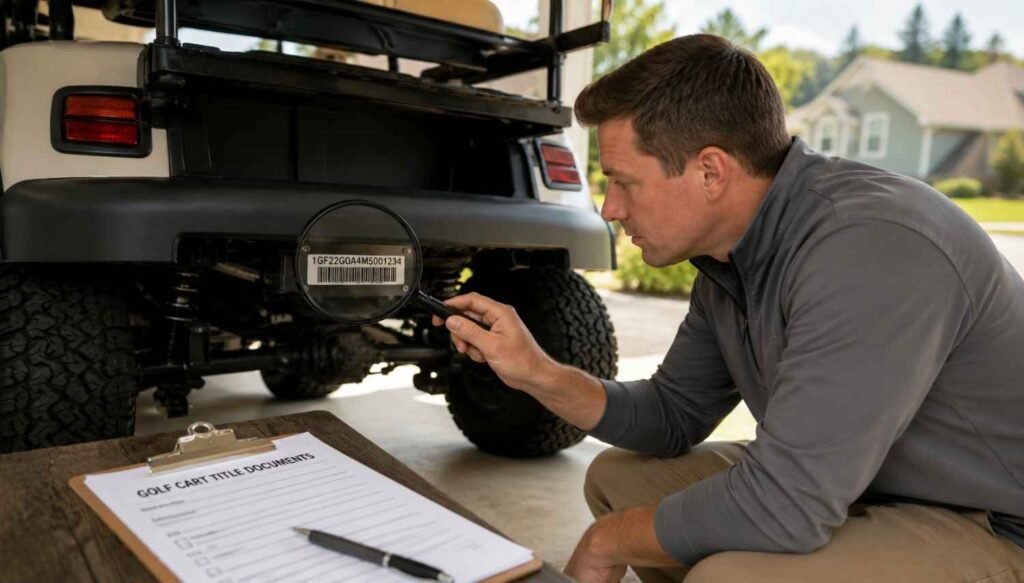
Your golf cart VIN and title are connected at the hip. You cannot get a state-issued title without a VIN, and not every golf cart comes with one from the factory. This is one of the most overlooked complications in golf cart ownership. What to eat after a round of golf for recovery can also be useful to consider for players who spend several hours on the course.
Standard recreational carts from brands like Club Car, Yamaha, and EZ-GO do have serial numbers, but those are manufacturer serial numbers, not federally standardized 17-digit VINs. When a cart needs to be titled as an LSV, the manufacturer assigns a proper VIN that conforms to federal standards. If your cart was not built as an LSV from the factory, you may need to apply for a state-assigned VIN through your DMV, a process that usually involves a physical inspection of the cart.
The golf cart VIN and title issue gets especially complicated with older or heavily modified carts. If a previous owner swapped out the frame or the motor, the original serial number might not even be on the vehicle anymore. In that scenario, most states require you to apply for a bonded title or go through a court order to establish ownership. Neither process is quick or cheap, which is exactly why verifying the VIN before you buy a used cart is so critical.
“The number one mistake we see with golf cart purchases is buyers accepting only a bill of sale with no serial number verification. When they try to get a title later, they realize the cart’s identity is essentially a mystery to the state.”
Shared by a frequently cited perspective in the Golf Cart Resource community, reflecting a consensus view among dealers and DMV processors who handle golf cart title applications regularly.
Golf Cart Bill of Sale vs Title: Which One Actually Protects You
This is a question that comes up constantly in online golf cart forums, and the answer is clear: a title is dramatically stronger protection than a bill of sale. Understanding the golf cart bill of sale vs title distinction could save you from buying someone else’s legal problem.
A bill of sale is simply a contract between two private parties. It says “Person A sold this cart to Person B on this date for this amount.” That is it. It does not prove Person A actually owned the cart. It does not clear liens. It does not transfer legal ownership in any state’s motor vehicle database. If the cart was stolen, financed, or disputed, the bill of sale offers you very little recourse.
A title, on the other hand, is a government-issued document that establishes legal ownership. When you buy a cart and the seller signs over the title to you, the state recognizes you as the legal owner. If the cart was ever financed, the lienholder’s name appears on the title and must be satisfied before the transfer is complete. That transparency protects you.
So which one should you insist on when buying? Both, ideally. Get the signed title transfer for the legal protection and keep the bill of sale as a supporting record of the transaction price and date. The golf cart bill of sale vs title debate only exists because so many carts have never been formally titled. For carts that are simply not titleable under your state’s laws, a notarized bill of sale with the manufacturer serial number clearly written is the next best thing.
Do Used Golf Carts Come With Titles?
Do used golf carts come with titles? Honestly, many do not, and that is not always a red flag. If a cart has spent its whole life on private property or a golf course and the state never required a title for it, there simply is no title to transfer. That is a legitimate situation. The problem arises when a cart should have been titled but was not, or when a seller cannot explain why the title is missing.
Do used golf carts come with titles when they were previously registered as LSVs? They absolutely should. If someone registered a cart for street use in a state that requires LSV documentation, a title was created. That title must accompany the sale. A seller who cannot produce it for a previously registered cart should raise serious concerns.
Here is a practical scenario. You find a 2019 Polaris GEM on Facebook Marketplace listed for $8,500. GEM vehicles are factory-built LSVs. They come with VINs and are titled as motor vehicles in every state that recognizes LSVs. If that seller does not have a title, you need to know why before you hand over any money. The cart could have a salvage history, an outstanding loan, or a disputed ownership situation that you would inherit entirely.
State Golf Cart Title Laws: How Much They Vary
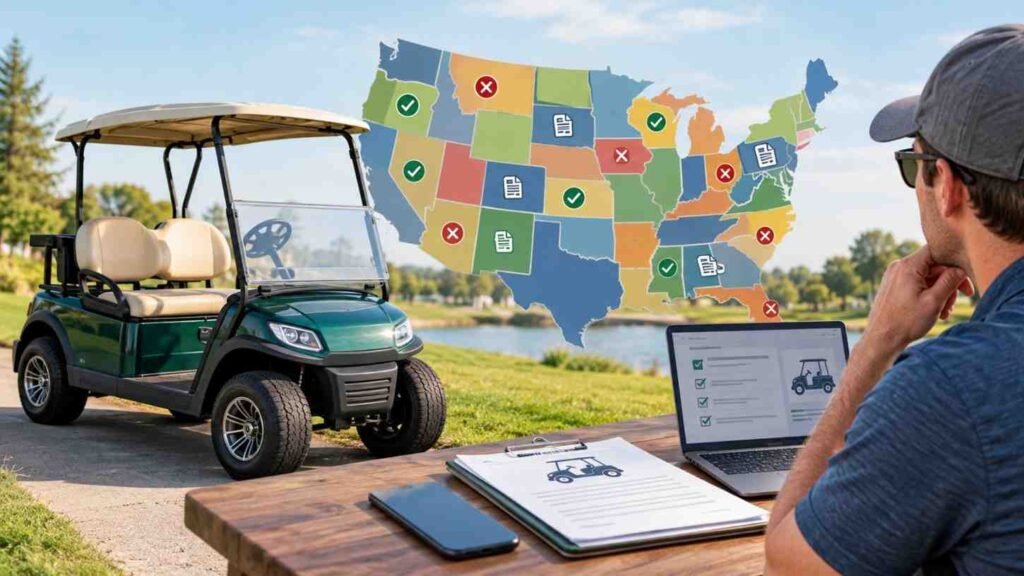
State golf cart title laws are genuinely all over the map. There is no single federal standard for when a golf cart must be titled. Every state has carved out its own rules, and some have changed those rules multiple times in the past decade as electric carts and LSVs have become more popular. Knowing your state’s exact requirements is not optional if you plan to ride anywhere beyond your own driveway. Players should also keep golf hydration tips for hot weather in mind when spending extended periods outdoors.
A few states worth knowing in detail:
- Florida: Does not require a title for standard golf carts, even those driven on designated public roads within communities. LSVs must be titled and registered. Golf cart operators must be at least 14 years old on designated roads. See the Florida Statute 316.212 for exact language.
- Georgia: Requires golf carts operated on public roads to be registered with the local county but does not require a state title for carts under 20 mph. LSVs over 20 mph require a full state title.
- California: Has strict LSV title requirements and requires that all carts driven on public roads be registered with the DMV and carry a certificate of title. The California DMV treats LSVs as motor vehicles without exception.
- Texas: Requires a title and registration for any golf cart used on a public road, including specially designated golf cart roads. Texas also requires liability insurance for on-road use.
- South Carolina: Permits titled and registered golf carts on roads with speed limits of 35 mph or less within four miles of a golf course or the cart owner’s residence. Proof of ownership, registration, and a slow-moving vehicle emblem are required.
State golf cart title laws are updated regularly, so always verify current rules directly with your state DMV before purchasing or modifying a cart for road use. The NCSL maintains a useful state-by-state overview of low-speed vehicle and golf cart laws that is a solid starting point.
LSV Title Requirements: The Stricter Standard
LSV title requirements follow a more demanding path than standard golf cart rules because LSVs are federally recognized vehicle types. If your cart qualifies as an LSV under NHTSA’s definition, here is what you are dealing with in most states:
The cart must have a 17-digit VIN assigned by the manufacturer. It must meet Federal Motor Vehicle Safety Standard 500, which covers lights, reflectors, mirrors, seat belts, a windshield, and a parking brake. Your state DMV will likely require proof that the cart meets FMVSS 500 before issuing a title, which usually means presenting the manufacturer’s certificate of origin (the factory equivalent of a title for a new vehicle).
LSV title requirements also typically include liability insurance in most states. Some states cap LSV operation to roads with speed limits of 35 mph or lower, and a few extend that to 45 mph roads. The title itself looks identical to a standard vehicle title because, legally, that is exactly what it is.
One nuance worth flagging: a cart that can physically go 28 mph but was not built to FMVSS 500 standards is not an LSV. It is an illegally modified golf cart. Titling it as an LSV requires bringing it into compliance first, which can be an expensive project depending on what is missing.
Golf Cart Registration and Title: The Application Process
Getting your golf cart registration and title sorted is a multi-step process that varies by state, but the general framework is consistent enough to walk through here. Think of this as a practical checklist you can actually use.
- Confirm your cart’s classification under your state’s law. Is it a standard golf cart, a street-legal neighborhood cart, or a federally defined LSV? That classification determines which DMV form you need.
- Locate the manufacturer serial number or VIN. For new LSVs, get the Manufacturer’s Certificate of Origin from the dealer. For used carts, get the existing title or bill of sale with the serial number.
- Check for any liens. If the previous owner financed the cart, the lender’s name may appear on the title. That lien must be released in writing before you can transfer ownership cleanly.
- Visit your county DMV office or use your state’s online title application portal. Bring the signed title transfer (or bill of sale for untitled carts), your proof of identity, proof of residency, and payment for title and registration fees.
- If your state requires an inspection for carts without an existing VIN, schedule that before going to the DMV. Some states send an inspector to you; others require you to bring the cart to a designated facility.
- Once the title is issued, keep it in a safe location, not in the cart. Losing a title creates a replacement process that takes weeks and costs money.
The golf cart registration and title process for a straightforward LSV with clean paperwork typically takes two to four weeks from application to receiving your documents by mail. Complicated situations, like bonded titles for carts with missing documentation, can stretch to 60 days or longer.
How to Get a Title for a Golf Cart Without One
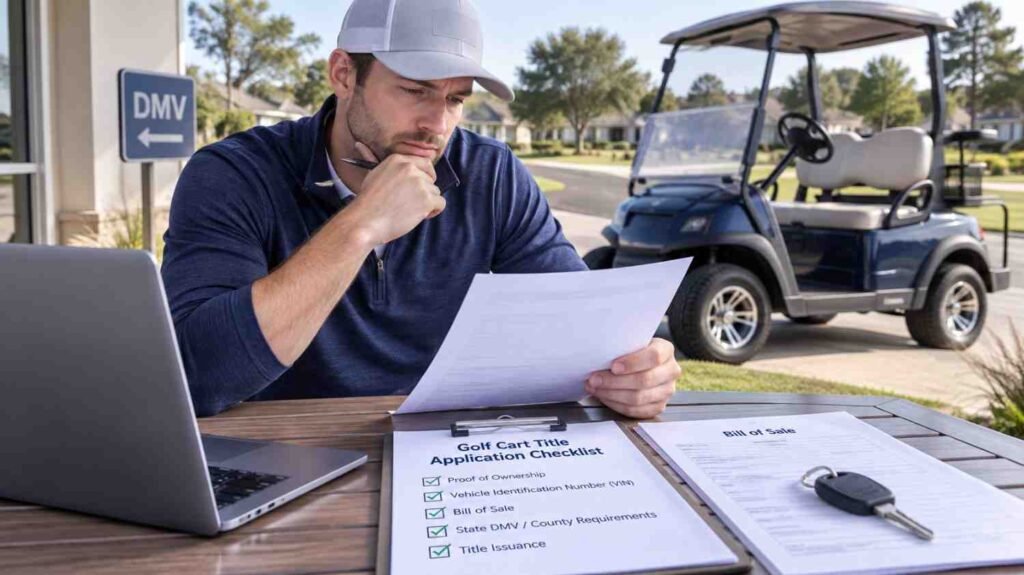
This is the scenario that causes the most frustration, and it is more common than you would think. You bought a used cart, you have only a bill of sale, and your state requires a title for your planned use. So how to get a title for a golf cart in that situation?
Your options depend on the state and the cart’s documented history. The most common paths are:
Bonded title: You purchase a surety bond equal to one to one and a half times the cart’s appraised value. The bond protects anyone with a prior claim on the cart. After a waiting period (usually one to three years), the bond is released and you receive a clean title. This is available in most states for vehicles with no existing title record.
Court-ordered title: You petition a local court to establish ownership based on the evidence you have, such as a bill of sale, payment records, or sworn testimony from the previous owner. The court issues an order that the DMV uses to create a new title in your name. This process is slower and more expensive than a bonded title but sometimes necessary.
Vermont title trick: Vermont is one of the few states that will issue a title for a vehicle based solely on a bill of sale, without requiring prior registration history. Many cart owners in states with complicated title processes register the cart in Vermont first, receive a Vermont title, and then use that title to transfer registration to their home state. This is legal but requires the cart to meet Vermont’s minimum safety requirements for the vehicle class.
Understanding how to get a title for a golf cart through these alternative routes takes patience, but it is genuinely doable. The worst thing you can do is ignore the problem and try to sell the cart later without any documentation.
Do Golf Carts Need a Title on Private Property?
If the cart never leaves private land, no. Do golf carts need a title for use on a private golf course, a farm, a large residential estate, or an amusement property? In every state, the answer is no. Title and registration requirements only apply to vehicles operated on public roads or public property.
But here is where many owners get surprised. Homeowner association roads inside a gated community are not always legally private. In many jurisdictions, roads within a planned community are publicly platted even if they feel private, which can trigger the same road-use rules as any other public street. If your HOA community is debating this, the answer often depends on whether the roads were ever dedicated to the public as part of the original subdivision plat. Your county clerk’s office can tell you.
Practically speaking: do golf carts need a title when you buy one for casual backyard or property use? No. Do they need one the moment you consider crossing onto a public road, even once? That is when you need to check your state’s specific rules immediately, because the answer is often yes.
A Framework for Deciding Whether You Need a Title
I call this the “Where Does It Roll?” framework. It cuts through the confusion faster than reading any single rulebook because it starts with your actual use case rather than abstract legal categories. Muscle recovery for golf injury is another consideration for golfers who regularly spend long hours on the course or deal with physical strain.
Step 1: Map every surface the cart will travel on. Private land only? You almost certainly do not need a title. Any public road at all? Move to Step 2.
Step 2: Check your state’s specific definition of “golf cart” versus “LSV” versus “motor vehicle.” These three categories carry different title obligations. Your state DMV website will have this, usually under recreational vehicle or low-speed vehicle regulations.
Step 3: Look at your cart’s top speed and safety equipment. Under 20 mph with no street-legal equipment? Probably a standard golf cart. Between 20 and 25 mph with lights, mirrors, and seat belts? Likely an LSV. Over 25 mph? Almost certainly classified as a motor vehicle regardless of what it looks like.
Step 4: Check whether the cart has a proper VIN. No VIN means no LSV title without going through the state inspection and VIN assignment process first.
Step 5: Decide whether to title it regardless of legal requirement. Even if your state does not require a title for your use case, having one makes the cart dramatically easier to sell, insure, and prove ownership of. That is almost always worth the small upfront cost.
Do Golf Carts Have Titles When Bought New from a Dealer?

For standard recreational carts, a new dealership sale typically comes with a Manufacturer’s Statement of Origin (MSO) or a manufacturer’s certificate of origin (MCO) rather than a consumer title. That document is the starting point if you ever need to apply for a formal title later. Keep it with your other ownership records.
For new LSVs sold at a dealership, you usually receive a formal title in the mail within 30 to 60 days of purchase, just like buying a new car. The dealer handles the title application as part of the transaction. If your dealer is not doing that for an LSV purchase, ask explicitly about the title status before you drive off the lot.
And do golf carts have titles when they are brand new fleet carts sold to a golf course? Typically no. Golf courses are private property operators, and their carts are treated more like commercial equipment than registered vehicles. That is why course carts often have no title history if they ever enter the private resale market. Buying a former fleet cart is fine, but just know that establishing a title for it may require more paperwork than a cart that was previously sold as an LSV or street-legal unit.
Protecting Your Investment: The Title Checklist
Before you buy any used golf cart, run through this list. Every item matters.
- Ask for the title first, before negotiating price. A seller who cannot produce a title for a cart that should have one is signaling a potential problem.
- Write down the manufacturer serial number or VIN and run it through your state’s title search tool or ask your DMV to check for any record of it.
- If a title exists, verify the seller’s name matches the name on the title. A mismatch means there is a title gap that must be resolved before the transfer can happen cleanly.
- Check for lien releases if the cart was previously financed. Ask the seller to provide written confirmation that no balance is outstanding.
- Get a bill of sale regardless of whether a title exists. Include the purchase price, date, both parties’ names and addresses, and the full serial number or VIN.
- If the cart has no title and you need one, get the seller to lower the price to account for your time and cost in obtaining a bonded title or pursuing another resolution.
Conclusion
The answer to “do golf carts have titles” is simpler than it first appears once you know the right variables to check: where the cart travels, how fast it goes, and what your state’s specific laws say about that combination. Standard course carts on private property need nothing. LSVs on public roads need everything. The tricky middle ground is where most buyers get caught.
If you already own a cart without a title and you want street access, the bonded title route is usually your fastest path to clean ownership. If you are buying used, insist on seeing any existing documentation before money changes hands. And if you are unsure about your state’s current rules, spend 20 minutes on your DMV’s website or call them directly. The rules shift, and a quick phone call is always cheaper than untangling a title problem after the fact.
One final thought worth sitting with: a golf cart is a meaningful investment for most buyers. Treat the paperwork with the same care you give the mechanical inspection. The title is not just a bureaucratic formality. It is proof that what you bought is actually yours.