Costco sells a four-piece urethane golf ball for under $25 a dozen, and the golf world still hasn’t fully recovered from the shock. That price point alone makes every serious golfer ask the same question: who makes Kirkland golf balls, and can they possibly be as good as the premium brands they’re being compared to? The short answer is that Nassco, a South Korean manufacturer, has been the primary producer behind the Kirkland Signature ball.
But the full story involves lawsuits, multiple reformulations, a supply chain that stretches across two continents, and a performance record that has made some tour-level players quietly pay attention. Here’s everything you need to know.
Who Makes Kirkland Golf Balls: The Manufacturer Breakdown
The question of who manufactures Kirkland golf balls is surprisingly complicated for a product you can grab alongside a rotisserie chicken. Costco does not operate its own golf ball factory. The Kirkland Signature golf ball manufacturer has varied across different product generations, and that matters because each generation performed differently on the course.
For the original three-piece Kirkland Signature ball that launched in 2016 and took the internet by storm, the widely accepted answer, based on industry sourcing and community research, is that Nassco produced it. The South Korean company has significant golf-ball manufacturing expertise and has reportedly held production contracts for several major brands over the years.
That experience is part of why the Kirkland ball felt premium from the first sleeve you opened. Still, equipment knowledge should complement practical golf tips that help you play better, since no ball can replace sound technique and smart course management.
The current 4-piece Kirkland Signature Performance+ ball, which is what you’ll find on shelves today, is also believed to be sourced from Nassco or a closely related South Korean facility. The Kirkland golf ball production chain runs primarily out of South Korea, which answers the parallel question golfers always ask about where are Kirkland golf balls made. They are not made in the United States. They arrive at Costco distribution centers after being manufactured overseas, which is a significant reason Costco can hit that price point without sacrificing construction quality.
This matters to your game because the manufacturing process and materials determine compression, spin rates, and feel around the greens. South Korean golf ball manufacturing, particularly from companies like Nassco, is not a budget tier. These facilities produce balls for a wide range of performance tiers.
Are Kirkland Golf Balls Made by Titleist? Clearing Up the Biggest Myth
This rumor refuses to die. Ask on any golf forum and someone will insist that the Kirkland Signature is basically a Titleist Pro V1 in a different box. The truth is more nuanced and arguably more interesting.
The question of are Kirkland golf balls made by Titleist gets a clear no. Titleist, owned by Acushnet, manufactures its balls primarily in New Bedford, Massachusetts, and has no relationship with Costco’s supply chain. Acushnet has been famously protective of its intellectual property, which is actually what fueled the lawsuit that temporarily pulled the original Kirkland ball off shelves in 2016 and 2017.
Acushnet sued Costco in 2016, claiming the Kirkland Signature ball infringed on 11 of its patents. Golf Digest reported the settlement between Acushnet and Costco in 2017, with the terms remaining confidential. What that lawsuit confirmed, indirectly, is that the Kirkland ball was technologically sophisticated enough that Acushnet felt genuinely threatened. You don’t sue over a product that poses no competitive threat.
So no, Titleist doesn’t make these balls. But the fact that Titleist lawyers took the time to file those patent claims tells you something real about the Kirkland golf ball origin and what the construction actually delivers. The comparison to a Pro V1 in terms of feel and performance is less absurd than it sounds, even if the manufacturing lineage is completely separate.
“The Kirkland ball is legitimately one of the best values in golf. The urethane cover and four-piece construction give you something that genuinely competes with balls costing three times as much. Golfers who dismiss it without testing it are leaving performance on the table.”
This sentiment has been echoed consistently across major golf equipment review communities, including the MyGolfSpy community forum, where independent testers have compared the Kirkland Performance+ against Tour-level balls from Titleist, Callaway, and TaylorMade in controlled conditions.
Who Owns Kirkland Golf Balls and What “Kirkland Signature” Actually Means
Understanding who owns Kirkland golf balls requires a quick look at how Costco’s private label brand works. Kirkland Signature is not a separate company. It is Costco’s house brand, owned entirely by Costco Wholesale Corporation, headquartered in Issaquah, Washington. The Kirkland golf balls company is, simply put, Costco itself.
Costco uses the Kirkland Signature label across hundreds of product categories, from olive oil to dress shirts to batteries. The brand strategy is consistent: source from manufacturers who already produce high-quality goods for name brands, negotiate favorable pricing through massive volume purchasing, and pass the savings to Costco members. The golf ball fits this model perfectly.
The Kirkland golf balls brand history on the equipment side is relatively short. Golf balls didn’t appear under the Kirkland Signature label until 2016, which makes the brand’s rapid rise in the golf community even more striking. Within weeks of the original launch, online stock sold out repeatedly. Costco’s website crashed under demand. The brand went from zero name recognition in golf to being a genuine conversation topic at country clubs and public courses simultaneously.
That brand history is also marked by inconsistency in availability. Costco has pulled and relaunched the ball multiple times, changed the construction from 3-piece to 4-piece, and adjusted pricing. If you’ve been frustrated finding them in stock, you’re not alone. That supply volatility is actually a direct consequence of Costco’s outsourced manufacturing model. They don’t control a factory, so production runs are ordered in batches rather than produced continuously.
The Kirkland Golf Ball Production Timeline: Every Generation Explained
The Kirkland golf ball production history has three distinct phases, and knowing which version you’re buying matters if you care about performance.
| Generation | Year Launched | Construction | Cover | Price per Dozen | Status |
|---|---|---|---|---|---|
| Version 1 (3-piece) | 2016 | 3-piece | Urethane | $14.99 | Discontinued |
| Version 2 (3-piece relaunch) | 2018 | 3-piece | Urethane | $22.99 | Discontinued |
| Performance+ (4-piece) | 2021 | 4-piece | Urethane | $24.99 | Current |
The jump from 3-piece to 4-piece construction was significant. A 4-piece ball gives you more separation between the layers responsible for distance off the tee and the layers responsible for spin around the greens. That’s the same architectural approach Titleist uses in the Pro V1x and TaylorMade uses in the TP5. The current Performance+ is genuinely the most capable ball Costco has produced under this label.
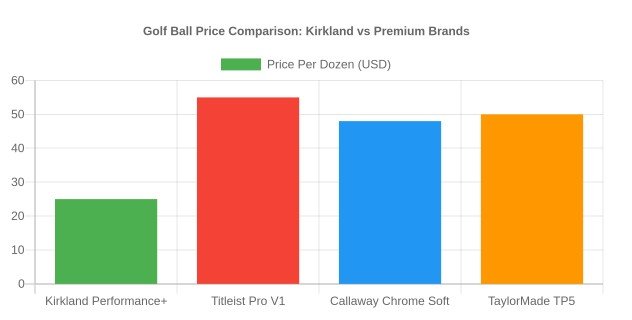
According to MyGolfSpy’s Ball Lab testing, the Kirkland Performance+ produced short game spin numbers that compared favorably with balls priced at $50 per dozen. That’s not a marketing claim. That’s a third-party robot test.
The “Nassco Connection” Framework: How to Think About Private Label Golf Balls
Here’s a framework I’d call the Manufacturer Separation Model, and it’s genuinely useful any time you’re evaluating a private label golf product. The brand on the box and the company that built the thing are often completely different entities. Your job as a golfer is to figure out the manufacturing tier, not just the retail brand.
Applied to the Kirkland situation, here’s how it works in practice. You know the Costco golf ball manufacturer is an external South Korean facility. You know that facility has the technical capability to produce multi-layer urethane balls. You know the product passed a real-world torture test when Acushnet’s legal team examined it closely enough to file patent claims. That three-point check tells you the manufacturing tier is legitimate, regardless of what the box says.
You can run this same check on any ball you’re considering. Who makes it? What’s their production history? Has anyone with serious IP stakes taken the construction seriously? If the answers come back positive across all three points, the ball is worth testing.
The Kirkland Signature passes on all three. That’s why who makes Kirkland golf balls is a question worth asking, not just for curiosity, but for making a genuinely informed buying decision before you commit to a brand for a whole season.
Practical Buying Guide: Should You Game the Kirkland Ball?
Whether the Kirkland Performance+ belongs in your bag depends on four things. Work through this checklist before your next order, just as you would confirm how many clubs are allowed in golf bag setups before a competitive round.
- Your swing speed: The Performance+ is optimized for moderate to high swing speeds, roughly 90 mph and above with a driver. If your swing speed sits below that, a softer, lower-compression ball might serve you better.
- Your short game priority: If you rely heavily on spin control around the greens and want a soft, responsive urethane feel on chips and pitches, this ball delivers that. It’s not a surlyn-covered distance ball pretending to be premium.
- Your tolerance for availability issues: Costco runs out. Sometimes for months. If inconsistent supply will disrupt your routine, you’ll want a backup option or a second brand you’re comfortable switching to mid-season.
- Your current ball cost per round: If you’re losing three balls a round and paying $55 per dozen for Tour balls, you’re spending real money on balls that are hitting ponds and tree lines. The Kirkland Signature at $24.99 cuts that cost almost in half without sacrificing urethane performance.
My honest take: if you’re a 15-handicap or better and you’re still paying full price for Pro V1s, you should test a sleeve of Kirklands on your next round before making your next order. The Kirkland Signature golf ball manufacturer produces a ball that deserves a real test, not a dismissal based on the Costco logo.
Who Manufactures Kirkland Golf Balls: What the Industry Still Won’t Confirm

Costco has never publicly named its manufacturing partner for the Kirkland golf ball with full transparency. That’s deliberate. Retailer-manufacturer relationships in private label industries are typically confidential, and Costco is famously tight-lipped about its supply chain across every category. The Nassco attribution comes from golf industry sourcing, trade reporting, and community research rather than an official Costco press release.
This opacity is worth acknowledging because it means the specific Kirkland golf ball origin story could shift again. If Costco renegotiates with a different manufacturer for the next generation, the ball’s characteristics could change. That happened between the original 3-piece version and the current 4-piece Performance+. The construction improved, but the transition wasn’t announced with any fanfare. Golfers noticed because the ball felt different, and testing confirmed the structural change.
Staying current with the Kirkland golf balls brand history means paying attention to those shifts when they happen, not just trusting that today’s ball matches what someone reviewed two years ago. The Kirkland golf balls company (Costco) reserves the right to change suppliers, and they’ve done it before.
Keeping an eye on resources like GolfWRX’s equipment forums is genuinely useful here. When a new Kirkland ball hits shelves, the community tears it apart within days. Physical construction analysis, compression testing, and side-by-side comparisons with known Tour balls usually appear within a week of any new release. That crowd-sourced intelligence is faster and often more detailed than any single review outlet.
The Bigger Picture: What Kirkland Changed About the Golf Ball Market
Before 2016, the golf ball market operated on a fairly comfortable assumption: premium performance costs premium money, full stop. The major manufacturers charged $50 to $55 per dozen for their top-tier Tour balls, and golfers who wanted urethane covers and multi-layer construction paid it.
Kirkland broke that assumption publicly. When who makes Kirkland golf balls became a trending question in golf communities, it forced a broader conversation about what premium golf ball pricing actually reflects. Some of that price covers genuine R&D. Some of it covers tour staff contracts, sponsorship deals, and brand marketing. The Kirkland ball, with no tour staff and no TV ads, stripped those costs away entirely.
The result was a product that performed within measurable range of balls costing twice as much. That did not destroy the premium ball market, but it pushed competitors to introduce value-tier urethane options.
Callaway’s ERC Soft, Vice Golf’s lineup, and Snell Golf’s MTB Black all occupy a space that arguably expanded because Costco proved the price floor could drop without quality collapsing. However, golfers should also improve centered strike in golf, since consistent contact often affects performance more than the difference between value and premium balls.
That’s the lasting impact of the Kirkland golf ball origin story. A warehouse retailer figured out that Costco golf ball manufacturer relationships could produce a Tour-grade ball at a fraction of the retail cost, and the industry has been adjusting ever since.
Final Thoughts
The answer to who makes Kirkland golf balls points to Nassco in South Korea, operating under a private label contract for Costco, which owns the Kirkland Signature brand outright. The ball is not made by Titleist, but it’s sophisticated enough that Titleist’s legal team took it seriously. The Kirkland Signature golf ball manufacturer produces a 4-piece urethane ball that performs at a tier most golfers have no business dismissing based on price alone.
If you’re serious about your game and you haven’t played a round with the current Performance+, grab a box on your next Costco run and actually test it. The question isn’t whether a $25-per-dozen ball can be good. The question is whether your current ball is good enough to justify paying twice as much for it.
So what’s it actually worth to you to have a logo on your ball?