

Most golfers know the feeling: you finish a round, think about the three awful drives, the missed short putts, and the approach that flew 20 yards over the green. By the time you get home, you have already decided what needs fixing. The problem is that memory tends to highlight the shots that annoyed you most, not necessarily the shots that cost you the most strokes.
That is where data-driven golf improvement changes the conversation. Instead of relying entirely on feel or a vague sense that your swing is “off,” you can look at what actually happened. Shot tracking, launch monitors, club distances, strokes gained, and even simple practice statistics can reveal patterns that are easy to miss during a round. More importantly, they can help you spend your practice time on the things that matter.
Stop Guessing What Is Holding Your Game Back
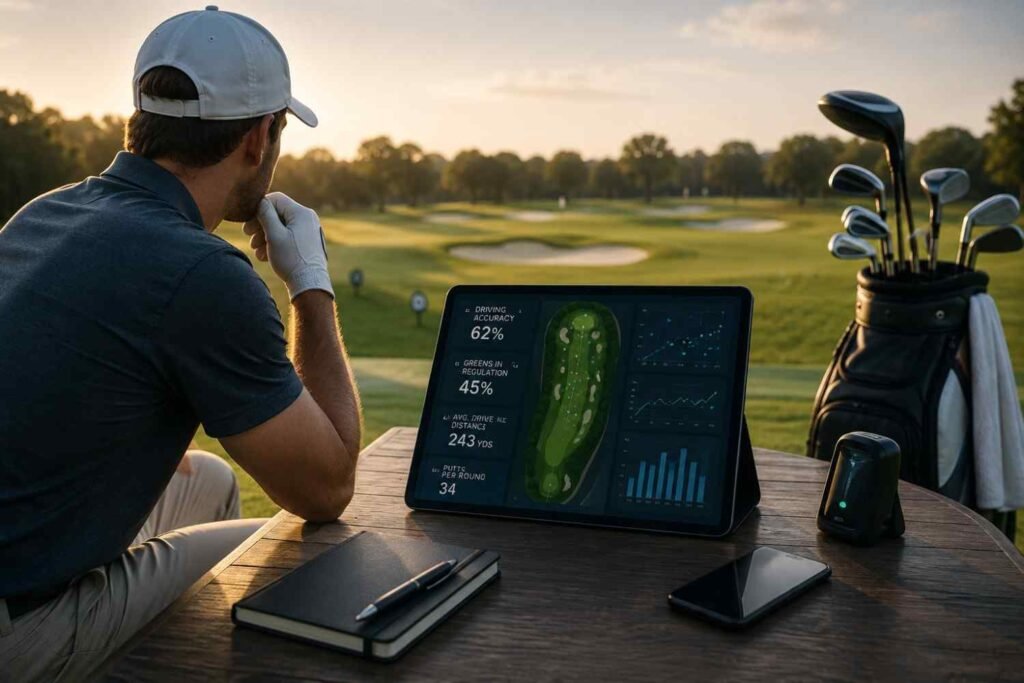
Golfers often practice the part of the game they notice most. A slice can make the driver feel like the obvious problem, while inconsistent approach shots quietly add more strokes to the scorecard. Data gives you a second opinion.
Tracking performance across driving, approach play, short game, and putting helps separate perception from reality. You might discover that your driver is not nearly as damaging as you thought, but your approach shots from 100 to 150 yards are costing you opportunities.
That distinction matters because better golf does not always come from practicing more. Sometimes it comes from practicing the right thing.
Look Beyond the Basic Scorecard
Fairways hit, greens in regulation, and total putts are useful starting points, but they do not tell the entire story. Strokes gained can provide a more detailed view by comparing your performance across different parts of the game.
Instead of simply saying, “I had 34 putts,” you can ask whether your putting performance was actually poor relative to your skill level. The same idea applies to driving and approach shots.
That makes performance data less about collecting impressive numbers and more about finding where those numbers point.
Use Swing Data to Understand What Is Actually Happening
A golf swing can feel completely different from what a camera or launch monitor shows. You may feel as though you are swinging from the inside, for example, while the club path tells a different story.
Modern golf technology can measure elements such as clubface angle, club path, angle of attack, ball speed, launch angle, spin rate, and shot direction. Some systems also analyze body movement, including posture, hip motion, and shoulder rotation.
That information can help a golfer and coach identify whether a ball flight comes from the movement they expected or from something happening earlier in the swing.
The real benefit comes from connecting the number to the result. If a small adjustment changes both the club delivery and the ball flight, you have something concrete to work with rather than simply hoping the swing feels better.
Turn Your Practice Sessions Into Targeted Work
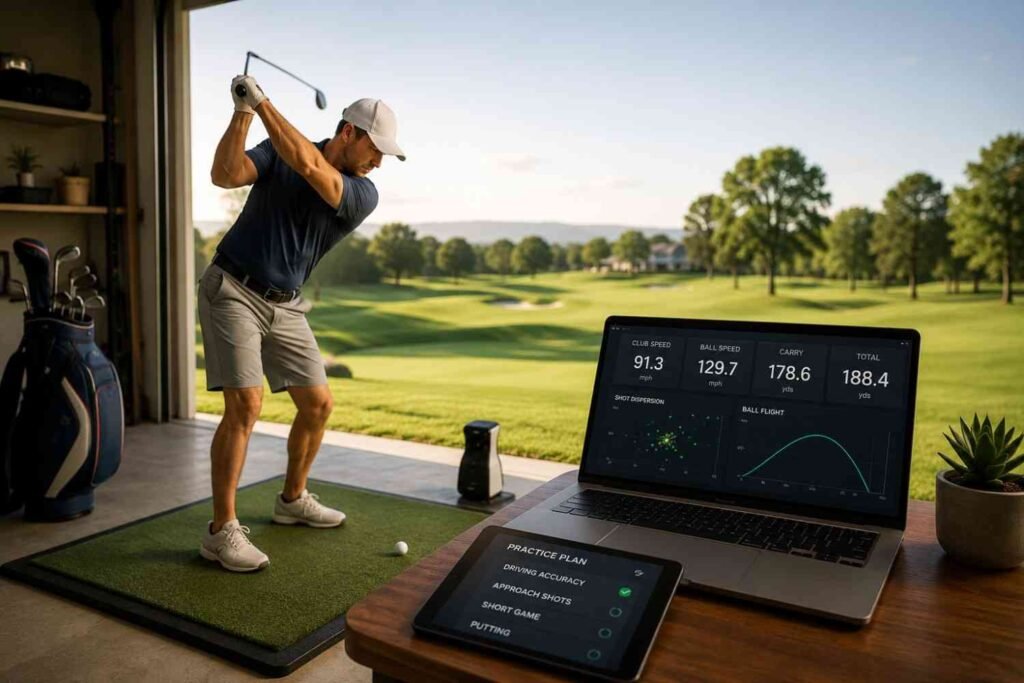
A range session can easily become 60 minutes of hitting balls without a clear purpose. You hit a few drivers, move to irons, finish with wedges, and leave feeling productive.
But did you actually work on your biggest weakness?
Performance data can make practice more deliberate. If your tracking shows inconsistent contact with mid-irons, that deserves more attention than hitting another 30 comfortable 7-irons. If your dispersion pattern with the driver is costing you playable positions, you can build drills around starting direction and shot shape.
Distance gapping is another practical example. Knowing your actual carry distances gives you better information than relying on the number printed on a club or your best-ever shot. A 7-iron that occasionally carries 175 yards does not mean you should automatically plan every 7-iron shot around 175.
If your biggest problem is inconsistent contact, understanding how to improve centered strike in golf can make practice much more useful because you are working toward repeatable contact rather than simply chasing distance.
Make Your Numbers Useful on the Course
Data becomes even more valuable when it leaves the practice range.
On-course tracking can reveal how your driving, approach shots, short game, and putting contribute to your score. Over several rounds, those patterns can help you make smarter decisions about where to aim, which clubs to choose, and when to take on risk.
Suppose your data shows that your driver produces more useful scoring opportunities than a conservative club, even when you occasionally miss the fairway. That could change how you approach certain tee shots.
The same principle applies to short-game decisions. If a simple bump-and-run gives you a wider landing area and a better chance of leaving the ball close, it may make more sense than attempting a delicate flop shot simply because it looks impressive.
Good course management is not about playing scared. It is about understanding your tendencies and making decisions that give your game a better margin for error.
You Do Not Need Every Piece of Golf Technology
It is easy to assume that data-driven golf improvement requires expensive equipment and a wall of numbers. It does not.
A launch monitor can provide detailed swing and ball-flight information. On-course tracking systems can record shots and performance trends. But even a notebook or spreadsheet can help you identify patterns.
Start with information you can actually use:
- Carry distances for your clubs
- Miss patterns
- Approach results by distance
- Three-putts and short-putt misses
- Fairway and green performance
- Scores and performance trends
The goal is not to become obsessed with statistics. It is to make your practice and decision-making more informed.
Data Still Needs Feel
Golf is not played inside a laboratory. Wind changes. Lies vary. Greens get firm or soft. Pressure affects decision-making. A shot that worked perfectly on the range might behave differently when you have water beside the target and a score to protect.
That is why data should support feel rather than replace it.
Use numbers to establish a baseline and identify patterns. Then learn how those changes feel in your swing. A coach can also help interpret the information instead of letting you chase every fluctuation in your numbers.
The best outcome is a balance: data tells you what is happening, while feel helps you execute it.
Build a Better Golf Improvement Loop

The biggest advantage of performance tracking is that it creates a repeatable process. You identify a weakness, work on it, measure the result, and then adjust again.
That approach also helps you learn how to improve driving accuracy and distance without automatically assuming you need to swing harder. The data may show that better contact, launch conditions, or dispersion matter more than adding raw clubhead speed.
A useful practice routine should follow the same logic. Rather than filling every session with random drills, how to build a golf practice routine that works becomes much easier when you already know which areas deserve the most attention.
Over time, that creates a feedback loop between practice and actual rounds. You are no longer judging improvement by whether one range session felt good. You are looking for repeatable changes that show up when you play.
Why Better Golf Starts With Better Questions
The real power of golf data is not the technology itself. It is the questions it helps you ask. Instead of wondering why your score refuses to drop, you can look at where those strokes are going. Instead of hitting another bucket of balls because your swing feels strange, you can identify the specific pattern that needs attention. And instead of treating every bad shot as evidence that something is broken, you can look at several rounds and decide whether there is actually a trend.
That shift can make improvement feel less frustrating. You still need practice, patience, and plenty of uncomfortable shots, but you have a clearer idea of why you are doing the work.
Golf will always have an element of feel. The smartest approach is not to eliminate it. It is to give that feel better information to work with.
Frequently Asked Questions: How Data-Driven Golf Improvement Can Change Your Game
1. What is data-driven golf improvement?
Data-driven golf improvement means using measurable performance information, such as shot tracking, strokes gained, launch data, club distances, and scoring patterns, to identify weaknesses and make more targeted practice decisions.
2. What golf statistics should beginners track?
Start with simple numbers such as scores, fairways, greens, putts, penalties, approach results, and club carry distances. You can add more detailed metrics once you understand how the basic information affects your game.
3. Can golf data really help lower my handicap?
Yes, when you use it to identify meaningful patterns and change how you practice or play. Data itself does not improve your swing; it helps you focus your time and decisions on areas that can make a measurable difference.
4. Do I need a launch monitor to improve with data?
No. Launch monitors provide detailed information, but golfers can start with a scorecard, shot-tracking app, or simple notes. The important part is consistently collecting useful information and acting on what it shows.