
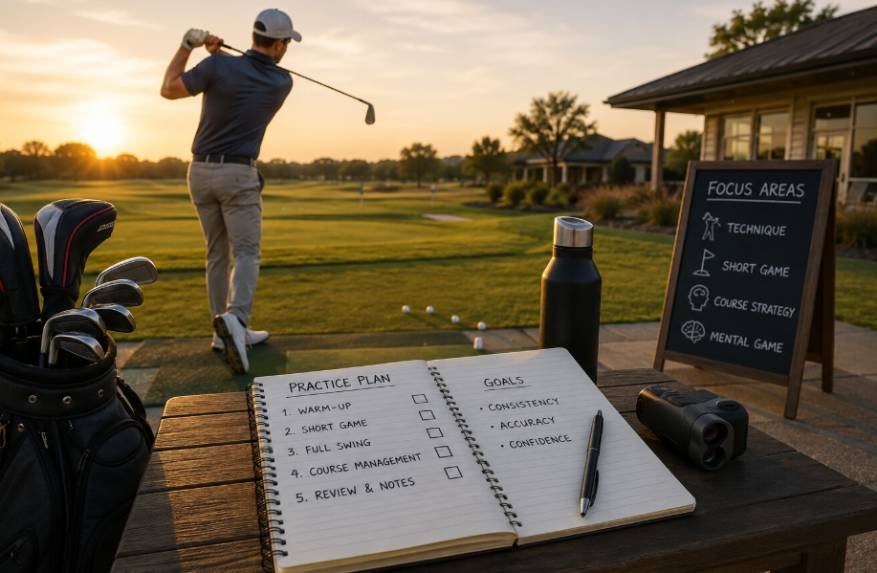
I used to think a productive golf practice session meant hitting a lot of balls and leaving the range feeling tired. If I struck a few clean drives and flushed some irons, I assumed I had done enough. The problem was that those sessions did not always show up on the scorecard. I was practicing plenty, but I was not always practicing the things that actually caused trouble during my rounds.
I eventually found that a better routine starts with a reason for every shot. Some sessions need technical repetition, while others should feel almost like a round of golf. Once I began separating those goals and paying attention to what was costing me strokes, practice became more focused. I did not necessarily need more time. I needed to use the time I already had better.
Start With What Is Actually Holding You Back

The first step is figuring out where your shots are going.
Look at your last few rounds and find the patterns. Maybe you are losing balls off the tee, leaving wedge shots short, three-putting too often, or struggling from greenside rough. Those problems should shape your practice routine.
Recent golf instruction has increasingly focused on building practice around measurable weaknesses instead of simply practicing favorite clubs. One current approach suggests giving the largest share of practice time to the biggest weakness, with smaller portions reserved for maintenance and enjoyment.
Be specific, too. “Improve my short game” is difficult to measure. “Get better from 20 to 40 yards” gives you something concrete to work on.
Your routine should change as your game changes. A problem that deserves 60 percent of your attention today may only need 20 percent a month from now.
Warm Up Before You Start Working
Do not make your first full-speed swing of the day a driver.
Start with dynamic movement and a few slow swings, then move into short wedge shots. Gradually increase the length and speed of your swings before moving into longer clubs.
A simple warm-up might take 10 minutes. Start with short half-swings, move toward fuller wedge shots, then progress through a mid-iron before reaching the driver.
This is not the part of practice where you need to chase perfect results. You are preparing your body and establishing contact before asking yourself to make technical changes or hit specific targets.
A structured warm-up is also useful when you have limited time. A recent short-session practice plan showed that even a 20-minute session can be organized around a brief warm-up, purposeful swings, specific targets, and feedback rather than simply hitting balls continuously.
Switch to Random Practice Before You Finish
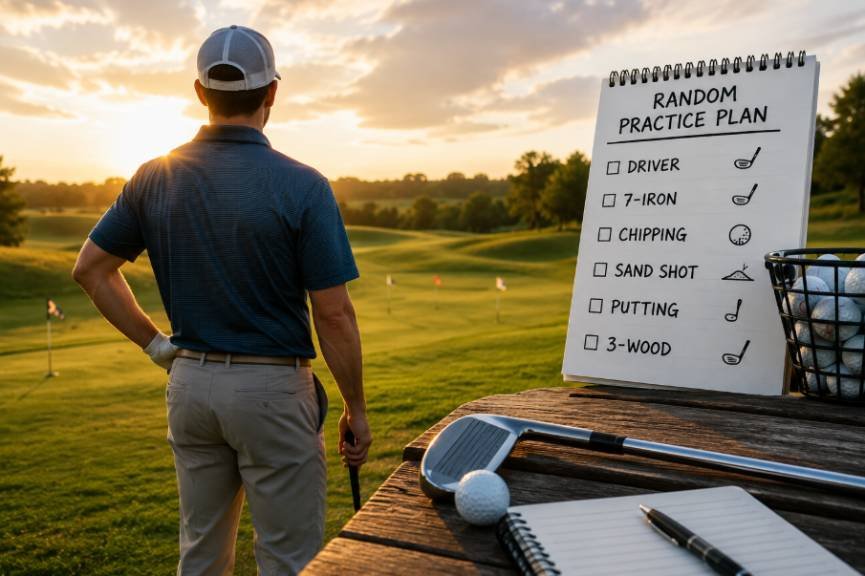
Once you have worked on the technical part, change the environment.
Hit a 7-iron, then a driver. Pick a different target. Hit a wedge. Change the distance. Go back to a long club. Treat each shot as if you are standing over a ball on the course.
That is random or variable practice, and it forces you to make decisions instead of simply repeating the same motion.
You can make it more realistic by following a pre-shot routine before every shot. Pick a target, visualize the ball flight, make your normal setup, and hit. Do not immediately rake another ball and swing again.
Practice games can make this even more effective. One useful format is to create imaginary fairways and greens and play through nine or 18 holes from the range, changing clubs and targets as you go. This type of practice brings more of the decision-making and focus of actual golf into a range session.
Make Your Practice Match Your Scoring Problems
Your practice routine should not be dominated by the driving range simply because hitting drivers feels more satisfying.
If missed greens are costing you strokes, spend more time around the green. If poor tee shots create recovery situations, work on your driving and course strategy. If you are consistently leaving long putts too far away, work on distance control.
Understanding how golf course difficulty is measured can also help you prepare for the challenges you are most likely to face. Course Rating, Slope Rating, effective playing length, hazards, and landing-area demands can all influence which parts of your game deserve extra attention before playing a particular course.
This is also where golf course management tips can influence your practice plan. If your rounds show that poor decisions are creating avoidable problems, practice should include more than ball striking. Rehearse choosing targets, accepting safer misses, and deciding when an aggressive shot is actually worth attempting.
The goal is to make practice reflect the golf you want to play, not simply the shots you enjoy hitting.
Give Your Short Game Enough Attention
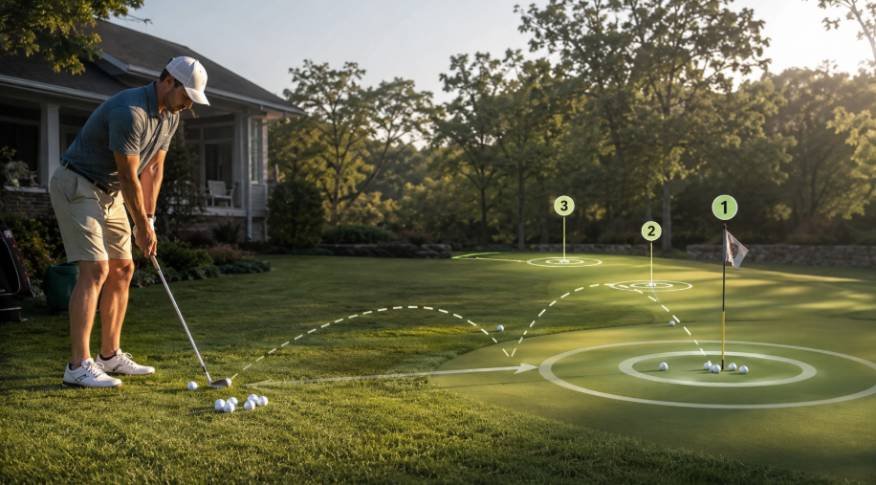
Short-game practice deserves a regular place in the schedule because these shots appear constantly during a round.
Do not practice only perfect lies. Change the lie, distance, landing area, and shot height. Hit some chips from clean fairway grass, then move into rough. Practice pitches, bunker shots, and awkward situations where the ball sits above or below your feet.
You can turn the session into a scoring game. For example, choose several different locations and give yourself one attempt from each. Keep score based on whether you get up and down.
This adds consequence to the shot. You are no longer hitting five chips from the same spot and taking the best one. You have one chance, just like you do on the course.
That same idea applies when practicing how to manage difficult approach shots. Instead of repeatedly hitting comfortable iron shots from perfect lies, create different distances, targets, and lies. Practice deciding where you want the ball to finish before choosing the club.
Make Putting Practice More Competitive
Putting practice becomes more useful when you stop treating it as endless repetition.
Spend part of the session on distance control. Hit putts from different lengths and focus on finishing within a small area around the hole.
Then add pressure. Try making a certain number of short putts in a row, or play a nine-hole putting game where two putts equal par. If you miss your target, keep score and try to beat your previous result.
Game-based putting can create pressure while keeping practice engaging. Structured putting games are also useful because they combine distance control, short-putt consistency, and the mental demands of having a result attached to each attempt.
Track Something That Matters
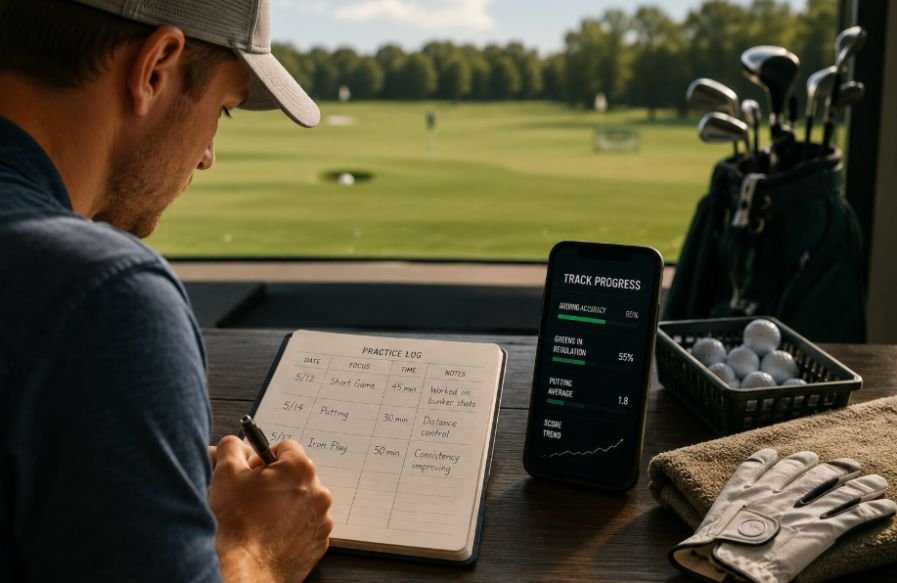
You do not need to record every piece of data your equipment can produce.
Choose a few numbers that actually tell you whether you are improving. You might track how many putts you make from six feet, how many wedge shots finish inside a chosen distance, how often you hit your target area, or how many up-and-downs you complete.
For technical practice, you may track a different metric. The important thing is consistency. Write down the result after the session and compare it over several weeks instead of judging your progress based on how good one practice session felt.
Technology can help, but it should answer a question rather than create more noise.
Build a Routine You Can Repeat
A good routine does not need to take two hours. A focused 45-minute session can be valuable if every part has a purpose.
You could spend 10 minutes warming up, 15 minutes on your main weakness, 10 minutes on random practice, and 10 minutes on putting or a short-game challenge. On another day, you might dedicate most of the session to the area costing you the most strokes.
If you have more time, expand the same structure instead of simply adding more balls.
And remember that practicing how to play safer without becoming too conservative is part of becoming a better decision-maker, too. Your goal is not to avoid every difficult shot. It is to understand your abilities well enough to know when a risk is worthwhile and when it is simply unnecessary.
Frequently Asked Questions
1. How often should I practice golf?
Consistency matters more than occasional marathon sessions. Two or three focused sessions each week can be more useful than one long session where your attention fades.
2. How long should a golf practice session be?
There is no perfect length. Even 20 focused minutes can help if you have a clear goal. Longer sessions should still be divided into purposeful sections.
3. Should I practice one club at a time?
Use one club when working on a technical change, then switch clubs and targets when practicing course-like decision-making. Both styles have a purpose.
4. How do I know if my practice routine is working?
Track a few meaningful results and compare them over several weeks. Improvement should eventually appear in your practice numbers and, more importantly, in your on-course performance.
Why Purpose Matters More Than Practice Time
A golf practice routine works when it connects what you do on the range to what you need on the course. That means identifying your biggest weaknesses, giving technical changes enough repetition to develop, then challenging yourself with different clubs, targets, lies, and pressure. It also means giving short game and putting the attention they deserve instead of spending every session chasing longer drives.
The best routine is not the one that fills the most hours. It is the one that gives every minute a reason.