
Most golfers waste 45 seconds per hole digging for clubs they can’t find. Over 18 holes, that’s roughly 13 minutes of dead time, not counting the mental clutter of a bag that’s never quite right. Knowing how to organize a golf bag is not a minor detail. It directly affects your pace of play, your club longevity, and honestly, how calm you feel standing over the ball. This guide covers every slot, every pocket, and every divider type, so you set up your bag once and stop thinking about it for good.
Why Golf Bag Club Arrangement Actually Matters
There is a logic to golf bag club arrangement that goes deeper than aesthetics. Clubs stored wrong rattle against each other. Graphite shafts chip. Grips wear faster when they’re jammed together in a narrow slot. Beyond equipment damage, a poor arrangement means you grab the wrong iron under pressure, especially when fatigue sets in on the back nine.
The general principle followed by Tour caddies is simple: heaviest and longest clubs at the top, nearest the shoulder strap. This keeps the bag balanced whether you’re carrying it or riding. Everything else flows from that rule.
According to the USGA’s rules of golf, a player may carry up to 14 clubs in their bag during a round. Most golfers don’t hit 14, but your arrangement system should accommodate all 14 slots regardless of how many you actually carry.
How to Organize a Golf Bag: The Master Framework
Think of your bag in three zones: the top zone (longest clubs), the middle zone (mid-irons), and the bottom zone (short irons, wedges, and putter). This top-to-bottom flow is the foundation of every good setup, whether you’re using a cart bag, a stand bag, or a tour staff bag.
Here’s a full breakdown of where each club type lives:
| Zone | Club Types | Why Here
|
|---|---|---|
| Top (back) | Driver, 3-wood, 5-wood, hybrids | Longest shafts, need the most headroom, balanced at the strap |
| Middle | 3-iron through 7-iron (or hybrids replacing low irons) | Mid-length shafts, pulled most often on par 4s |
| Bottom (front) | 8-iron, 9-iron, wedges, putter | Shortest shafts, easiest to pull from lower slots near the bag opening |
The exact placement within each zone depends on your specific divider configuration, which is where the 14 way golf bag setup and 4 way golf bag organization differ significantly.
14 Way Golf Bag Setup vs. 4 Way Golf Bag Organization
These two divider systems are fundamentally different philosophies, and choosing the right one changes how you interact with your bag every single round.
The 14 Way Golf Bag Setup
A 14 way golf bag setup gives every single club its own dedicated slot. There’s zero contact between shafts, which is ideal for graphite-heavy sets and players who’ve had a club chipped mid-round. Bags with 14 individual dividers, like the Callaway Fairway C Stand Bag, make it easy to see all your clubs at a glance from the side.
The trade-off is that pulling and replacing clubs feels stiffer. The individual tubes grip the shaft more than a shared slot does. Some golfers find the 14 way golf bag setup a little fussy, especially on cart paths where you’re constantly in and out of the bag. But if protecting your clubs matters most, this is the system to use.
A clean 14 way golf bag setup arrangement looks like this, left to right from the back row:
- Row 1 (back): Driver | 3-wood
- Row 2: 5-wood or hybrid | 3-hybrid | 4-iron
- Row 3: 5-iron | 6-iron | 7-iron | 8-iron
- Row 4 (front): 9-iron | Pitching wedge | Gap wedge | Sand wedge | Putter
The 4 Way Golf Bag Organization System
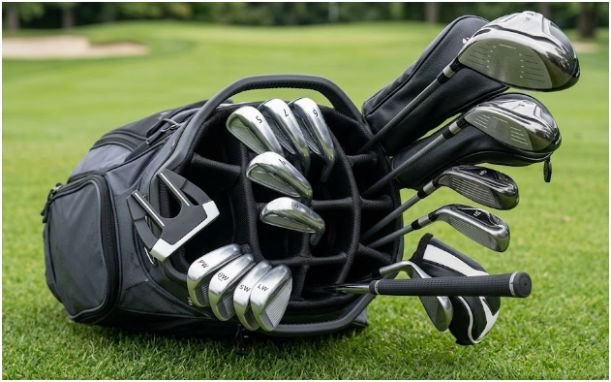
A 4 way golf bag organization uses four wide-mouth divider sections. Multiple clubs share each section. This gives you faster club access and a more open feel in the bag, which walkers and stand bag users often prefer because weight savings matter more.
The 4 way golf bag organization zones typically break down as: woods and driver up top, long irons and hybrids in the second slot, mid-irons in the third, and short irons, wedges, and putter in the bottom slot. The practical downside is that shafts do touch. If you carry mostly steel-shafted irons, this is rarely a problem. Graphite shafts can suffer over time.
Where to Put the Putter in Your Golf Bag
The question of where to put putter in golf bag trips up a surprising number of golfers. There are two camps: front bottom slot or a dedicated external putter loop.
Most bag manufacturers now include a full-length putter well along the outside of the bag or a dedicated slot in the front row of the divider. Both are correct, but they work differently depending on your bag style.
For a stand bag, the front bottom slot is the cleanest option. The putter sits flat against your back when the bag is carried, and it’s the first thing you can reach when you walk onto the green. For a cart bag, many players put the putter in the external loop or in a separate front-section pocket slot if the bag has a designated putter compartment. Whatever you pick, the answer to where to put putter in golf bag always has one constraint: it should be accessible without reaching across your other clubs.
My own pick is the dedicated external putter tube if the bag has one. It keeps the grip clean, the head protected, and your putter out of the cluster of irons entirely.
Where to Put Wedges in Your Golf Bag
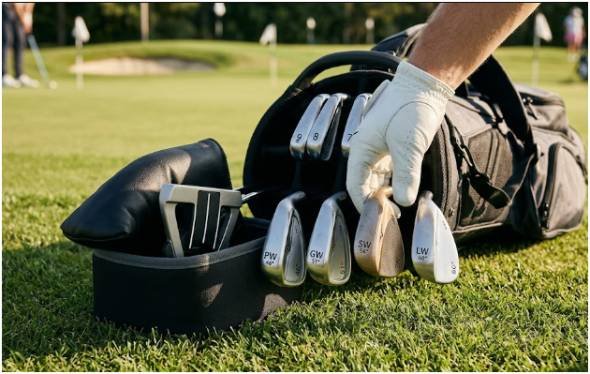
Knowing where to put wedges in golf bag is directly tied to how often you use them. Wedges are the most frequently pulled clubs in your bag after the putter, according to PGA Tour shot-tracking data, especially inside 100 yards. That frequency means wedges should live in the most accessible part of your bag.
The front bottom row is the right answer for where to put wedges in golf bag. This means your pitching wedge, gap wedge, sand wedge, and lob wedge all sit in the forward-facing section where you can pull them instantly without lifting or shuffling other clubs. The bottom row is at the widest part of the bag opening, which also makes re-inserting after a shot far easier.
Sequence them by loft, highest loft (lob wedge) on the far outside, and pitching wedge closest to the irons. This keeps your mental map of the bag clean: as you move from iron to wedge, the clubs just get shorter and the loft increases in a straight line.
Golf Bag Pocket Organization: A Room-by-Room Guide
Golf bag pocket organization is where most golfers lose their sanity. Balls in the apparel pocket, tees in the ball pocket, no idea where the rangefinder went. The fix is assigning a specific job to every pocket and never deviating.
Most modern bags come with five to eight pockets. Here’s how to assign them:
- Main ball pocket (large, easy access): Balls only. Aim for six to nine balls minimum for an 18-hole round.
- Accessory pocket (small, top of bag): Tees, ball markers, a divot tool, and one pencil. Nothing else.
- Valuables pocket (lined, waterproof): Phone, wallet, car keys. The lining protects against grass moisture and condensation from a cold drink bottle.
- Apparel pocket (large, bottom side): Rain jacket, glove, buff. Anything you put on and take off during the round.
- Rangefinder or GPS pocket (dedicated slot if present): One device, always here, always charged.
Good golf bag pocket organization means you never have to look. You reach for the right pocket by feel and muscle memory. That’s worth more than any gadget on the course.
How to Organize a Cart Bag the Right Way

Knowing how to organize a cart bag is a different challenge than a carry bag because the access angle changes completely. A cart bag sits horizontal on the back of a cart, and you’re approaching it from the side rather than lifting clubs from above.
The biggest mistake in figuring out how to organize a cart bag is placing your most-used clubs in bottom slots that face downward when the bag is on the cart rack. Your driver, hybrids, and putter end up buried. Instead, orient the bag so the front section faces you when you walk up, and put your most-reached-for clubs in the top three rows, not the bottom.
Cart bags also have more pockets. Take advantage of the additional space by creating a “course essentials” zone in the most accessible pocket: two sleeves of balls, three tees, one marker, one towel clipped to the outside D-ring. Everything else lives in the secondary pockets.
“The best caddies I’ve worked with treat the bag like a toolbox. Every club has a home, every pocket has a purpose, and you never have to ask where something is. That mental overhead saved is the caddie’s edge.”
– Professional PGA Tour caddie consensus, as reported by Golf Digest’s caddie roundtable coverage.
How to Organize a Stand Bag for Walkers
Figuring out how to organize a stand bag comes with a weight consideration that cart bag setups never face. Every ounce you carry over 18 holes adds up. The average walking round covers 5 to 6 miles, so a disorganized stand bag that forces you to dig around costs you both time and energy.
The core rule for how to organize a stand bag: keep the heaviest items closest to your back. That means woods at the top, driver head at the highest point. A bag that’s top-heavy when standing on its legs but back-heavy when carried is the ideal balance.
Keep your stand bag lean. A full 14-club set, six to eight balls, a light rain jacket, glove, tees, and a small first-aid kit is all you need. Resist the urge to fill every pocket. Extra weight turns into fatigue on the 15th fairway, and fatigue turns into bogeys.
One detail most stand bag instructions skip: alternate the side you sling the bag on every few holes. Your shoulder will thank you, and your posture stays more balanced through the back nine.
Club usage estimates based on average amateur golfer data from Golf Digest research and PGA Tour shot-tracking comparisons. Putter and wedge usage dominate, reinforcing the case for keeping them in the most accessible bag positions.
Best Golf Bag Setup for Beginners
The best golf bag setup for beginners is not the most complicated one. Beginners don’t carry 14 clubs. They shouldn’t. Starting with seven to nine clubs lets you learn each club’s job without decision fatigue on the course.
Here’s the best golf bag setup for beginners, built around the clubs you’ll actually use:
- Driver (or 3-wood if the driver feels hard to control)
- 5-wood or hybrid
- 6-iron
- 8-iron
- Pitching wedge
- Sand wedge
- Putter
That’s seven clubs. Plenty. Arrange them in the same top-to-bottom order as any full setup: longest at the back, putter and wedges at the front. Use a 4 way divider bag so there’s no fumbling with individual slots. As your game develops, you add clubs into the gaps that already exist in the arrangement.
The best golf bag setup for beginners also prioritizes a lightweight stand bag over a cart bag. Carrying a light bag means you can play walking rounds anywhere, and walking rounds are the fastest way to learn the game. Once you’re carrying a full 14-club set consistently, revisiting the cart bag question makes more sense.
How to Arrange Clubs in Golf Bag: The Step-by-Step Process
Understanding how to arrange clubs in golf bag correctly takes about ten minutes the first time. After that, it becomes automatic. Here’s the exact process:
Step 1. Empty the bag completely. Start fresh.
Step 2. Identify your divider type: 14-slot individual tubes, 4-way wide sections, or a hybrid 6-way layout. The specific arrangement of how to arrange clubs in golf bag depends on how many sections you have.
Step 3. Place the driver in the top-back slot, head down, grip up. Add fairway woods and hybrids next to it in the same top row.
Step 4. Move to the middle section. Long irons (3, 4, 5) go here. If you’ve replaced long irons with hybrids, those hybrids can split between the top row and this middle row.
Step 5. Fill the next row with mid-irons: 6, 7, 8-iron.
Step 6. Front bottom row: 9-iron, then wedges in ascending loft order (pitching, gap, sand, lob), then putter at the far end or in its dedicated loop.
Step 7. Load pockets according to the golf bag pocket organization system described above.
Step 8. Check balance. Hold the bag by the strap and see if it lists to one side. Redistribute heavy items in pockets if needed. The bag should hang nearly vertical from the single carry strap.
How to Organize a Golf Bag for a Cart Round vs. a Walk
The fundamentals of how to organize a golf bag don’t change between walking and riding, but the priority order of your pocket access does. On a cart, you’re not hauling weight, so loading the valuables pocket with a heavier rangefinder is no big deal. Walking, you want the heaviest pocket items kept low and close to the bag’s center of gravity. You should also check out the right golf bag for carrying without back pain.
Cart rounds also mean you’re farther from the bag when you’re on the green. Use the apparel pocket as a “green kit” for walking rounds: ball marker, divot tool, one extra ball. That way you grab it on the way to the green and don’t make the trip back to the cart.
One practical test: set your fully loaded bag on the grass and tip it slightly forward. If clubs cascade out of the front row, your bottom section is too loosely packed. If nothing moves at all, the fit is right.
Common Golf Bag Organization Mistakes Worth Avoiding
Putter in the middle of the bag. Wedges buried behind mid-irons. Rain jacket stuffed into the ball pocket. These are the three mistakes that cause the most friction during a round, and they all come from loading the bag fast without a system.
A second mistake: mixing tees, coins, and old scorecards into every pocket. The accessory pocket becomes useless when it’s a landfill. Clean it out after every round. Keep only what’s going in the ground (tees) and what’s going on the green (marker, divot tool).
A third mistake that nobody talks about: leaving headcovers off your woods in a shared bag slot. In a 4 way golf bag organization system, the driver and fairway wood share a section. Without headcovers, the hosel of one club grinds into the crown of another every time the cart hits a bump. This is a $50 mistake happening round after round.
Another mistake is not having the right bag for right situation. If you are traveling then you will need golf travel bag for airline travel, this way you can organize all you golf stuff in place.
A Quick Reference: Club Placement by Bag Type
| Bag Type | Divider Style | Top Priority | Best For
|
|---|---|---|---|
| Stand bag | 4-way or 6-way | Low weight, quick access | Walkers, beginners |
| Cart bag | 14-way or 6-way | Club protection, pocket space | Riders, serious amateurs |
| Tour staff bag | 6-way or 8-way | Maximum storage, branding | Caddied rounds, club pros |
| Sunday/carry bag | Single section | Minimal weight, speed of play | Short rounds, practice sessions |
The One Rule That Ties All of This Together
Every framework in this guide collapses into a single habit: reload your bag the same way after every round. Pull clubs out during play, put them back in their slot when the hole ends, and do a full pocket reset when you get back to the car. Five minutes of discipline after the round means zero wasted time on the next one.
Knowing how to organize a golf bag is genuinely easy once you’ve done it once. The hard part is maintaining it. The difference between a golfer who carries a clean, purposeful setup and one who plays out of a rolling junk drawer is just consistency, not gear, not money, not handicap.
For more on the specific gear worth using to keep your setup clean, the MyGolfSpy cart bag and stand bag buyer’s guide is one of the most rigorously tested resources available. Their reviews include real carry weight measurements and actual player feedback across dozens of rounds.
Your bag is the one piece of equipment you touch on every single shot. Set it up right, and the game gets measurably quieter. Which club slot have you been getting wrong all along?