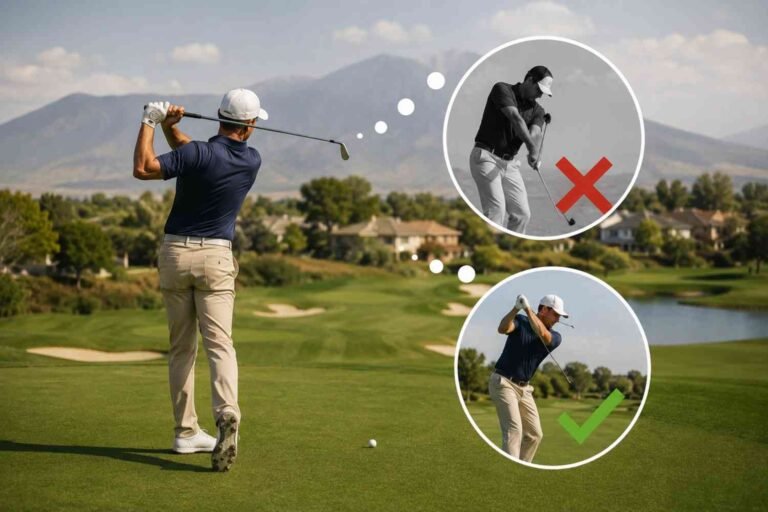
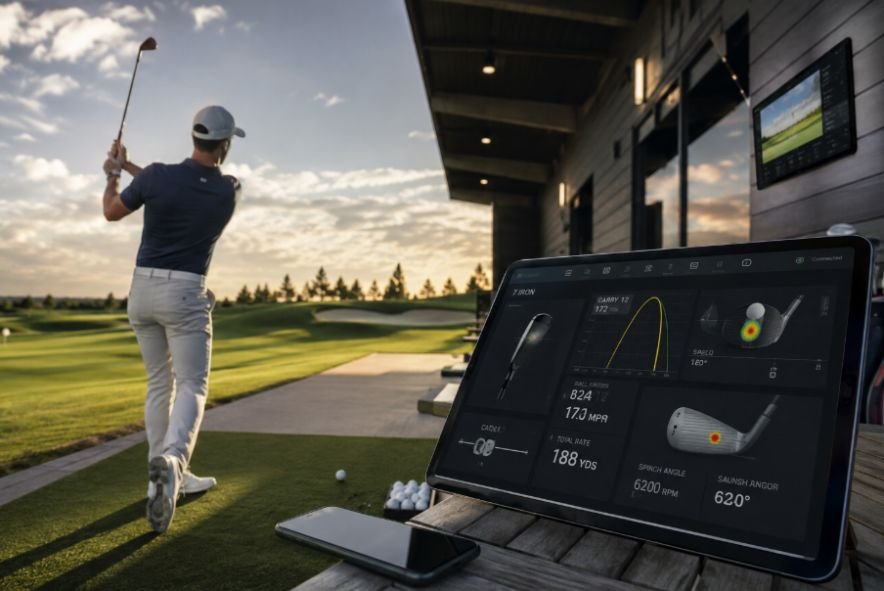
I used to think a productive range session meant leaving with an empty bucket and a tired swing. After a while, I noticed I could hit 80 balls and still have no clear idea what improved. I remembered my best shots, ignored the ugly ones, and usually practiced whatever felt fun that day.
I started paying attention to the numbers, and the difference was clear. A launch monitor showed that my carry distance was not what I assumed, while dispersion revealed miss patterns I barely noticed on the course. Once practice became a way to answer specific questions, each session had a purpose.
Why More Practice Does Not Always Mean Better Practice
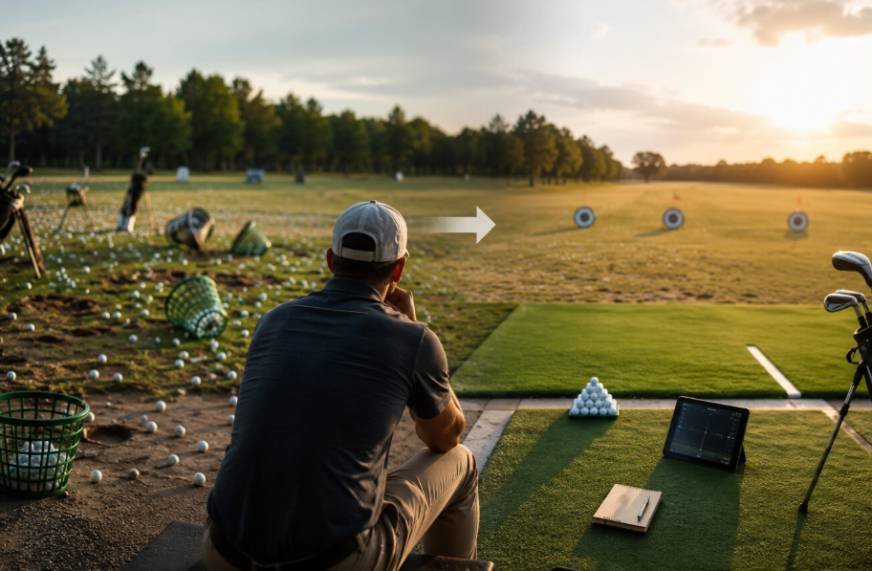
Hitting more balls is not the same as improving. Random practice can feel productive, but it may not address the biggest weakness.
A golfer might hit drivers because they are fun, even when approach shots are the bigger problem. Data-driven golf practice changes the question from “Did that feel good?” to “Did the result move closer to my target?”
Start With a Baseline
Before changing your swing, establish a baseline. Hit enough shots to see a pattern.
For a driver, record speed, carry, launch, spin, and dispersion. For irons, carry and distance control may matter more. On the course, track fairways, greens, penalties, and putting.
Modern launch monitors can capture club path, face angle, launch, spin, and carry distance. Research has also found common measures such as clubhead speed, ball speed, and carry distance to be reliable across repeated sessions in skilled golfers.
The goal is to create a useful starting point.
Focus on Metrics That Explain the Shot
Club path and face angle can help explain why a ball starts and curves the way it does. A recurring open face, for example, gives you a measurable clue behind a fade or slice.
Carry distance helps build dependable club gapping. Spin and launch add context, especially with irons and wedges.
Dispersion may be more useful than your longest shot. If 15 drives produce a wide pattern with most misses right, that tells you more about your playing pattern than one perfect drive.
This is where golf practice efficiency becomes practical. The point of data is not to turn every range session into a laboratory. It is to spend limited practice time on a problem you can measure.
Turn Data Into Targeted Practice
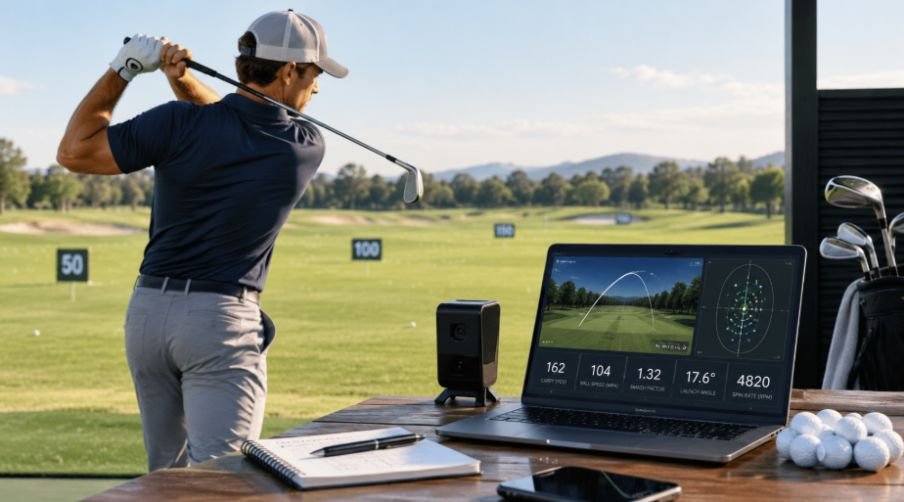
Once you identify a weakness, build the session around it.
Suppose your seven-iron carries 150 yards, but your front-to-back spread is 18 yards. Focus on distance control rather than changing your entire swing. Pick a target window, hit a small group, record the results, make one adjustment, and test again.
The same approach works with the driver. If dispersion is too wide, test whether a setup change or tee height produces a tighter pattern.
Video can show what the body and club are doing while the launch monitor shows the result. When they disagree with your feel, that is useful information.
The objective is to find changes that produce repeatable results.
Use On-Course Data, Too
Range numbers become more useful when they connect to actual rounds. A golfer can hit beautiful shots on a simulator and still struggle because the real problem is poor decisions, weak wedge play, or too many three-putts.
Strokes gained organizes this information by comparing performance with a relevant benchmark across driving, approach, short game, and putting.
If approach play is costing strokes, another hour of driver work may not be the best investment.
For a newer golfer, this becomes easier with a simple golf practice plan for beginners. Rather than fixing every part of the game at once, choose a few measurable priorities and build sessions around them.
You do not need expensive technology. A phone, GPS tracker, or spreadsheet can record fairways, greens, penalties, putts, and club distances.
Review Trends Instead of Chasing One Session
One practice session can mislead you. Fatigue, weather, timing, or a lucky run of strikes can change the numbers.
Review several sessions instead. Look for changes in averages, dispersion, contact, and consistency. If carry distance rises but dispersion becomes much wider, the change may not help your scoring. If speed stays similar while contact improves, that can be a meaningful gain.
Garmin reported in 2026 that golfers in its user data who used a launch monitor for at least six months had average scores 4.4 strokes lower afterward. That is an observational result, not proof that the device caused the improvement, but it shows why longer-term tracking can be useful.
Data is feedback, not magic. Changes still need time to last.
Build Distance Without Losing Control

If you want more yards off the tee, track clubhead speed, ball speed, launch, spin, carry, and dispersion together.
A speed increase that creates a much larger miss may not help your score. A smaller speed gain with better contact and a tighter pattern can be more valuable.
This is where increasing driving distance naturally fits into a broader practice approach. Sustainable gains come from improving speed, strike quality, launch conditions, and physical preparation rather than trying to swing harder on every ball.
A useful session can include a warm-up, baseline drives, one focused drill, and a final retest. You get a clear comparison without turning the session into a numbers exercise.
Let the Numbers Guide Your Next Move
The best use of golf data is simple: let it tell you what deserves attention. Numbers can expose patterns that are difficult to notice during a round, but they should support judgment rather than replace it.
Knowing your normal carry distances, common misses, scoring weaknesses, and practice priorities gives each session a clearer purpose. You stop hoping something improves and start testing what actually works.
The numbers matter most when they change what you do. That is the real value of data-driven golf practice.
Frequently Asked Questions
1. What is data-driven golf practice?
It means using measurable performance information to decide what to practice, how to structure the session, and whether a change is working.
2. What golf metrics should I track?
Start with carry distance, dispersion, contact, and basic on-course statistics. Add launch, spin, path, and face data when they help explain a problem.
3. Do I need a launch monitor?
No. You can track distances, fairways, greens, penalties, and putts manually. A launch monitor simply provides more detailed feedback.
4. How often should I review golf data?
Review trends across several sessions or rounds rather than reacting to one result. Consistent patterns are more useful than isolated numbers.