
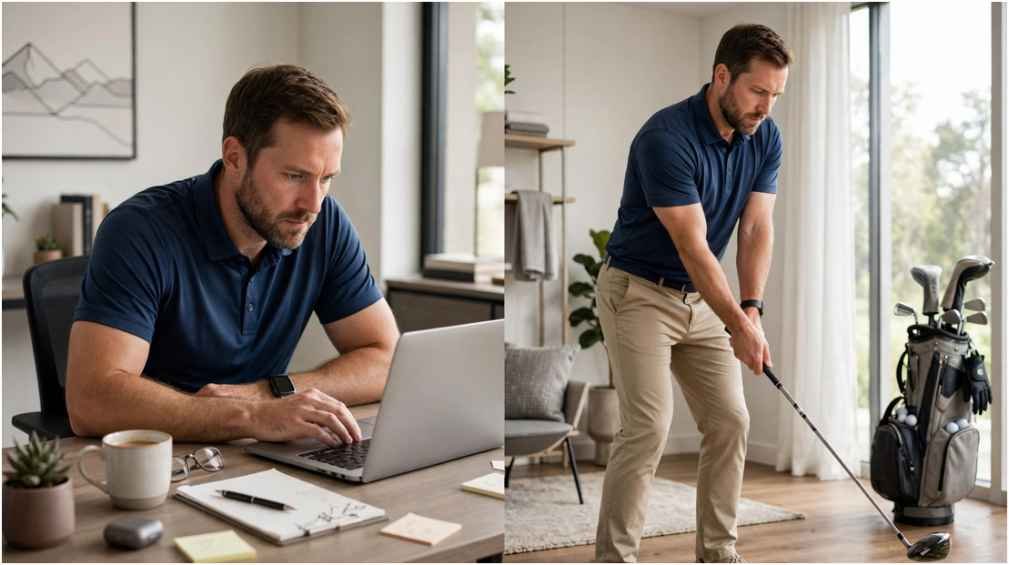
If your setup feels athletic on Saturday but stiff after five days at a computer, your swing may be fighting your workday before you hit a ball. When I build golf posture exercises for desk workers, I focus on three things: restoring hip movement, reopening the upper body, and getting the thoracic spine rotating again.
I do not treat posture as a command to “sit up straight.” Golf posture is dynamic. You need enough mobility to hinge from the hips while keeping your trunk controlled.
Research has found an association between prolonged sitting, physical inactivity, and reduced passive hip extension. Golf biomechanics research also highlights the important relationship between pelvic and thoracic rotation during the swing.
Why Desk Work Can Affect Your Golf Posture
A useful golf setup requires more than a straight back. You need a controlled hip hinge, slight knee flexion, relaxed shoulders, and enough upper-back movement to rotate without forcing motion through the lower back.
That is why I would not build golf posture exercises for desk workers around hamstring stretching alone.
My preferred sequence addresses five common movement needs: hip hinging, hip extension, chest mobility, thoracic rotation, and posture awareness.
If desk stiffness affects more than your setup, adding broader golf exercises for people who sit all day can help you train the rest of your body as well.
Best Golf Posture Exercises for Desk Workers
Seated External Posture Reset
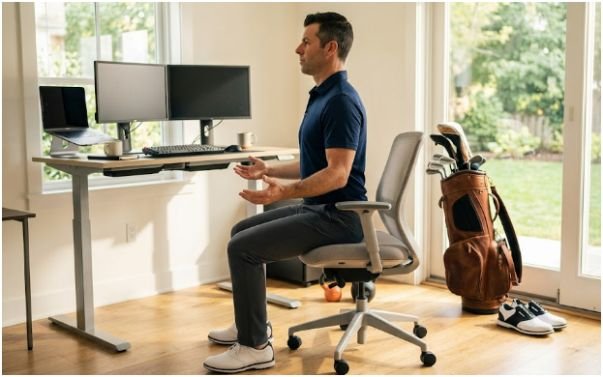
Move toward the front of your chair and place both feet flat.
Turn your palms upward. Gently draw your shoulder blades back and down. Tuck your chin slightly and imagine growing taller through the crown of your head.
Take three to five controlled breaths.
Avoid throwing your chest upward or dramatically arching your lower back. I like this movement first because it gives you a cleaner posture reference before you start rotating.
Seated Good Morning Hip Hinge
Sit near the chair edge and cross your arms over your chest.
Keep your trunk controlled while tipping forward from the hip creases. Return to your starting position without rounding your back.
Complete 8 to 10 repetitions.
This is one of the most useful golf posture exercises for desk workers because it rehearses the basic hip hinge required at address without needing a golf club.
Thread the Needle for Thoracic Rotation
Start on your hands and knees.
Slide one arm beneath your chest while rotating through your upper back. Reverse the motion and reach that arm upward.
Complete 6 to 10 slow repetitions on each side.
Thoracic movement deserves attention because golf requires coordinated rotation between the upper body and pelvis.
I care more about smooth rotation than reaching as far as possible.
Doorframe Pec Stretch
Place one forearm against a doorframe with your elbow around shoulder height.
Step forward slightly and turn your chest away until you feel a comfortable stretch through the chest and front of the shoulder.
Hold for 20 to 30 seconds per side.
Do not force the shoulder backward. The goal is to create comfortable space across the front of the upper body.
Half-Kneeling Hip Flexor Stretch
Place one knee on the floor and your opposite foot forward.
Gently tuck your pelvis and squeeze the glute on the kneeling side. Move forward only until you feel the front of that hip stretching.
Hold for 30 to 45 seconds before switching sides.
I avoid taking an exaggerated lunge. Research comparing hip-flexor stretching techniques found that pelvic positioning can change the mechanical effect of the stretch.
Chair Thoracic Rotation
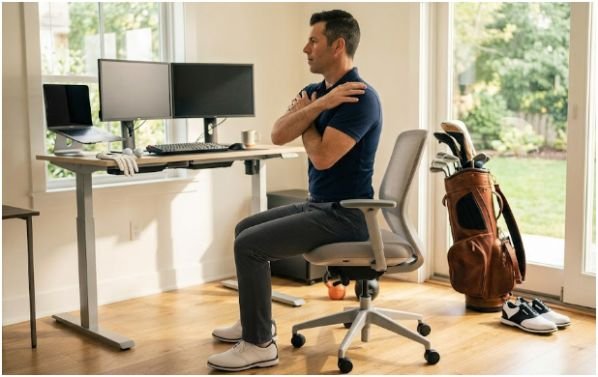
Sit tall with both feet planted.
Cross your arms across your chest and rotate your rib cage to one side. Keep your knees relatively still.
Perform 6 to 8 repetitions per side.
Of all the golf posture exercises for desk workers, this may be the easiest to use during the workday because you need no mat, equipment, or change of clothes.
Wall Hip-Hinge Check
Stand about six inches in front of a wall with your back facing it.
Soften your knees. Push your hips backward until they touch the wall without turning the movement into a squat.
Complete 8 slow repetitions.
I use this drill to transfer the seated hinge pattern into a standing position that looks more like golf posture.
My 8-Minute Desk-to-Tee Routine
I prefer a short routine golfers will actually repeat over a 30-minute mobility session they abandon after two days.
| Exercise | Dose | Main purpose |
| Seated posture reset | 3–5 breaths | Upper-body alignment |
| Seated good morning | 8–10 reps | Hip-hinge control |
| Chair rotation | 6–8 each side | Thoracic mobility |
| Doorframe stretch | 20–30 sec/side | Chest mobility |
| Hip-flexor stretch | 30–45 sec/side | Hip extension |
| Wall hip hinge | 8 reps | Golf-posture transfer |
Use these golf posture exercises for desk workers after a long work block or shortly before leaving for the driving range.
You do not need to chase extreme flexibility. You need enough usable movement to reach your setup without unnecessary compensation.
Try My Three-Point Desk-to-Tee Posture Check
This is the part I would add that most generic posture routines miss.
It is not a clinical assessment. It is simply a practical way to decide which drill deserves more attention that day.
First, perform five wall hip hinges. If you immediately squat or round your spine, repeat the seated good morning.
Next, sit upright and rotate left and right. If one direction feels noticeably more limited, perform another controlled rotation set.
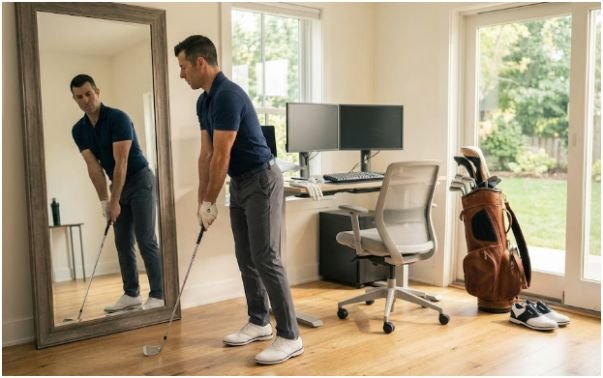
Finally, take your normal address position in front of a mirror. If your shoulders collapse forward or your head reaches excessively toward the ball, repeat the posture reset and doorframe stretch.
Instead of doing every exercise blindly, this makes golf posture exercises for desk workers responsive to how your body feels after that particular workday.
How Often Should Desk Workers Work on Golf Posture?
I prefer frequent, short movement breaks instead of relying on one large stretching session before the weekend round.
You might perform two exercises after a long meeting, then complete the full routine before practice.
The CDC recommends at least 150 minutes of moderate-intensity activity each week for adults, plus muscle-strengthening activity on two or more days. ACSM also emphasizes combining exercise with less sitting and more movement across the day.
For golfers adding resistance training, how many days a week should golfers workout is worth considering separately from daily mobility.
| Frequency | Practical approach |
| Daily | 2–4 minute mobility breaks |
| 2–3 days weekly | Strength and mobility work |
| Before golf | 6–8 minute posture reset |
| After long sitting | Hip hinge plus rotation |
Common Golf Posture Exercise Mistakes
The first mistake I see in posture routines is trying to stand or sit like a soldier. Golf posture should feel athletic, not rigid.
Another mistake is forcing the hip-flexor stretch. More range does not automatically mean a better stretch.
The third mistake is gaining mobility without practicing the position you want to improve.
I therefore finish golf posture exercises for desk workers with a standing hip hinge or several rehearsals of address posture.
For a more complete weekly approach, a golf fitness routine for weekend golfers can add strength, balance, and rotational control around these mobility exercises.
Stop an exercise if it produces sharp pain, numbness, tingling, or worsening symptoms. Persistent problems should be assessed by an appropriate healthcare professional.
Frequently Asked Questions
1. Can sitting all day affect golf posture?
Prolonged sitting is associated with reduced hip extension and may leave some golfers feeling less mobile when they move into their address position.
2. What are the best golf posture exercises for desk workers before playing?
A posture reset, hip hinge, thoracic rotation, chest stretch, and hip-flexor stretch make a practical pre-golf combination.
3. How long should a golf posture routine take?
About six to eight focused minutes is enough for a convenient after-work or pre-range mobility reset.
4. Should golfers stretch or strengthen to improve posture?
I would use both because mobility helps you reach useful positions while strength helps you control those positions.
Your Desk Does Not Get the Last Swing
I would never try to undo eight hours at a desk by forcing myself into “perfect posture” for another eight hours. I would interrupt the sitting, restore the movements golf asks for, then practice those movements in an address position.
That is the real value of golf posture exercises for desk workers. They connect the workday to the golf swing instead of treating mobility as a separate fitness chore.
Before your next range session, run through the seated reset, chair rotation, hip-flexor stretch, and wall hinge. Six focused minutes today will be far more useful than one heroic stretching session every Saturday.