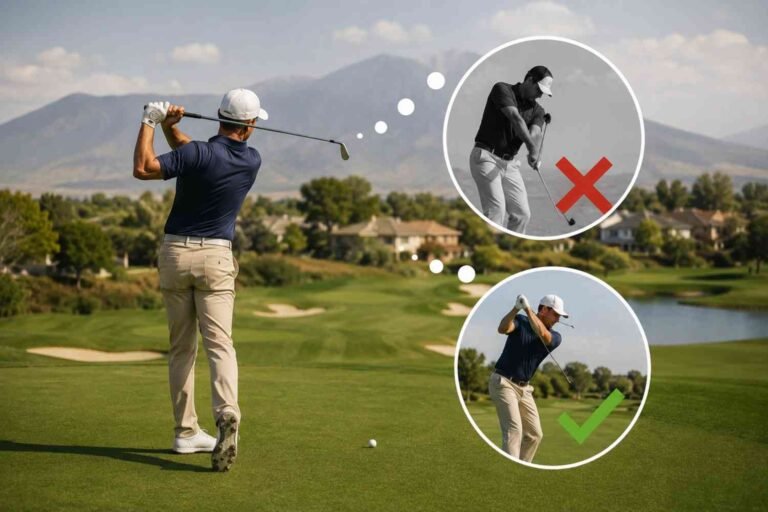

I’ve had practice sessions where I hit a full bucket of balls and walked away feeling like I had accomplished something, only to play a round and realize very little had actually changed. The swings felt familiar, the contact looked decent, and the bucket disappeared quickly.
But familiarity is not the same as improvement. Over time, I started paying more attention to what I was actually trying to improve during practice, and that changed the way I used my time.
I also found that the most productive sessions were rarely the longest ones. A shorter session with a clear target, a proper setup, and enough time between shots often taught me more than an hour of rapid-fire swings. That is where golf practice efficiency becomes useful.
The goal is not simply to hit more balls. It is to make each practice session produce information, better habits, and skills that can survive once you step onto the course.
Golf Practice Efficiency Starts Before You Hit a Ball
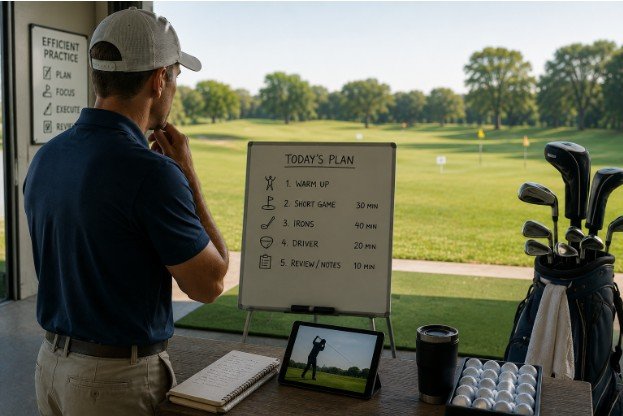
A productive practice session begins with a decision: what needs attention today?
That answer should come from your actual game rather than whatever swing tip happens to be popular. If you missed several greens because your wedge distances were inconsistent, work on wedge control. If your drives are starting in different directions, focus on start line and face control. If three-putts keep appearing on the scorecard, spend more time on putting.
Trying to fix five problems in one session usually creates a noisy practice environment. You end up changing clubs, swing thoughts, targets, and techniques before any one skill has time to settle.
A simple objective gives the session direction. It can be as specific as improving contact with a 7-iron or controlling 30-yard wedge shots. Once you know the purpose, you can judge whether the practice actually helped.
Make Every Swing Answer a Question
Feedback turns practice from repetition into learning.
After a shot, ask something useful. Where did the ball start? Where did it finish? Was the strike toward the heel or toe? Did the club interact with the turf as expected? Did the ball fly higher or lower than intended?
Those observations create a feedback loop. Instead of saying, “That felt bad,” you can identify what actually happened and decide what to change.
A launch monitor can add useful information such as club speed, launch, spin, carry distance, and face-related data. But technology should support the practice goal rather than become the goal itself. If you are working on start direction, staring at ten different numbers after every shot may create more confusion than clarity.
The ball flight remains one of the simplest pieces of feedback available. If the intended shot was a controlled fade and the ball starts left and hooks farther left, that result gives you something concrete to investigate. Effective practice relies on feedback that helps you make the next decision.
Practice the Short Game With a Purpose
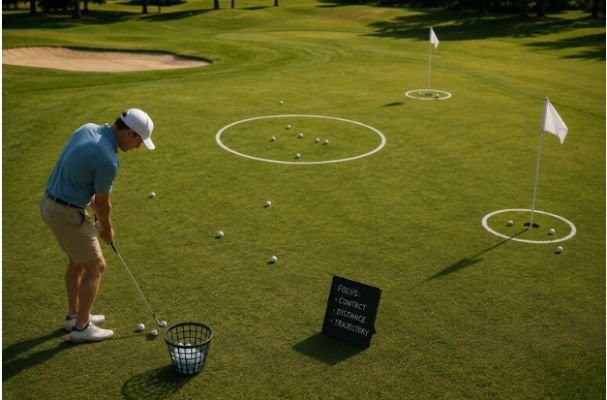
Short-game practice becomes much more useful when you stop trying to simply get the ball close.
Choose a landing area. Pick a target. Decide how you want the ball to behave after it lands. Then repeat the process from different lies or distances.
Putting deserves the same approach. Rather than rolling 30 putts from the same spot, change the distance and direction. Test your speed control. Give yourself uphill and downhill putts. Finish with a challenge where you have to two-putt from different distances.
That type of practice develops adaptability instead of dependence on one perfect setup.
If fast greens are part of the courses you play, learning how to control putting speed on fast greens can also make your putting practice more realistic. Speed control is not just a technical skill. It is a decision-making skill that changes with slope, green speed, distance, and the consequences of a miss.
Build a Better Full-Swing Practice Block
Once your short game has received attention, move into full-swing work with a specific purpose.
Start with a few easier shots to establish contact and rhythm. Then narrow the focus. You might spend several swings working on iron start direction, followed by a small group of target shots where you use your normal pre-shot routine.
Avoid changing your swing thought every time you hit a poor shot. One bad result does not automatically mean the entire motion needs rebuilding.
Your driver practice should also have a clear objective. That might be center contact, start direction, dispersion, or speed. If increasing speed is the goal, technique and sequencing should support it rather than simply swinging harder.
For golfers working on improving driver swing speed, efficient practice means giving speed work its own purpose and enough recovery between swings. Fatigue can turn a speed session into a collection of rushed swings that do little for your actual mechanics.
Turn Practice Into a Game
The final part of a good practice session should test whether the skill survives without constant technical attention.
This is where target games become valuable.
Imagine you are playing the opening hole at your home course. Pick the club you would normally use, select a target, complete your routine, and hit one shot. Then choose a completely different target and club for the next shot.
You can also create simple scoring systems. Give yourself one point for hitting the target area and zero for missing. For wedge practice, set a proximity goal. For putting, see how many attempts you can finish without a three-putt.
This type of random practice introduces decisions and uncertainty. It also more closely resembles golf, where every shot presents a slightly different problem. Research and instruction around effective practice consistently point toward recreating real-round situations rather than relying exclusively on repetitive range swings.
A Simple 30-Minute Practice Structure

You do not need two hours at the range to have a productive session. A focused 30-minute block can be enough when every part has a purpose.
One practical structure is:
- 5 minutes: Warm up with easy wedges and irons, checking contact and basic setup.
- 10 minutes: Work on one technical priority with deliberate repetitions and feedback.
- 10 minutes: Switch to target-based practice using your normal pre-shot routine.
- 5 minutes: Finish with a pressure game or simulated on-course sequence.
This structure gives you time to work on mechanics while still testing performance. A similar three-part approach of mechanics, target practice, and pressure-oriented performance has been recommended for golfers with limited range time.
The key is not the exact minute count. It is the transition from learning a skill to testing it.
Make Your Practice Look More Like Your Round
The best test of golf practice efficiency is what happens after you leave the range.
If you hit 50 perfect 7-irons from a flat mat but struggle with the first 7-iron you face during a round, the practice did not fully transfer. That does not mean the range work was useless. It means you need to add more realistic practice.
Change targets. Change clubs. Vary distances. Use different lies when possible. Practice the shots you commonly face rather than only the ones you enjoy hitting.
Your practice should eventually force you to make decisions. What is the target? What is the miss? What club fits the distance? What shot shape gives you the largest margin for error?
Those questions are part of playing golf, so they belong in practice too. A consistent pre-shot routine, realistic targets, and varied shot selection can help bridge the gap between range performance and course performance.
Track What Actually Matters
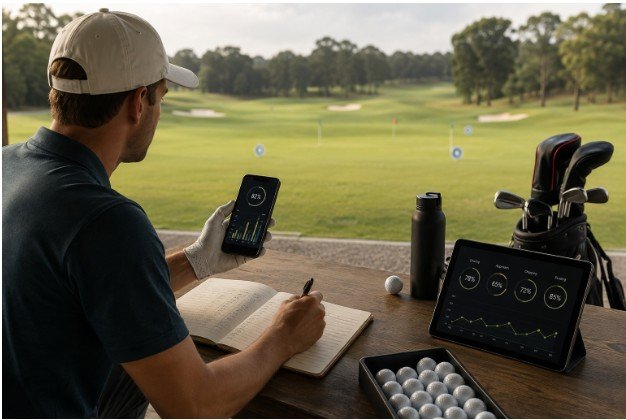
You do not need a complicated spreadsheet after every session.
Write down a few useful observations. Maybe your 50-yard wedge shots finished short more often than expected. Maybe your driver started well but curved too much. Maybe your putting speed improved when you focused on the landing area instead of the hole.
Over several sessions, those notes reveal patterns.
If distance is one of your priorities, you can also separate speed from actual on-course distance. A faster swing is not automatically a better result if contact and direction suffer. For golfers interested in increasing driving distance naturally, the most useful practice combines efficient mechanics, centered contact, appropriate launch conditions, and enough consistency to keep the added distance playable.
The goal is to leave practice knowing something you did not know before you arrived.
Why Better Practice Creates Better Golf
Golf practice efficiency is really about making limited time count. A golfer who spends 30 focused minutes working on a specific weakness, using feedback and finishing with realistic targets, may get more useful information than someone who spends twice as long hitting balls without a plan.
Short-game work, pre-shot routines, target practice, and performance testing all have a place, but they work best when each has a clear role.
The next time you practice, do not ask how many balls you can hit. Ask what you want the last ball to teach you. That small change can turn practice from something you simply complete into something that actually moves your game forward.
FAQs: The Simple Approach to Better Golf Practice Efficiency
How long should an efficient golf practice session be?
There is no perfect length. A focused 30-minute session can be highly productive if you have a clear goal, use feedback, and avoid mindless repetitions. Shorter sessions can also help prevent fatigue from reducing the quality of your practice.
Should I practice my short game more than my full swing?
For many recreational golfers, yes. Putting, chipping, pitching, and wedge distance control can have a direct effect on scoring. The exact split should depend on the weaknesses showing up in your rounds.
Should I hit the same club repeatedly?
Some repetition helps when learning a technical change, but it should not dominate your entire session. Mix in different targets, clubs, distances, and shot situations so your practice eventually resembles actual golf.
How do I know if my practice is working?
Track a few measurable outcomes over time, such as dispersion, strike quality, start direction, putting distance control, or wedge proximity. Look for trends across multiple sessions rather than judging yourself by one practice day.