

I used to assume a motorized cart was always the fastest and easiest way to complete a round. Once I began paying closer attention to my energy, concentration, expenses, and enjoyment, the decision became far less obvious. Walking offers valuable exercise and time to prepare for every shot, while riding can preserve strength when the weather or course becomes demanding.
The better choice depends on your fitness, mobility, playing goals, course layout, and weather. Walking generally wins for physical activity and a natural playing rhythm. Riding is usually preferable when conserving energy, managing pain, or covering difficult terrain matters more.
Walking and Riding at a Glance
Walking turns a round into several hours of sustained, low-impact activity. It allows each golfer to travel directly toward their own ball, observe the terrain, and think about the next shot. However, it also requires sufficient endurance to cover the entire layout without allowing fatigue to damage the swing.
Riding considerably reduces the physical demand. It provides space for water, food, clothing, and equipment while helping golfers cope with long distances between holes. A cart can nevertheless produce a rushed feeling, particularly when players drive immediately to their balls without mentally resetting after the previous shot.
Neither option automatically produces a better score. Whether you prefer to be early to arrive for a tee time or follow a shorter routine, the best method is the one that helps you remain comfortable, focused, safe, and ready through the final hole.
Which Option Provides Better Exercise?

Walking is the clear choice for golfers who want their round to contribute meaningfully to their fitness. In a controlled comparison, walking golfers recorded approximately 17,000 steps and expended around 880 calories. Those using a motorized cart recorded approximately 6,300 steps and 456 calories.
Individual results vary according to body weight, playing speed, course length, elevation, weather, and whether the golfer carries or pushes the bag. Therefore, calorie estimates should be treated as useful ranges rather than guarantees.
Riding still involves activity. Golfers must walk around tees and greens, enter and exit the cart, retrieve balls, play shots, and cover areas closed to vehicles. Nevertheless, it provides much less continuous movement than walking the complete layout.
Carrying Versus Using a Push Cart
A push cart is an effective compromise. It preserves most of the activity associated with walking while reducing the burden of carrying clubs. Golfers who are new to walking can start with nine holes, use a lightweight bag, and gradually build enough endurance for a complete round.
Does walking vs riding a golf course Affect Performance?
Walking can create a valuable transition between shots. That interval gives a golfer time to process the previous result, study the next lie, notice wind and elevation, and begin choosing a target. Continuous movement may also help the body stay loose, reinforcing the benefits of flexibility, instead of repeatedly becoming stiff in a seat.
However, feeling more focused does not guarantee lower scores. Recent performance research found that walkers experienced greater physical fatigue, yet there was no significant difference in measured clubhead speed, ball speed, or carry distance. The participants were young, highly skilled golfers, so recreational players may respond differently.
An older golfer, a beginner taking more strokes, or anyone unused to prolonged walking may lose balance, posture, or concentration on the closing holes. When fatigue begins affecting shot preparation, riding becomes the better performance decision.
Is Riding Actually Faster?

A motorized cart moves faster than a person, but vehicle speed does not determine the total duration of a round. Pace also depends on course traffic, tee-time spacing, player ability, ball positions, vehicle restrictions, and how efficiently two golfers share a cart.
Walkers can travel independently and proceed directly to their own balls, which can help them prepare for a round of golf more efficiently. Two riders may need to drive from one side of the fairway to the other before either can play. Under cart-path-only conditions, a golfer may also walk back and forth after discovering that the required club was left in the vehicle.
Riding is often fastest on an open course when golfers use the cart properly. Each player should prepare while the other plays, carry several possible clubs when leaving the path, and park near the quickest exit from the green. On a crowded course, both groups will usually wait regardless of their transportation.
Cost, Terrain, and Weather
The layout matters as much as the price. A compact, relatively level course is generally comfortable to walk. A property featuring steep hills or lengthy transitions between greens and tees may make riding more practical.
Weather should also influence the decision. Mild conditions support walking, but high heat and humidity increase exertion and dehydration risk, making it important to follow practical tips for exercising in humidity. Rain can make slopes slippery, while strong wind and cold can drain energy. Riding does not eliminate exposure, although it reduces the continuous effort required.
When Should You Walk?
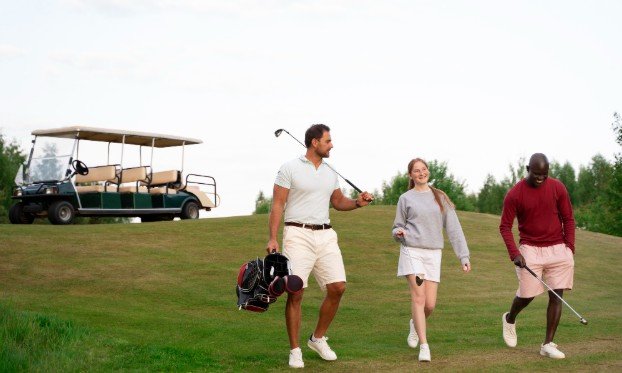
Choose walking when you:
- Want more physical activity
- Can comfortably cover the course
- Prefer time to reset between shots
- Are playing a compact layout
- Want to reduce the cost of your round
- Can maintain the expected pace
- Enjoy observing the course closely
When Should You Ride?
Choose a motorized cart when you:
- Experience pain or restricted mobility
- Are returning after an injury
- Need to conserve energy
- Face steep terrain or long transitions
- Are playing in intense heat
- Plan to play several rounds
- Carry substantial food, water, or clothing
- Would struggle to finish safely on foot
Frequently Asked Questions
1. Is walking a golf course better than riding?
Walking provides more exercise and may support concentration, rhythm, and course awareness. Riding is better when terrain, weather, fatigue, injury, or limited mobility makes walking uncomfortable or unsafe.
2. How far do golfers walk during 18 holes?
The total commonly reaches several miles because the route includes distances between holes, detours toward balls, and movement around tees and greens. The precise distance depends on the layout and accuracy of the player.
3. Does walking vs riding a golf course change your score?
Neither method guarantees a lower score. Walking may help some golfers think between shots, while riding may help others preserve the energy needed to maintain their swing late in the round.
4. Does using a cart still count as exercise?
Yes, although it produces less activity than walking. Riding golfers still swing, walk through vehicle-restricted areas, move around greens, and spend several hours physically active outdoors.
5. Can walkers keep pace with riders?
Yes. Efficient walkers move directly toward their balls and prepare while approaching. Riders gain the greatest pace advantage on an open layout when they share the vehicle intelligently and follow ready-play practices.
Final Thoughts
I would choose walking when the course, weather, and my physical condition allow me to complete the round without harmful fatigue. It offers exercise, saves money, and gives me valuable time to understand each hole. I would ride when heat, hills, pain, or accumulated tiredness could reduce my safety or consistency.
The decision does not need a permanent winner. A golfer can walk nine holes, use a push cart, ride during demanding conditions, or change approaches throughout the season. The best choice is simply the one that preserves comfort, attention, enjoyment, and purposeful play until the last putt.