A quarter-inch looks insignificant, yet golf equipment is built around small dimensional changes. If you want to know how to measure golf club length, the quickest home check is simple: place the club in its normal playing position on a hard, level floor, run a long ruler along the back of the shaft, and read to the top of the grip.
That gives you a useful playing-length reference. The catch is that the official rules use a different controlled setup, so two measurements are not always directly comparable.
Why Club Length Matters
Club length affects hand height, posture, distance from the ball, and how easily you return the face to impact. A longer club can potentially create more clubhead speed, but extra length can also make centered contact harder. Similarly, learning How to Choose Golf Balls helps golfers match ball construction, compression, spin, and feel to their swing and playing conditions.
A 2026 Fort Hays State University biomechanics project using 3D motion capture examined body dimensions, clubhead speed, and impact mechanics together. The takeaway is useful: length is a calibration value, not a magic distance setting.
The Practical At-Home Method
You need a hard floor and a 48-inch ruler or reliable tape measure.
1. Set the Club Naturally
Place the clubhead on a level floor as though you were addressing a ball. The sole should sit naturally rather than being forced onto the heel or toe. Changing the club’s angle changes the reading.
2. Align the Measuring Tool
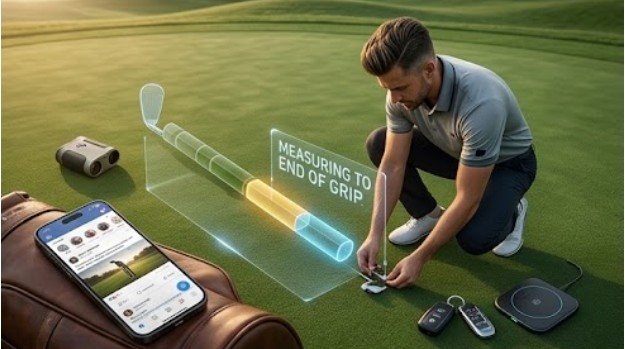
Place the zero end on the floor and run the ruler closely along the back of the shaft. Do not measure only the bare shaft; you are checking the assembled club.
3. Read to the End of the Grip
Read the measurement at the uppermost end of the grip cap. Record it to the nearest 1/8 inch if possible, then repeat once to catch positioning errors.
The Official USGA Method Is Different

For rules compliance, the USGA does not simply stand a wood or iron at address. Under the USGA Equipment Rules, the club lies on a horizontal plane while its sole rests against a 60-degree plane. Length is measured from the intersection of those planes to the top of the grip.
The R&A equipment standard uses the same convention. Putters are measured differently: from the top of the grip along the shaft axis, or its straight-line extension, to the sole.
This explains why a home ruler check, manufacturer specification, and official equipment measurement may differ slightly.
The general equipment limit is at least 18 inches and, except for putters, no more than 48 inches. Certain competitions can adopt Model Local Rule G-10, which reduces the maximum to 46 inches.
Useful Length Benchmarks
There is no universal manufacturer “standard,” so treat these as reference points rather than fitting prescriptions.
| Club | Common reference length | Practical note |
| Driver | About 45–46 in. | Model specs vary |
| 7-iron | About 37 in. | Useful iron-set midpoint |
| Pitching wedge | About 35.5–36 in. | Usually shorter for control |
| Putter | Roughly 33–35 in. | Posture strongly affects fit |
Graphite-shafted irons have sometimes been built slightly longer than comparable steel versions to help manage club feel and swing weight. Do not assume a half-inch difference applies to every set; check the maker’s specification. Pairing the right equipment with Golf Swing Consistency Drills can also help golfers develop a more repeatable tempo, setup, and centered strike.
Measuring Yourself for the Right Length
Measuring a club tells you what you own. It does not automatically tell you what you should play.

Start with standing height, measured without shoes on a flat floor. The NCBI overview of height assessment emphasizes consistent positioning, while an NIH standing-height protocol recommends duplicate measurements when reliability matters.
Then measure wrist-to-floor distance. Stand naturally with your arms relaxed at your sides and have another person measure from the wrist crease to the floor. Do not bend into a golf stance.
Height gives a broad starting point. Wrist-to-floor improves the estimate because golfers of identical height can have different arm lengths. Longer arms may reduce the need for extra length; shorter arms may increase it.
Use a Three-Part Fit Test
Before changing club length, check:
- Posture: Can you address the ball without excessive crouching or reaching?
- Strike pattern: Hit 10 balls using impact tape or foot spray. Is contact clustered near the center?
- Dynamic lie: If the club consistently arrives too upright or flat, length alone may not solve the problem.
Professional fitting adds launch-monitor data and considers length with lie angle, shaft weight, flex, grip size, speed, and delivery.
A 6-foot-4 golfer may need longer irons, but long arms can still make standard length suitable.
Mistakes That Create Bad Measurements
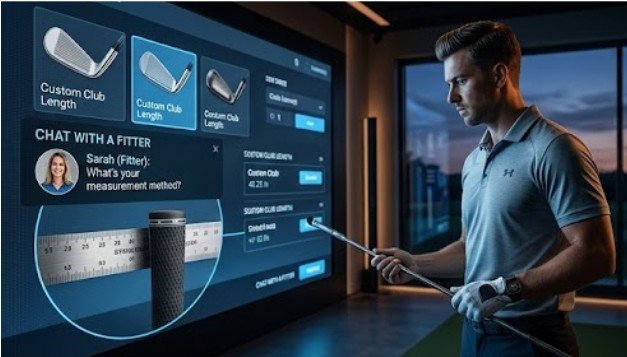
The most common error is measuring only the shaft and calling that club length. The installed head, grip, and measuring convention affect the final number.
Another mistake is forcing the sole completely flat when it does not sit that way naturally. Avoid comparing a home measurement with a manufacturer chart unless you know how that company defines length.
Finally, do not lengthen a driver solely to chase speed. More theoretical speed is useless if center-face contact and dispersion get worse.
Frequently Asked Questions
1. How do I measure myself for golf club length?
Measure standing height without shoes, then measure wrist crease to floor while standing naturally with arms relaxed. Use both as fitting inputs rather than a final answer.
2. How long should your golf clubs be for your height?
Height only gives a range. Wrist-to-floor distance, posture, dynamic lie, strike quality, and swing characteristics determine whether standard, shorter, or longer clubs fit better. For beginners, understanding the Golf Swing Sequence for Beginners can also help connect club fitting with proper setup, posture, and movement through impact.
3. Do I need longer golf clubs if I’m 6ft 4?
Possibly, but not automatically. Many tall golfers need extra iron length, while long arms can offset height. Confirm with wrist-to-floor measurement and strike testing.
4. What is the 70/30 rule in golf?
There is no universal version. In golf instruction, it often means roughly 70% pressure on the lead foot and 30% on the trail foot for certain chips or controlled shots.
Conclusion
Learning how to measure golf club length is less about hunting for one perfect number and more about creating a repeatable reference. Measure the assembled club carefully, record the method, and compare like with like. For a simple equipment check, the floor-and-ruler method is practical. For rules compliance, use the USGA convention.
If you are deciding what length you should play, combine height and wrist-to-floor measurements with posture, impact pattern, and dynamic lie. The best length is not necessarily the longest or the most “standard”; it is the one that gives you comfortable setup, centered contact, and repeatable control.