

Golf fitness becomes much easier when I stop thinking like a bodybuilder and start planning around the next tee time. A good weekly workout plan for recreational golfers should make the swing feel stronger and freer without leaving the body exhausted when Saturday arrives.
For most everyday players, I prefer three focused training days. One develops mobility, one targets rotation and core control, and one builds total-body strength. The result is a practical schedule that can fit around work, family, range sessions, and weekend golf.
Why Three Golf Workouts Per Week Make Sense
Golf needs more than flexible shoulders. The swing uses lower-body force, trunk rotation, balance, coordination, and upper-body strength within a very short movement.
Research supports training several of those qualities instead of relying on stretching alone. A 2024 systematic review found clubhead speed was associated with strength, lower-body power, upper-body power, and flexibility.
Strength training also has broader health value. Current U.S. Physical Activity Guidelines recommend muscle-strengthening activity on at least two days each week for adults.
Three sessions give me room to train golf-specific qualities while leaving recovery days between harder workouts.
Weekly Golf Fitness Schedule at a Glance
| Day | Focus | Time |
| Monday | Mobility and movement | 20–25 minutes |
| Tuesday | Walk or rest | Optional |
| Wednesday | Core and rotational power | 25–30 minutes |
| Thursday | Recovery | Optional |
| Friday | Total-body strength | 25–30 minutes |
| Saturday | Golf | — |
| Sunday | Easy mobility or walking | 10–20 minutes |
This weekly workout plan for recreational golfers is not fixed to Monday, Wednesday, and Friday. Keep the sequence and recovery gaps, then move the days around your normal playing schedule.
Players who only golf once each weekend can also pair this plan with a broader golf fitness routine for weekend golfers when building their seasonal schedule.
Monday: Golf Mobility and Movement Day
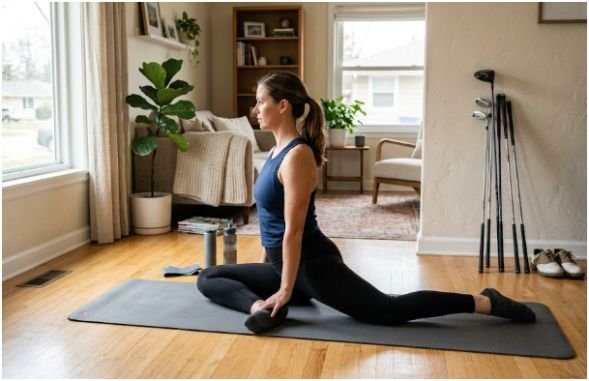
Monday is my reset session. I want to restore useful movement after sitting at a desk, driving, traveling, or playing during the weekend.
The priority areas are the hips, thoracic spine, shoulders, and glutes.
Monday Workout
Start with 90/90 hip switches for 10 controlled repetitions per side. Follow them with 10 open-book rotations per side.
Next, perform 12 tactical frog rocks and 12 to 15 cat-cow repetitions. Finish with three sets of 12 glute bridges.
Do not race through these movements. Mobility work becomes more useful when I control the available range instead of forcing a deeper stretch.
Golfers who struggle with stability can complement this session with balance exercises for senior golfers at home, particularly single-leg and supported balance drills.
Wednesday: Core Stability and Rotational Power
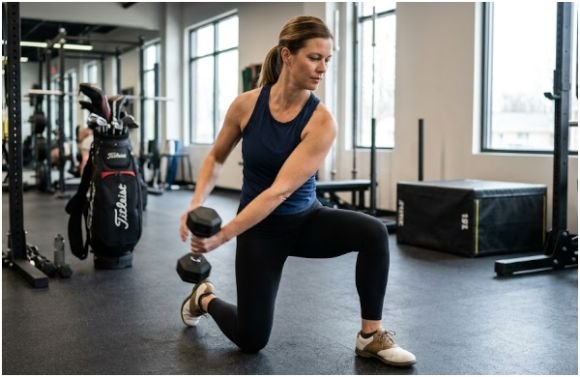
Wednesday is the athletic session.
The golf swing produces rotation, but good training should also teach the torso when not to rotate. That is why I combine rotational movements with exercises that resist unwanted trunk movement.
Core training has shown promising golf-specific results. One controlled study reported a small improvement in clubhead speed after isolated core training.
Wednesday Workout
Perform dumbbell half-kneeling woodchops for three sets of 10 per side. Use a light weight and rotate smoothly.
Then complete three sets of eight plank T-spine rotations per side, followed by three sets of 10 split-stance press-to-rotations.
Add three sets of five countermovement jumps if jumping feels comfortable. Keep every landing quiet and controlled.
Finish with bird-dogs for three sets of eight to 10 repetitions per side.
The goal is quality, not fatigue. Golf power work loses value when every repetition becomes slower than the one before it.
Friday: Full-Body Golf Strength
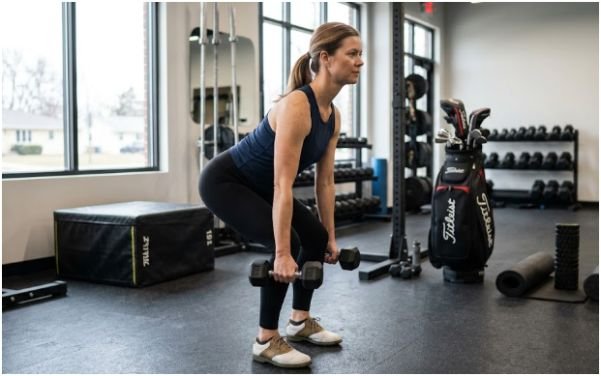
Friday develops the strength that supports posture, ground-force production, and repeated swings.
Research on golfers has found that structured strength and power programs can improve clubhead speed. An eight-week trial involving collegiate golfers reported improvements following combined strength and power training.
Friday Workout
Begin with dumbbell Romanian deadlifts for three sets of eight to 10 reps. Follow them with goblet squats for three sets of 10.
Perform dumbbell bent-over rows for three sets of 10 to 12, then push-ups for two or three sets of eight to 12.
Finish with lateral lunges for two sets of eight repetitions per side.
A pair of adjustable dumbbells can cover almost everything here. Players building a home setup can use a dumbbell workout for golfers at home to expand this session without needing machines.
How to Adjust Training Around Your Tee Time
This is where I make the routine more practical.
I use a simple tee-time buffer rule: the closer I get to a meaningful round, the less fatigue I create.
If I play Saturday morning, Friday is not the day to chase personal records. I stop each strength set with roughly two or three good repetitions still available.
Players who regularly experience next-day soreness can move the strength workout to Thursday instead.
If golf happens Sunday, the normal Friday session usually provides more recovery time.
This small scheduling change separates training for golf from training that simply happens to involve golfers.
What to Do on Rest and Recovery Days
Rest does not require sitting still.
Tuesday and Thursday can include an easy walk, relaxed cycling, or several minutes of mobility. Keep the intensity low enough that the session leaves you feeling better afterward.
Sunday can work as an active recovery day after an 18-hole Saturday round.
Walking also helps recreational players accumulate aerobic activity. U.S. guidelines recommend 150 to 300 minutes of moderate aerobic activity each week for adults seeking substantial health benefits.
Five-Minute Golf Warm-Up Before Playing

A weekly workout plan for recreational golfers should not replace a pre-round warm-up. Training develops capacity over time; warming up prepares the body for the swings you are about to make.
I start with about 30 seconds of arm circles and torso turns. Then I perform 10 leg swings per leg and 8 to 10 controlled squats.
I finish with five or six gradually faster practice swings.
The important word is gradually. Your first aggressive swing of the day should not happen with a driver on the opening tee.
How to Progress This Golf Workout Plan
Run the routine for four weeks before making major changes.
During weeks one and two, learn the exercises and leave several repetitions in reserve. During weeks three and four, add a small amount of resistance or one extra set to the main strength movements.
Do not increase weight, repetitions, sets, and workout frequency simultaneously.
That makes it difficult to identify what caused excess soreness or reduced swing quality.
After four weeks, I prefer improving one variable at a time. For example, a golfer using 20-pound dumbbells for Romanian deadlifts could move to 25 pounds while keeping the same repetitions.
Train for Saturday, Not Just Friday
The smartest golf workout is not the one that leaves you crawling toward the shower.
It is the one that quietly improves what happens when you stand over the ball.
That is why I like this weekly workout plan for recreational golfers: mobility gets its own day, rotational control gets focused attention, and strength work supports the swing without dominating the week.
Start with manageable resistance and protect the quality of every repetition. When Saturday arrives, your training should feel like an advantage—not something you need to recover from on the first nine.
Frequently Asked Questions
1. How many days a week should recreational golfers work out?
Three focused sessions work well for many recreational golfers, although two well-planned workouts can still build useful strength and mobility.
2. What is the best weekly workout schedule for a weekend golfer?
Train mobility early in the week, core and rotational power midweek, then strength at least one day before golf when possible.
3. Should golfers lift weights the day before playing?
You can, but keep the workout moderate. Avoid unfamiliar exercises, failure training, or excessive leg volume that may cause next-day soreness.
4. Can recreational golfers improve with only home workouts?
Yes. Dumbbells, resistance bands, bodyweight movements, mobility drills, and jumping exercises can train many physical qualities relevant to recreational golf.