

I still remember looking at my first scorecard and wondering why such a small piece of paper contained so many numbers, colors, boxes, and abbreviations. Once I learned how to read a golf course scorecard, however, I realized that it was not merely a place to record strokes. It was also a compact guide to the course.
A scorecard identifies the holes, distances, pars, tee options, handicap-stroke allocations, and important course information. It can even help you choose clubs and develop a sensible strategy. This guide explains every major section so you can arrive at the first tee feeling prepared.
What Is a Golf Scorecard?
A golf scorecard is a printed or digital record used to track each player’s score during a round. Most full-size courses have 18 holes, although nine-hole courses and shorter layouts are also common.
For a beginner, understanding the card is only one part of feeling comfortable on the course. Knowing what to expect on your first golf course can also make check-in, tee times, playing order, pace, and basic course routines feel much less intimidating.
The card normally contains:
- Hole numbers
- Yardages from different tees
- Par for each hole
- Handicap or stroke index
- Player score boxes
- Front-nine, back-nine, and round totals
- Course Rating and Slope Rating
- Local rules and course information
Although designs differ between clubs, these essential components remain largely consistent.
Begin With the Hole Numbers
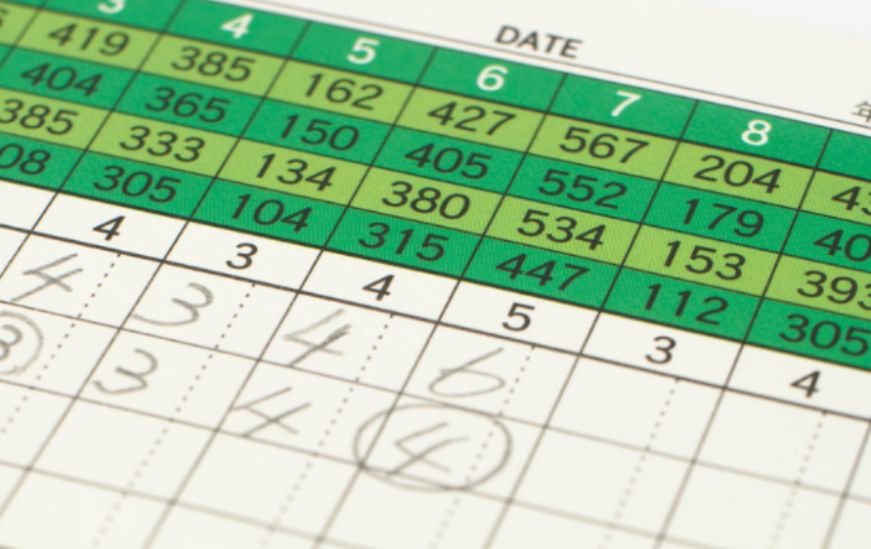
The numbers running across the top represent the order of the holes. Holes 1 through 9 form the front nine, while holes 10 through 18 form the back nine.
You may also see three important labels:
- OUT means the total for holes 1 through 9.
- IN means the total for holes 10 through 18.
- TOTAL means the combined score for all 18 holes.
Suppose you score 46 on the front nine and 44 on the back nine. You would enter 46 under OUT, 44 under IN, and 90 under TOTAL.
Match Your Tees to the Correct Yardage Row
A scorecard usually displays several rows of yardages. Each row corresponds to a particular set of tee markers on the course. If you start from the blue markers, follow the row associated with those markers throughout the round.
Your typical driving distance can also help you select an appropriate tee row. Golfers who generate less clubhead speed may benefit from both playing a manageable course length and choosing equipment designed for easier launch and forgiveness. Comparing the best driver for slow swing speed can help you understand which driver features may better suit that type of game.
Do not assume that tee colors have universal meanings. A white tee might be a middle option at one facility and a forward option somewhere else. Always match the markers you are playing to the name or color printed on that course’s card.
The yardage under each hole indicates its length from your selected tee to the measured point on the green. Total yardage appears near the end of the row.
Choose tees according to your playing distance and comfort—not age, gender, or pride. Suitable tees create more enjoyable approach shots and can improve pace of play.
Understand the Par Row

Par represents the score an expert golfer would generally be expected to make on a hole under ordinary playing conditions. Most holes are designated as par 3, par 4, or par 5.
Your result is described relative to par:
- Eagle: two strokes under par
- Birdie: one stroke under par
- Par: equal to par
- Bogey: one stroke over par
- Double bogey: two strokes over par
If you complete a par-4 hole in five strokes, you have made a bogey. Nevertheless, you should write “5” in your scoring box rather than the word “bogey.”
Beginners should treat par as a reference point, not a demand. Honest scores are more useful for measuring improvement than artificially low numbers.
Decode HCP or Stroke Index
The HCP row causes more confusion than almost any other part of the card. It does not show your personal Handicap Index.
HCP, sometimes labeled SI or stroke index, indicates the order in which handicap strokes are allocated. A hole marked 1 receives the first allocated stroke, while a hole marked 18 receives the last.
For example, a player receiving nine strokes gets one stroke on holes allocated HCP 1 through 9. A player receiving 20 strokes gets one on every hole and an additional stroke on holes allocated 1 and 2.
People commonly describe HCP 1 as the hardest hole and HCP 18 as the easiest. Playing difficulty influences the allocation, but the sequence may also be arranged to distribute strokes appropriately during different formats. Therefore, “stroke-allocation order” is the more accurate interpretation.
Read Course Rating and Slope Rating Correctly

Course Rating estimates the score a scratch golfer could be expected to produce from a particular set of tees under normal conditions. A Course Rating of 71.6 does not mean the course’s par must be 71.6.
Slope Rating compares how difficult those tees are for players who are not scratch golfers relative to scratch golfers. A higher Slope Rating generally means the challenge increases more significantly for higher-handicap players.
These figures are calculated separately for each rated tee set. They help convert a Handicap Index into a Course Handicap, which determines the number of strokes a golfer receives for that round.
Record Every Hole Properly
Write the player names in the available rows before beginning. After each hole, count all strokes made and add any applicable penalty strokes. Enter the final numerical total in the box beneath that hole.
Record the result immediately. Waiting several holes makes forgotten shots and incorrect totals much more likely.
For a simple example, imagine that you take five swings on a par-4 hole and receive no penalty. Write 5. If an applicable rule adds one penalty stroke, write 6.
Circles and squares are optional visual shortcuts. Golfers commonly circle birdies and draw squares around bogeys. Double circles can indicate eagles, while double squares can represent double bogeys. These markings are useful but not required for an ordinary round.
Gross and Net Scores
Your gross score is the actual number of strokes recorded, including penalties. Your net score is the result after applicable handicap strokes have been deducted.
If your gross score is 92 and you receive 18 handicap strokes, your net score is 74. The stroke index determines the holes on which those handicap strokes are allocated. During the round, continue recording gross hole scores and calculate the net result separately when the format requires it.
Check the Other Side of the Card
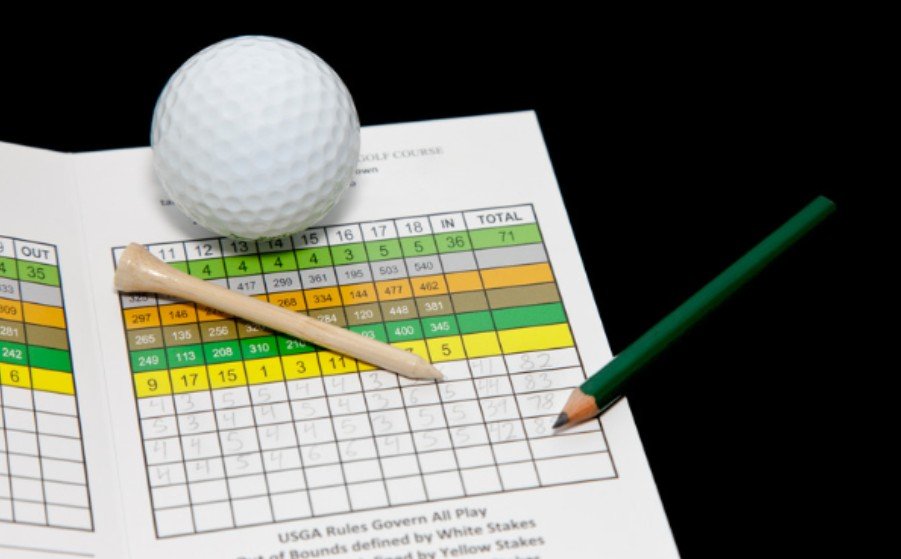
Do not put the card away after finding the yardages. Its reverse side may contain local rules, penalty-area information, out-of-bounds descriptions, pace expectations, emergency details, and course diagrams.
Those pace and course-care instructions often overlap with basic golf course etiquette for new golfers, including where to stand, when to play, how to protect the greens, and how to avoid holding up the group behind you.
Local instructions can affect how you handle a particular situation. In organized play, also check the competition’s scoring and certification requirements before returning the card.
Common Scorecard Mistakes to Avoid
The most frequent mistakes include following the wrong tee row, confusing HCP with a personal Handicap Index, forgetting penalty strokes, and adding the front or back nine incorrectly.
Players also assume tee colors mean the same thing everywhere or that Slope Rating is simply a universal difficulty score. Checking the card before teeing off prevents most of these errors.
Frequently Asked Questions
1. How do I learn how to read a golf course scorecard quickly?
Identify five items first: hole number, your tee row, yardage, par, and HCP. Record your numerical score after every hole, add holes 1–9 under OUT, holes 10–18 under IN, and combine them under TOTAL.
2. What does HCP mean on the scorecard?
HCP is the stroke index. It shows the order in which handicap strokes are allocated across the holes, not your personal Handicap Index.
3. Is a lower golf score better?
Yes. Golf rewards completing the course in the fewest strokes. A total of 85 is therefore better than a total of 90.
4. What do circles and squares mean?
A circle commonly represents a birdie, while a square represents a bogey. Double circles and double squares usually indicate an eagle and double bogey.
5. Do tee colors have the same meaning everywhere?
No. Colors and tee names vary by facility. Use the yardage row that corresponds to the markers you selected at that particular course.
Final Thoughts
Once I focus on the card one section at a time, the apparent maze of numbers becomes a useful map of the round. I begin with my tee row, check the yardage and par, record every stroke, and total the two nines carefully.
Learning the system also makes it easier for me to compare rounds honestly, use handicap strokes correctly, and recognize where my game needs attention. Before playing, I always check the local information and confirm which tees I am using. That brief routine prevents confusion and lets me concentrate on the next shot.