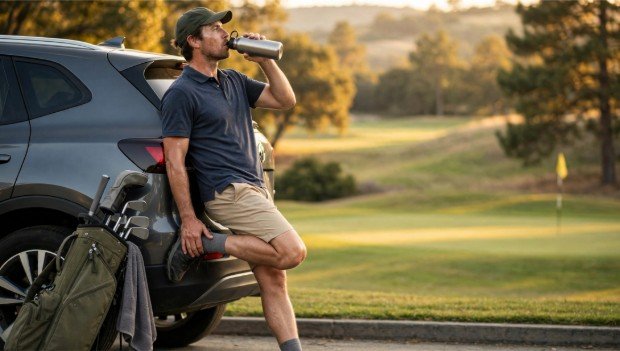
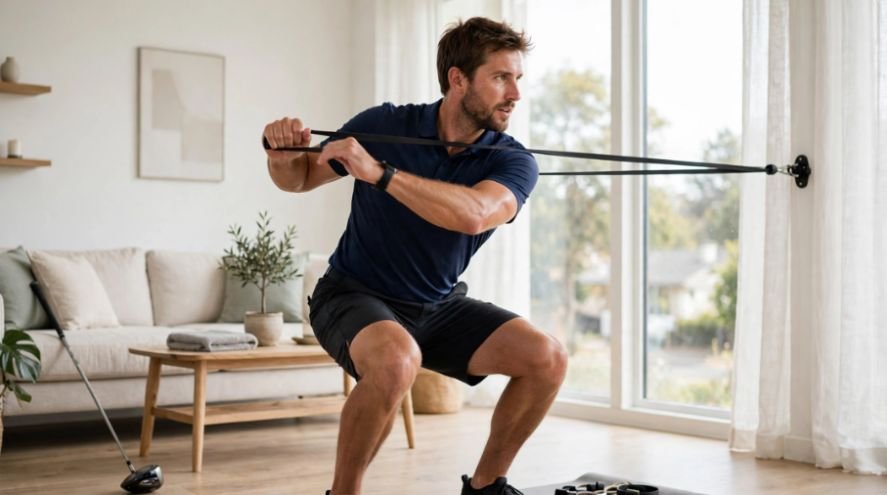
A 20 minute golf workout at home can improve the physical qualities your swing depends on without turning your living room into a gym. When I build a short golf session, I focus on hip rotation, thoracic mobility, core control, balance, and fast force production. Those qualities matter more to me than simply getting tired.
My preferred 20 minute golf workout at home uses a 4-8-8 split: four minutes to warm up, eight minutes for rotation and stability, then eight minutes for balance and power. You need floor space, comfortable shoes, and an optional golf club.
Why This Golf-Specific Routine Works
Golf requires coordinated rotation rather than strength in one isolated muscle. Modern golf biomechanics research describes thorax rotation relative to pelvic rotation as one mechanism involved in storing and releasing energy during the swing. Research into golf-related lower-back pain also identifies hip strength, hip mobility, trunk activity, and pelvis-trunk rotation as relevant physical factors.
Another study found that golfers who performed better on a golf movement screen demonstrated better spine control and could create a greater X-factor.
That is why this 20 minute golf workout at home does not chase exhaustion. My rule is simple: if posture, balance, or landing control disappears, reduce the speed or range.
For longer training days, I would pair this routine with a golf workout at home without equipment to add more bodyweight strength work.
4-Minute Dynamic Golf Warm-Up for Mobility
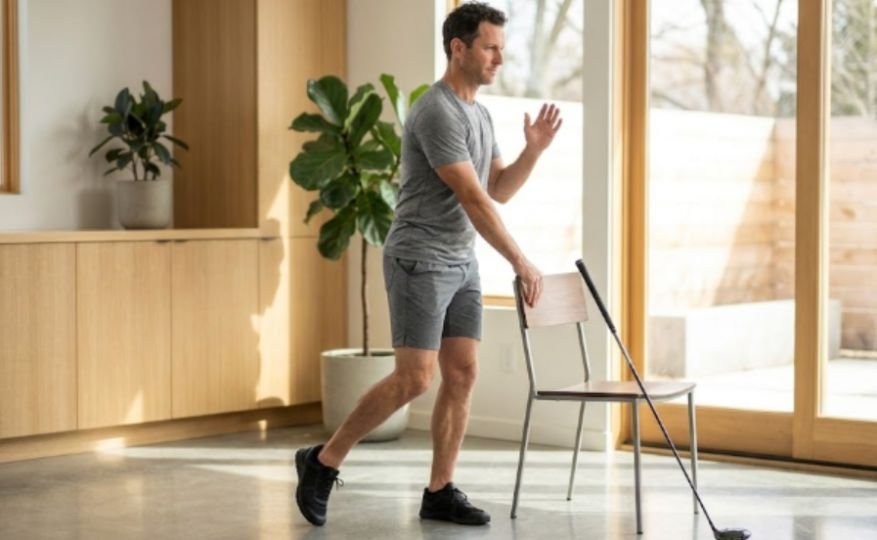
I use the first four minutes to prepare for the faster movements that follow. Research reviews have found that appropriately structured warm-ups can support subsequent exercise performance.
Minute 1: Bodyweight Squat With Overhead Reach
Stand with your feet about shoulder-width apart. Reach your arms overhead, then sit your hips down and back.
Keep your heels planted and chest tall. I focus on smooth movement rather than forcing maximum squat depth.
Minute 2: World’s Greatest Stretch
Step into a long lunge. Place one hand inside your lead foot and rotate your chest toward the front leg.
Alternate sides for one minute. If reaching the floor compromises your posture, support your hand on your thigh instead.
Minute 3: Standing Leg Swings
Hold a wall or chair for balance. Swing one leg forward and backward for 30 seconds before changing sides.
Keep the motion controlled. Do not turn it into an aggressive kick.
Golfers who regularly feel restricted around the pelvis can add golf stretches for tight hips on separate mobility days.
Minute 4: Arm Circles and Shoulder Mobility
Begin with small arm circles and gradually increase their size. If you have a golf club, use a wide grip and move it gently overhead within a comfortable range.
I would add golf stretches for tight shoulders if shoulder restriction makes it difficult to reach a comfortable backswing position.
8-Minute Core and Rotation Circuit
The middle block of the 20 minute golf workout at home trains rotation while asking you to maintain posture. Work for about 45 seconds, use roughly 15 seconds to change positions, and complete two rounds.
Lunge With Thoracic Rotation
Step into a comfortable forward lunge. Extend your arms ahead of your chest and rotate your torso toward the lead leg.
Return to center and repeat before changing sides. Keep your front knee stable while you rotate.
Glute Bridge With Alternating March
Lie on your back with your knees bent and feet planted. Raise your hips, then lift one foot a few inches from the floor.
Lower it and change sides. I treat this as a control exercise, so the pelvis should stay level throughout each march.
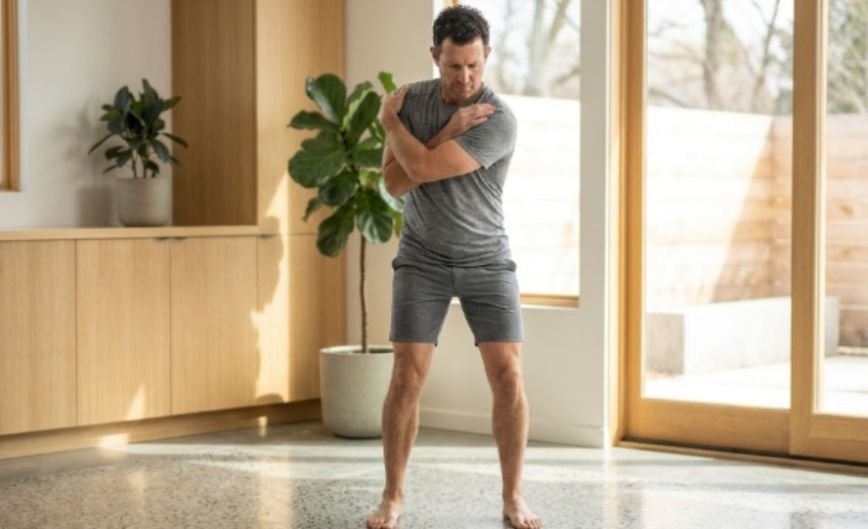
Golf-Setup Spine Rotation
Take your normal golf address posture and cross your arms over your chest. Rotate your shoulders away from an imaginary target, return to center, then rotate through.
Avoid sliding sideways.
I include this movement in the 20 minute golf workout at home because it lets you practice rotation from a golf-specific posture without repeatedly swinging a club indoors.
Bird-Dog With Controlled Reach
Start on your hands and knees. Extend the opposite arm and leg while keeping your ribs and pelvis steady.
Pause briefly and switch sides. Think about reaching long rather than lifting the leg as high as possible.
8-Minute Balance and Rotational Power Circuit
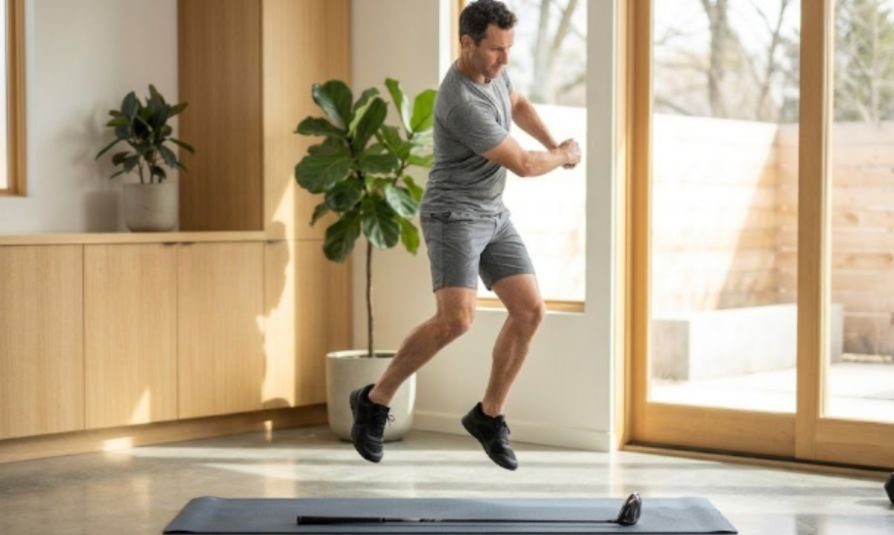
The final block adds speed to your 20 minute golf workout at home while keeping control as the priority. Perform each movement for about 45 seconds and use 15 seconds to reset. Complete two rounds.
Stork Balance With Mini Swings
Stand on one leg with a slight bend in your knee. Make small backswing and follow-through motions using your arms.
If you continually lose balance, shorten the movement. A smaller controlled swing beats a larger unstable one.
This balance work becomes even more useful when you connect it to how pressure moves through your feet during an actual swing. Learning how to improve weight transfer in golf swing can help you coordinate the move from the trail side toward the lead side without excessive swaying or losing your finish.
Skater Hops With a Stick Landing
Hop laterally from one foot to the other. Pause for about one second after landing.
I prefer controlled landings over maximum jumping distance. Your foot, knee, and hip should remain organized before the next jump begins.
Rotational Vertical Jumps
Start in a shallow squat with a small turn toward your trail side. Jump upward while rotating gently toward the lead side.
Land softly with your knees tracking over your feet. Beginners can replace the jump with a fast squat-to-calf-raise.
Speed Plank Knee Drives
Start in a high plank. Alternate bringing each knee toward your chest.
Keep the hips stable and shoulders above your hands. If speed causes your lower back to sag, slow down immediately.
How Often Should You Do It?
I would use the 20 minute golf workout at home two or three times per week, depending on your existing training and recovery.
If time is your biggest barrier, the 20 minute golf workout at home format also makes consistency more realistic than planning a long session you regularly skip.
However, I would not treat it as a complete fitness program. Current U.S. physical activity guidance recommends that adults combine aerobic activity with muscle-strengthening activity on at least two days each week.
Golfers who already lift weights can use this as a lighter mobility and power session. Beginners should master the controlled versions before progressing to faster jumps.
Mistakes That Waste Your 20 Minutes
The biggest mistake I see in short workouts is treating every repetition as a race. Fast rotations become sways. Jumps lose landing control. Planks turn into lower-back extension.
For the 20 minute golf workout at home, control should beat repetition count.
That same control matters when you return to the course. If your lower body, hips, and torso lose sequence during the downswing, unwanted clubface and swing-path patterns can appear. Golfers who regularly curve the ball sharply to the right can learn how to fix a golf slice step by step while using this workout to support better balance, rotation, and body control.
Ask yourself three questions while training: Can I breathe normally? Can I control the finishing position? Can I repeat the movement without losing posture?
If the answer becomes no, reduce the speed.
You also should not force painful ranges of motion. Stop if an exercise causes sharp or unusual pain, particularly around the back, hips, knees, or shoulders.
Frequently Asked Questions
1. Can a 20 minute golf workout at home improve my swing?
It can improve golf-related mobility, balance, core control, and power, although swing technique still needs golf-specific practice.
2. Is a 20-minute golf workout suitable for beginners?
Yes. Beginners can remove the jumps, shorten their range of motion, and focus first on stable positions.
3. Do I need a golf club for this home golf workout?
No. A club can help with golf-posture drills, but every exercise can be performed using bodyweight.
4. Should I do this workout immediately before playing golf?
Use the dynamic four-minute section before playing, but save demanding jumps and power work for separate training if they create fatigue.
Your Swing Has 20 Minutes—Use Them Well
I like the 20 minute golf workout at home because every minute earns its place. The warm-up creates usable movement. The middle block challenges rotational control. The final circuit puts balance and faster force production under pressure.
I would not judge this workout by sweat or soreness. Cleaner repetitions, quieter landings, and better control are much more useful markers.
Start with two sessions this week. Notice which movements expose stiffness or instability, then use that information to shape your next training session. Twenty focused minutes can be far more productive than an hour of random exercises.