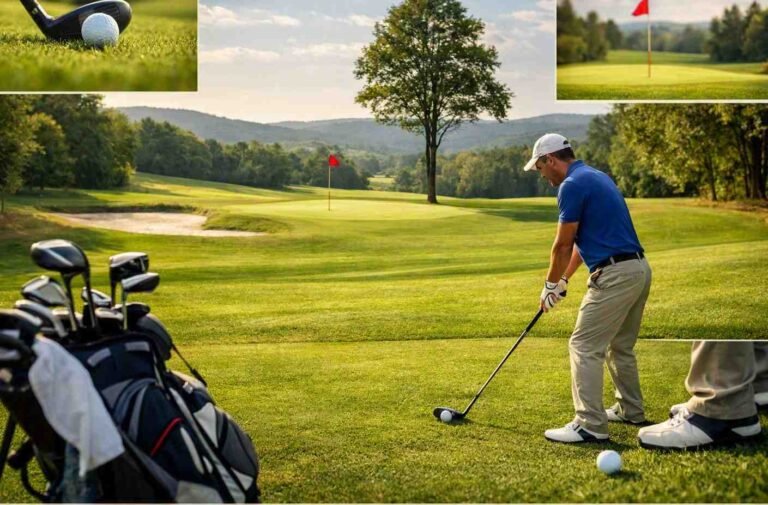

Golf swings do not fail at the top of the backswing—they fail before the club ever moves. Biomechanical studies from the Titleist Performance Institute reveal that over 80% of amateur swing errors trace directly back to address setup mistakes.
For anyone accustomed to setting up camera tripods, framing horizon lines, or managing spatial physics, golf offers a familiar mechanical challenge. Dialing in a proper golf stance for beginners is less about arbitrary rules and more about structural balance, weight distribution, and leverage.
The Geometry of Setup: Why Your Golf Stance Is Like Setting Up a Camera Rig
Think of your body as a tripod system supporting a heavy payload. If the legs of a camera rig are set too narrow, the center of gravity shifts at the slightest breeze or pan. Set them too wide, and tracking movement becomes rigid and locked.
In the same way, a consistent Golf Workout At Home can help strengthen the legs, core, and stabilizing muscles needed to maintain a balanced and athletic golf stance.
In a golf setup, your lower body acts as that steady base while your spine operates as the central axis. If your alignment or kinetic chain is off by just three degrees at address, the clubhead can drift off path by several inches at impact.
Understanding spatial alignment gives you a massive head start in diagnosing these physical mechanics. A consistent Golf Warm Up Routine can also prepare your lower body, spine, and shoulders for the rotational demands of the swing while helping you establish better alignment before the first tee shot.
Deconstructing the Setup: Core Elements of Alignment
The base setup relies on four primary variables: foot width, knee flex, hip hinge, and arm hang. Mastering how these components interact creates a repeatable kinetic system.
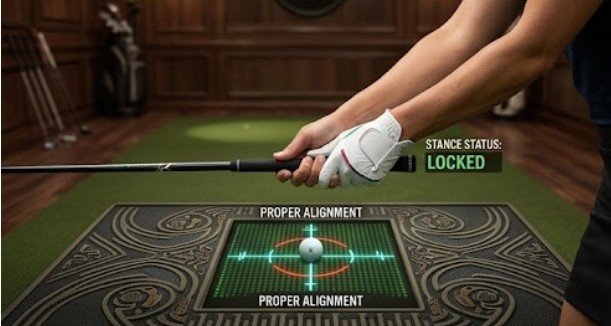
Base Width and Foot Flare
Standard iron shots require a base where the insides of your feet align directly with the outer edges of your shoulders. This creates an athletic base capable of handling rotational torque.
- Driver Stance: Expand the feet slightly wider than shoulder-width to support higher rotational speeds.
- Lead Foot Flare: Angling your lead foot outward by 15 to 20 degrees reduces torque stress on the lead knee and allows the hips to rotate freely through impact.
Spine Angle and Center of Mass
Rather than bending from the lower back, hinge directly from your hip sockets while maintaining a neutral spine. Allow your knees to flex softly without dropping into a full squat. Your arms should hang loosely beneath your shoulders, letting gravity drop your hands directly below your chin.
| Club Category | Feet Base Width | Lead Foot Flare | Ball Position Relative to Stance | Weight Distribution |
| Short Irons (8-PW) | Shoulder-width (inside to inside) | 10–15 degrees | Center of stance | 50/50 balanced |
| Mid/Long Irons (3-7) | Shoulder-width (outside edge) | 15–20 degrees | 1–2 inches forward of center | 50/50 balanced |
| Driver | Wider than shoulder-width | 20–25 degrees | Inside lead heel | 60/40 rear-foot bias |
Editor’s Note: For visual learning, a stacked bar chart illustrating weight distribution shifts across club types works best to visualize balance adjustments.
Ball Position Mechanics
Ball placement alters the attack angle at impact. Short irons require a neutral center ball position to strike down on the ball. Long irons move slightly forward, while drivers sit opposite the inside lead heel. This forward placement lets the clubhead catch the ball on an upward trajectory.
Biomechanics Data: What Sports Science Reveals

Research published by the Journal of Sports Sciences highlights that dynamic balance during address directly correlates with center-face ball contact. Elite golfers maintain roughly 50/50 weight distribution from left to right with mid-irons, while shifting up to 60% of their body weight toward the rear foot when using a driver.
[Target Line] ———————————————>
(Lead Foot) (Trail Foot)
Flared 15-20° Square (90°)
\ |
\ |
+——-+ +——-+
| L | | R |
+——-+ +——-+
^ ^
|——- Shoulder Width ——–|
|
[Ball Position]
(Center for Mid-Irons)
Furthermore, pressure plate testing conducted by golf biomechanists shows that stance width directly impacts rotational speed. A stance that is too wide restricts hip turn, forcing the upper body to compensate and leading to slices or severe pushes. Understanding How to Fix a Golf Slice can help golfers identify whether stance width, alignment, grip, or swing path is contributing to the problem.
A 4-Step Calibration Checklist for Range Days
Use this physical calibration protocol before every practice session to lock in your setup:
- Establish the Base: Ground your feet shoulder-width apart with weight evenly balanced between your heels and the balls of your feet.
- Hinge the Axis: Place a club shaft across your thighs, push your hips back, and tilt your torso forward until your chest points toward the ball.
- Soft-Lock the Knees: Flex your knees just enough to unlock your joints. Your weight should feel centered over your mid-foot.
- Check Hand Hanging Point: Let go of the grip with your trail hand and let it swing naturally. If it hangs straight beneath your nose, your distance from the ball is precise.
Limitations, Exceptions, and Real-World Adjustments
Standard stance advice acts as a baseline, not a rigid law. Physical variations like hamstring tightness, hip mobility limitations, or height discrepancies require adjustments.
Older golfers or players with limited lumbar flexibility often benefit from flaring both feet outward up to 20 degrees. This modification reduces rotational resistance on the hips and lumbar spine. Similarly, playing on uneven lies or thick rough demands a wider base and a lower center of gravity to preserve balance through impact.
Frequently Asked Questions
1. What is the proper golf stance for a beginner?
A proper beginner stance features feet shoulder-width apart, knees softly flexed, a waist hip hinge with a neutral spine, relaxed hanging arms, and weight balanced evenly across the middle of both feet.
2. What is the 70/30 rule in golf?
The 70/30 rule typically refers to short-game pitching, placing 70% of your body weight on your lead foot and 30% on your trail foot to encourage a clean, downward strike.
3. How far should a 60 year old man hit his driver?
The average drive for a 60-year-old male golfer ranges between 200 and 225 yards, depending on swing mechanics, physical fitness, equipment fitting, and total clubhead speed.
4. What is the 80/20 rule in golf?
In golf, the 80/20 rule suggests that 80% of your scoring improvement comes from mastering 20% of your fundamental skills—specifically setup posture, alignment, putting, and short-game control.
Summary and Next Steps
Establishing a proper golf stance for beginners is about constructing a balanced, repeatable mechanical frame. By treating foot width, spine angle, and weight balance as interconnected variables, you set up a system that yields consistent power and contact.
Just as sharp camera framing creates clean visual shots, an athletic stance lays the foundation for a predictable, effective swing path. Practice these positioning steps at home in front of a mirror until your setup feels effortless, setting you up for solid contact every time you step onto the tee.