I do not think golfers need a home gym to become stronger for golf. A smart golf workout at home without equipment can train the hips, trunk, balance, and rotation patterns that influence how efficiently the body moves during a swing.
The key is choosing movements that have a reason to be there. Random push-ups and sit-ups may improve general fitness, but golf asks the body to rotate while maintaining posture and transferring force through the ground. Research has linked golf performance with qualities such as core stability, balance, strength, and flexibility.
Why Golfers Need More Than General Home Exercise
A golf swing happens quickly, yet several physical qualities work together.
Your hips must create and control rotation. Your torso needs enough mobility to turn without forcing movement through the lower back. Your core must resist unwanted motion while allowing powerful rotation. Your legs also need enough strength to maintain posture and push against the ground.
Research reviews have found that lower-body strength and power are important physical determinants of clubhead speed and carry distance.
That is why I build a golf workout at home without equipment around three jobs rather than individual muscles:
Rotate efficiently.
Brace against unwanted movement.
Drive force through the hips and legs.
I call it the Rotate, Brace, Drive approach.
The Rotate, Brace, Drive Training Method
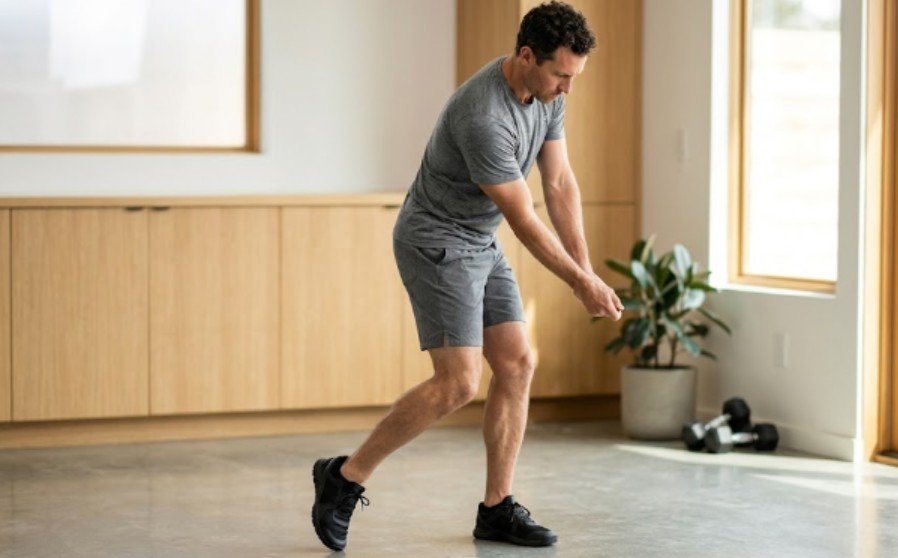
The routine below requires floor space and, optionally, one golf club for balance or positioning. Move slowly at first. Good control matters more than racing through repetitions.
Rotate: Floor Tap Rotations
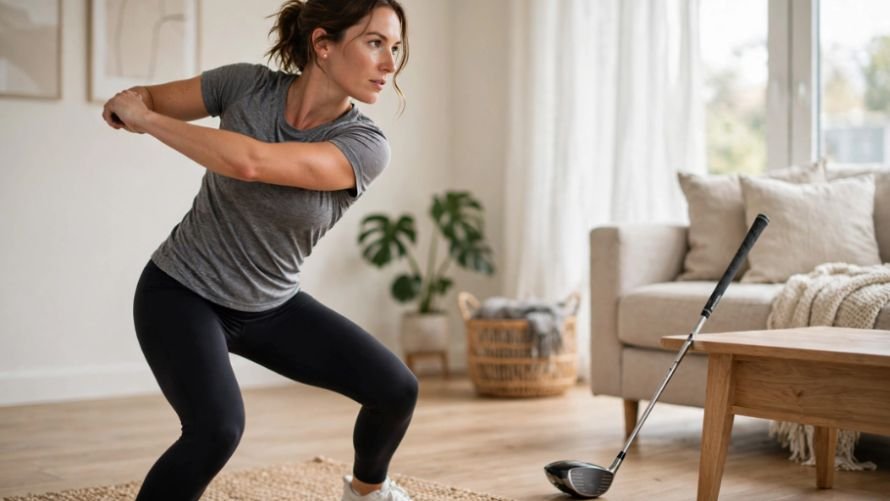
Stand in your normal golf posture with your knees slightly flexed. Begin making small alternating foot taps while rotating into a backswing and follow-through position.
Complete about 10 controlled rotations toward each side.
I like this movement because it combines foot activity with upper-body rotation instead of isolating the torso. Try to turn through your rib cage while keeping your posture stable.
If you struggle to rotate before playing, add these movements to your dynamic stretches for golfers before playing routine rather than relying only on long static stretches.
A systematic review of golf warm-ups found that dynamic and resistance-based warm-ups tended to support performance better than static stretching alone.
Rotate: Split-Stance Golf Turns
Take a split stance with one foot slightly ahead. Hinge from your hips until your torso resembles your golf setup.
Rotate your chest toward your trail side and feel your trail hip accept the turn. Pause for about two seconds, return, and repeat eight times before switching sides.
Do not chase a huge shoulder turn. I prefer a smaller rotation that stays controlled over a bigger turn created by swaying.
This exercise makes the golf workout at home without equipment more golf-specific because you practice rotation while maintaining posture.
Brace: Deadbugs
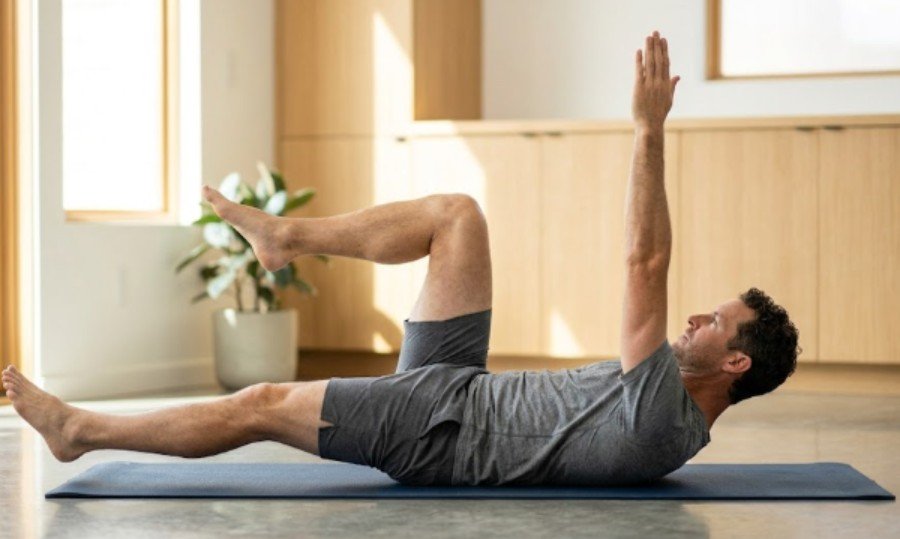
Lie on your back with your hips and knees bent near 90 degrees. Extend your arms upward.
Slowly lower one arm and the opposite leg while keeping your lower back gently controlled against the floor. Return and switch sides.
Aim for 8 to 10 repetitions per side.
Deadbugs teach the trunk to remain stable while your limbs move. That ability matters in golf because efficient rotation should not require uncontrolled movement through every part of the spine.
Brace: Plank Shoulder Touches
Start at the top of a push-up position. Place your feet slightly wider if needed.
Lift one hand and touch the opposite shoulder. Put it down before changing sides.
Complete 12 to 20 total touches.
The challenge is not touching your shoulder quickly. The challenge is stopping your hips from rocking.
I often use this as the anti-rotation component of a golf workout at home without equipment because it exposes poor trunk control immediately.
Bodyweight Golf Exercises for Hip and Leg Strength
Rotation alone will not create an athletic golf body. The lower body needs enough strength to control your stance and produce force.
Drive: Split Squats
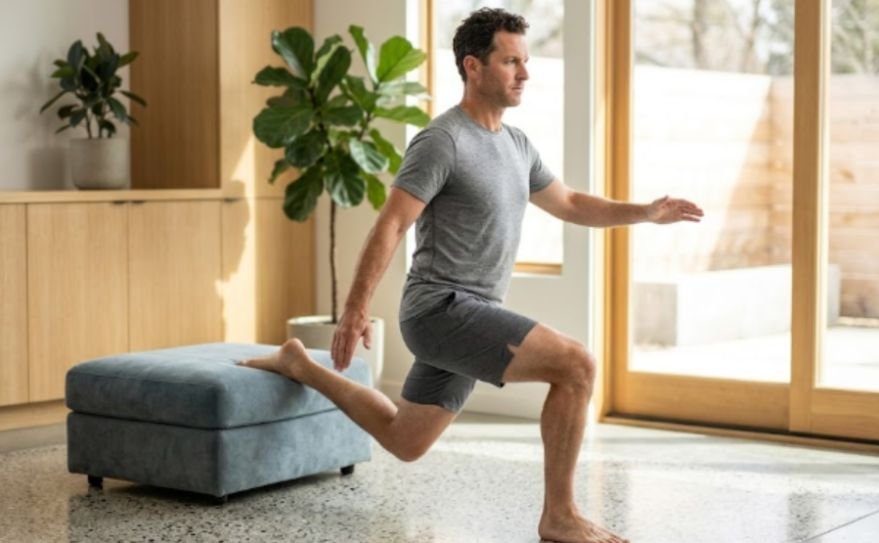
Stand with one foot forward and one foot behind you. Lower your back knee toward the floor while keeping the front foot planted.
Perform 6 to 10 controlled repetitions per leg.
Keep most of your pressure through the front foot and avoid letting the knee collapse inward.
Split squats train each leg independently. That makes them useful for golfers because the swing places different demands on the lead and trail sides.
Drive: Wall Bridges
Lie on your back with your feet placed against a wall. Bend your knees and drive through your feet as you raise your hips.
Pause briefly at the top and lower with control.
Complete 2 to 3 sets of 10 to 12 repetitions.
You should feel your glutes and hamstrings working. If your lower back takes over, reduce how high you lift.
Together, split squats and bridges give the golf workout at home without equipment a genuine strength component instead of turning it into another stretching session.
A 20-Minute Bodyweight Golf Workout
For a simple session, I use two rounds at first and progress toward three.
Start with floor tap rotations for 10 repetitions each side. Follow with eight split-stance turns per side. Then complete 10 alternating deadbugs, 16 plank shoulder touches, eight split squats per leg, and 12 wall bridges.
Rest for roughly 30 to 60 seconds when your technique begins to fade.
Two rounds can fit comfortably into a short session. Three rounds create more training volume without changing the exercises.
My original progression rule is simple: earn repetitions before adding speed.
If you can perform every repetition without losing posture, rocking your pelvis, or rushing, add repetitions. Only then should you make rotational exercises faster.
How Often Should Golfers Train at Home?
For most recreational golfers, I would start this golf workout at home without equipment two or three times each week.
That schedule also fits broader resistance-training recommendations. Current U.S. physical activity guidance advises adults to perform muscle-strengthening activity involving major muscle groups on at least two days each week.
ACSM’s 2026 resistance-training guidance also supports bodyweight and home-based resistance exercise as legitimate training methods.
Avoid turning every session into maximum effort. Golf practice, walking the course, range sessions, and other exercise all add to your weekly workload.
Before an early tee time, use a shorter golf warm up routine before a morning round rather than completing the full strength session immediately before playing.
Golf Mobility and Core Training Mistakes to Avoid
The first mistake I watch for is confusing flexibility with useful rotation. Forcing the shoulders farther around does little good if your hips slide and your spine loses position.
If limited shoulder movement is part of the problem, adding golf stretches for tight shoulders before playing can help you prepare the shoulders and upper back with controlled mobility before you begin swinging at full speed.
The second mistake is performing core exercises too quickly. Deadbugs and shoulder taps become far less useful when momentum replaces control.
Another common problem is training hard every day because the movements use body weight. Bodyweight training still creates fatigue.
After playing, recovery-oriented mobility may be more appropriate. A post round golf stretching routine for weekend golfers can help separate recovery work from your strength sessions.
Pain is also different from normal muscular effort. Stop an exercise that produces sharp, worsening, or unusual pain and seek qualified medical guidance when needed.
How to Progress Without Adding Equipment
No equipment does not mean no progression.
First, increase movement quality. Then add repetitions. After that, slow the lowering phase of split squats or bridges.
You can also pause longer at difficult positions. A three-second split-squat descent is dramatically harder than dropping quickly into the bottom.
For plank shoulder touches, move your feet closer together as your control improves. For rotations, increase speed only while maintaining balance.
This progression method keeps a golf workout at home without equipment useful long after the first few sessions.
Frequently Asked Questions
1. Can beginners do a golf workout at home without equipment?
Yes. Beginners can start with one or two rounds, use smaller ranges of motion, and increase repetitions as control improves.
2. What are the best bodyweight exercises for golfers?
Split squats, bridges, deadbugs, plank variations, and controlled rotational drills cover many useful strength and stability demands.
3. Can home exercises increase golf swing speed?
Strength and conditioning can support clubhead speed, although results depend on the program, golfer, technique, and training consistency.
4. Should golfers work out before or after playing?
Use short dynamic mobility before golf and place harder strength sessions away from important rounds when possible.
Your Living Room Can Build a Better Swing
I would rather see a golfer perform six purposeful exercises consistently than collect 30 drills they rarely finish.
A golf workout at home without equipment works when every movement has a job. Rotate through the upper body and hips. Brace the trunk. Build strength through the legs and glutes. Then progress only when you can maintain control.
Physical improvement is only one part of making golf easier. Players still developing consistency may also benefit from choosing best golf clubs for high handicappers that prioritize forgiveness, easier launch, and confidence while their swing continues to improve.
Start with two rounds twice this week. Do not chase soreness. Chase cleaner movement. Your swing needs a body that can control force, not just survive another set of random exercises.