
When I first started playing golf, I thought a full bag made me look prepared. Then I realized more clubs did not make the game easier. They only gave me more choices to overthink. That is why What Golf Clubs Do You Really Need as a Beginner? matters for new players who want to learn without wasting money.
The truth is simple. You need a small, forgiving setup that helps you tee off, hit approach shots, chip near the green, and putt with confidence. A beginner bag should remove confusion, not add pressure.
Beginners Do Not Need a Full 14-Club Bag
Golf allows players to carry up to 14 clubs, but that number is a limit, not a beginner requirement. Many new golfers assume every slot must be filled before knowing the tee time intervals. That is an easy way to spend too much before understanding your swing.
Most beginners are better with five to seven clubs at first. A smaller setup helps you learn distance, contact, and control faster. Instead of choosing between similar irons, you learn how one reliable club reacts from different lies. That repetition builds confidence.
The Best 5-Club Setup for a Beginner
A driver can be useful, but it is not always the easiest club to control. If it feels frustrating, a 5-wood or 7-wood can be a better tee club because it launches higher and feels easier to swing. A hybrid is also smart because it replaces hard-to-hit long irons and works from the tee, fairway, and light rough.
The 7-iron teaches swing control. The pitching wedge helps with short approach shots and chips. The putter is essential because every hole ends on the green.
The Ideal 7-Club Beginner Golf Bag
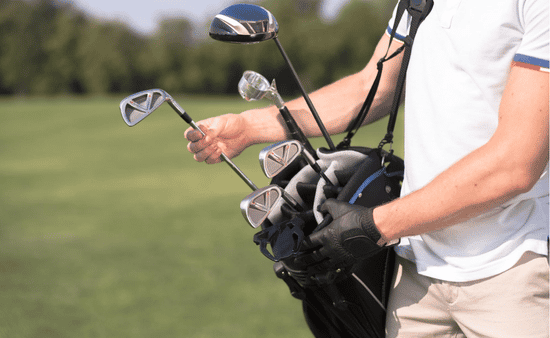
If you want more coverage, a seven-club setup is the sweet spot. A smart beginner bag can include a driver or fairway wood, one higher-lofted fairway wood, one hybrid, a 7-iron, a 9-iron, a pitching wedge or sand wedge, and a putter.
This setup gives enough variety without making club selection stressful. The fairway wood helps on longer tee shots, the hybrid gives you a safer option from rough, the 7-iron covers middle-distance shots, and the 9-iron gives better control near the green. One wedge is enough for many beginners, but a sand wedge can help if you often face bunkers.
What Each Club Does in Your Starter Set
Your longest club is for tee shots and longer holes. For some players, that will be a driver. For others, it will be a fairway wood because accuracy matters more than distance in the beginning.
The hybrid is your rescue club. It helps from light rough, longer fairway lies, and situations where a long iron feels too difficult. Mid-irons like the 7-iron are for approach shots and solid contact. Short irons like the 9-iron help you control height and direction. Wedges are for chips, pitches, and bunker play. The putter is your scoring club.
Clubs Beginners Should Avoid Buying Too Soon
Some clubs are exciting to own but hard to use early. Long irons, especially 3-irons and 4-irons, are difficult because they require speed, clean contact, and good launch. A hybrid is usually a better choice.
Blade irons are another poor early purchase because they offer little forgiveness. Game-improvement irons or cavity-back irons are better because they reduce distance loss when you miss the center of the clubface.
A lob wedge can also create problems. It looks useful for high, soft shots, but it can lead to thin shots, chunked chips, and poor distance control. Expensive tour-style clubs are not necessary either. Forgiveness, comfort, and consistency matter more than brand prestige.
Should You Buy a Complete Beginner Set?

A complete starter set can be a good option if you want everything matched and ready to play. Many beginner sets include a driver, fairway wood, hybrid, irons, wedge, putter, and bag. This is convenient if you do not want to build a set one club at a time.
However, a full set is not always the best value. If your budget is limited, a half set or used set can be smarter. Your swing will change as you learn, so avoid spending heavily before you know your preferred shaft flex, grip size, and club style.
Look for forgiving clubheads, comfortable grips, regular or lightweight shafts, and clubs that feel easy to launch.
When Should You Add More Clubs?
Add clubs only when you notice real gaps. If your hybrid goes too far and your 7-iron does not go far enough, you may need another iron. If bunker shots keep costing you strokes, a sand wedge may help. If your tee shots become more consistent, a driver may finally become useful.
Add clubs because your game is ready, not because your bag looks empty.
Frequently Asked Questions
1. What Golf Clubs Do You Really Need as a Beginner?
A beginner needs a fairway wood or driver, hybrid, 7-iron, wedge, and putter to start playing with confidence.
2. How many clubs should a beginner carry?
Most beginners should carry five to seven clubs at first, then add more as distance control improves.
3. Should beginners use a driver?
Beginners can use a driver, but a fairway wood or hybrid may be easier to control from the tee.
4. Are used golf clubs good for beginners?
Used clubs are a smart choice if they are forgiving, comfortable, and in good condition.
Final Thoughts
When I look back at my first rounds, I wish I had started with fewer clubs. A simple bag would have helped me focus on contact, direction, and confidence instead of guessing between clubs I barely understood.
The best beginner setup is not the most expensive one. It is the one that helps you enjoy the course, learn faster, and avoid costly mistakes. Start small, choose forgiving clubs, and let your bag grow as your swing improves.