Most golfers have heard the word “links” tossed around like it just means any old golf course. It does not. A true links course is a radically different beast from the manicured parkland tracks most American golfers grew up on, and if you show up to one without understanding what you’re walking into, the wind, the bounces, and the brown fairways will eat you alive.
Here’s exactly what a links golf course is, why it plays nothing like your home course, and how to actually enjoy one instead of fighting it the whole round.
What Is a Links Golf Course, Really?
The links golf course meaning goes deeper than most people realize. The word “links” comes from the Old English word hlinc, which referred to rising ground or a ridge. In Scotland, it came to describe the sandy, undulating coastal land that sits between the beach and the farmable inland soil. That ground was essentially useless for agriculture, so in the 14th and 15th centuries, people started using it for recreation. Golf was the sport that stuck.
A genuine links course is built on linksland: sandy, fast-draining soil near the sea. No irrigation needed, no artificial shaping of the terrain. The course works with whatever the land already offers, and the land offers a lot of unpredictability. Pot bunkers drop six feet straight down. Fairways roll and heave like frozen ocean swells. Rough isn’t just rough, it’s fescue grass so thick it’ll swallow your ball and your wedge along with it.
So when someone asks what is a links golf course, the short answer is: a course built on coastal sandy linksland, shaped by wind and sea rather than by irrigation and architects. But that short answer barely scratches the surface.
History of Links Golf: Where It All Started
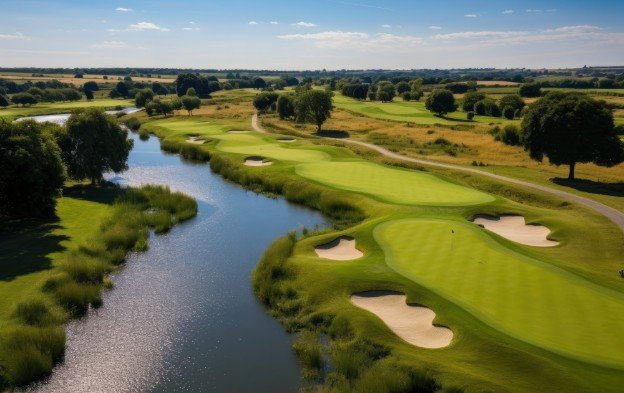
The history of links golf is really the history of golf itself. The game is believed to have been played on the linksland of Scotland’s eastern coast as early as the 15th century. St Andrews, which dates its golfing history to at least 1552, is widely considered the spiritual home of the game. That stretch of land along the North Sea was barren, windswept, and perfect for what would become the world’s most obsessive sport.
Early golfers played on whatever the land gave them. There were no greens in the modern sense, no sand traps designed by committee, and no fairway widths decided by a yardage book. Sheep grazed the rough and actually kept it playable. Rabbits dug the original bunkers. The history of links golf is essentially a story of humans adapting to coastal terrain rather than forcing terrain to adapt to human preferences.
By the 18th century, formal clubs had formed at Leith and St Andrews. The Royal and Ancient Golf Club of St Andrews, founded in 1754, became the governing body that codified the rules. From those wind-battered Scottish shores, the game spread globally. But the courses that spread with it to the American interior and the manicured suburbs of England bore very little resemblance to the originals.
“Links golf is the original form of the game, and it remains the purest test. The wind, the ground game, the imagination required to plot your way around a links course demand a completely different kind of golf intelligence.”
This sentiment, echoed consistently by golf historians and players at the Royal and Ancient Golf Club of St Andrews, reflects a near-universal view among those who have studied the game’s origins.
Features of a Links Golf Course That Set It Apart
Understanding the features of a links golf course makes the experience make sense. Every element you find on a links is a direct product of where that land sits on the planet. Here’s what you’ll actually encounter:
- Sandy, fast-draining soil that dries out quickly and produces firm, fast fairways even after rain.
- Fescue grasses rather than the rye or bentgrass you’d find on a parkland course. Fescue plays incredibly fast and can be brutally penal in the rough.
- Pot bunkers that are small, deep, and vertical-walled. Some you can barely see from the fairway. Many you cannot get out of without going sideways.
- Undulating terrain with humps, hollows, and ridges that redirect perfectly struck shots in directions nobody planned.
- No trees or very few. The coastal environment and sandy soil don’t support significant tree growth. This means wind hits you from every direction with nothing blocking it.
- Open sky and sweeping views, usually of the sea, dunes, or both.
The links golf course terrain is not just a visual backdrop. It’s an active participant in every shot you hit. A ball landing in the fairway on a parkland course stays near where it landed. On a links, that same ball might kick forward 40 yards, or it might dive into a hidden hollow. The ground matters as much as the air.
Wind is perhaps the defining feature. Because there are no trees and the course sits near the coast, sustained winds of 20 to 30 mph are just an average Tuesday. Club selection becomes a two-variable problem at minimum: distance and wind direction. Playing upwind into a stiff breeze, a 150-yard shot might need a 5-iron. Downwind with the same breeze, a 9-iron might barely hold the green.
Links Golf Course Meaning vs. What People Think It Means
Here’s where most golfers get confused. The links golf course meaning has been diluted by marketing. Courses in Arizona, Florida, and inland England will call themselves “links style” when they really mean “we have some undulating fairways and pot bunkers.” That is not a links course. That’s a course borrowing aesthetic cues from a links.
A true links must sit on genuine coastal linksland. If the course is inland, no matter how windy or sandy it feels, it is not technically a links. There are no true links courses in most of the continental United States because the coastal linksland geography that defines them simply does not exist here in the same way it does along the coasts of Scotland, Ireland, and England.
Explaining the links style as a design philosophy is a different conversation. Many courses adopt links-inspired elements, including wide fairways, minimal trees, ground-game emphasis, and deep bunkers. These courses can be wonderful and demand a similar approach to shot-making, especially for golfers learning how to play a golf course strategically. However, calling them links courses is technically inaccurate, and any serious golfer should understand the distinction.
Links Golf vs Regular Golf Course: The Real Differences
The links golf vs regular golf course comparison comes down to four fundamental contrasts. Knowing these will completely change how you approach a links round.
| Factor | Links Course | Parkland/Regular Course
|
|---|---|---|
| Soil Type | Sandy, porous, fast-draining | Clay or loam, holds moisture |
| Wind Exposure | Constant, often severe | Moderate, buffered by trees |
| Fairway Firmness | Firm, fast, bouncy | Soft, holds divots |
| Trees | Rare to none | Abundant, shape strategy |
| Shot Approach | Ground game, bump and run | Air game, high approach shots |
| Green Firmness | Fast, firm, difficult to hold | Soft, receptive to spin |
| Location | Coastal linksland | Inland, varied terrain |
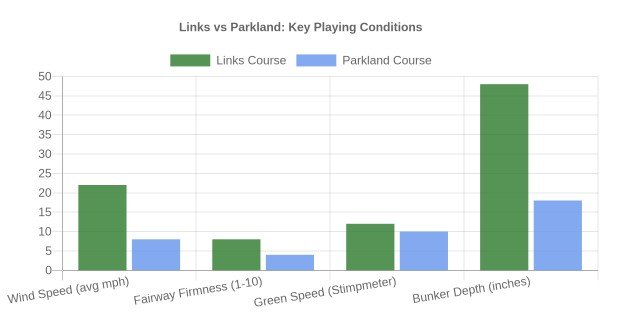
The links golf vs regular golf course gap is most felt on the green. On a parkland course, you learn to fly the ball in with backspin and have it stop near where it lands. On a links, that same high, spinning approach shot might never reach the putting surface because the ground is so firm. You have to think about using the contours, running the ball up, and trusting the bounce. It’s a completely different mental model.
What Makes a Course a Links: The Official Criteria
So what makes a course a links in the strictest sense? Golf historians and architects generally agree on a cluster of criteria, though there is no single governing body that formally certifies a course as a links the way a whisky can be certified as Scotch.
The primary criteria most experts use:
- Location on or immediately adjacent to a coastline, specifically on linksland (sandy, low-fertility ground between beach and farmland).
- Soil composition that drains rapidly and supports fescue or marram grasses rather than irrigated turf.
- Course layout that follows and reflects the natural topography, not one that was sculpted by earthmovers.
- Exposure to coastal winds without significant tree cover to break them.
- A playing surface that rewards a ground game and punishes an exclusively aerial approach.
What makes a course a links is ultimately geography and geology, not design choice. You cannot build a true links in Kansas. The land has to already be there, and a course designer’s job is to work within it, not against it. That’s a philosophy fundamentally opposite to how most modern courses are designed.
Famous Links Golf Courses Around the World
The famous links golf courses that define the category are concentrated in the British Isles, though a handful exist in Ireland and along the coasts of Australia and New Zealand. These are the courses that have shaped how professionals and architects think about the game.
St Andrews Links (Old Course), Scotland is the most historically significant course on earth. Founded in the 1400s, its double greens, Road Hole bunker, and Valley of Sin are pilgrimage sites for serious golfers. The St Andrews Links Trust manages six courses on the original linksland, and the Old Course ballot for tee times is legitimately competitive.
Royal County Down, Northern Ireland has sat at or near the top of virtually every global course ranking for decades. The backdrop of the Mourne Mountains against the Irish Sea is genuinely stunning, and the course beneath it is genuinely brutal. Blind tee shots, native rough, and greens that reward imagination over power.
Carnoustie Golf Links, Scotland has hosted nine Open Championships and has a reputation as the most demanding of all the famous links golf courses on the Open rota. Players and architects alike reference Carnoustie when they want to talk about unforgiving design.
Royal Portrush, Northern Ireland returned to the Open Championship rota in 2019 after a 68-year absence and reminded everyone exactly why it belongs among the elite. The Dunluce Links sits on the Antrim Coast, and the views from the clifftop holes are among the best in golf.
Ballybunion Golf Club, Ireland is the course most American golf tourists fall in love with on their first trip to Ireland. Tom Watson famously called it one of the greatest courses in the world. The Atlantic Ocean eats into the dunes directly beside several holes.
For more on the courses that define tournament links golf, the Open Championship’s official course rota gives you a curated list of the world’s most significant links venues.
Links Golf Course Terrain: Reading the Ground
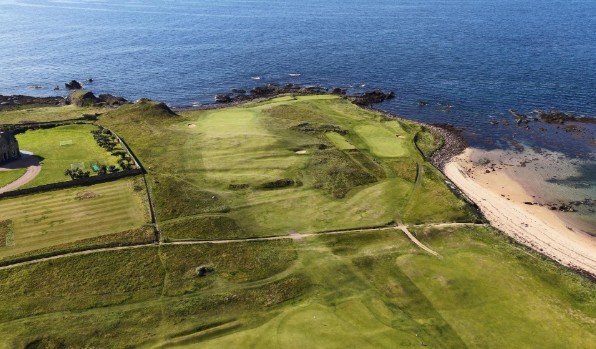
The links golf course terrain is something most golfers have to actively learn to read, because it operates on completely different logic from what you’re used to. On a parkland course, you look at a shot and think about trajectory, spin, and landing zone. On a links, you add a third dimension: where does the ball go after it lands?
Fairways on a links course are rarely flat. They tilt, they ridge, they hollow. A shot landing on the left side of a fairway might funnel toward the center. A shot landing on the right might kick off into rough. The links golf course terrain is doing active work all the time, and good links players learn to use it rather than fight it.
Greens are elevated, domed, or surrounded by chipping slopes that kick approach shots away from the flag. Approach shots fired from 100 yards that land short of the green and run on are often more effective than high-spinning wedges that fail to hold the firm putting surface. This concept, playing the bump and run, is the tactical heart of links golf.
Dunes frame many holes on coastal links golf courses, providing natural visual definition but also creating wild unpredictable lies when a ball rolls into them. The dunescape on courses like Lahinch in County Clare or Brora in the Scottish Highlands is as much an obstacle as any water hazard, and often just as penalizing.
How to Play Links Golf: A Practical Framework
Learning how to play links golf is not just about adjusting your club selection. It requires a complete recalibration of how you think about scoring, shot selection, risk management, and course markings such as red stakes VS yellow stakes golf hazards. Here is a framework I call the “Three Accepts” for approaching a links round successfully.
The Three Accepts Framework for Links Golf
Accept the wind. Don’t fight it. Fighting a 25 mph headwind with a high-trajectory shot is a losing battle every single time. Take more club, punch the ball low, and put it in play. A low running shot into a headwind is not a surrender, it’s correct golf.
Accept the bounce. Your ball is going to take funny bounces. That’s not the course cheating you. That’s links golf. Plan for balls to run further than you expect, and aim to use slopes rather than fight them. Many of the best shots in links golf are played to a spot 20 yards short of the pin and allowed to run up.
Accept bogey as a reasonable outcome. When the wind is howling and the ground is fast, a bogey on a difficult hole is not a failure. Experienced links players are always thinking about avoiding double bogey or worse. The range of outcomes on any single links hole is far wider than on a protected parkland hole, and staying patient matters more than being aggressive.
Practical Checklist for Your First Links Round
- Check wind direction on every tee box, not just on the first tee.
- Carry more clubs than you think you’ll need for short shots. You’ll use a 7-iron for chip-and-runs you’d normally take a sand wedge for.
- Use the ground. Practice bump-and-run shots before the round if the facility allows it.
- Study the pot bunkers from a distance before committing to a line. Many are invisible from the tee.
- Aim for the fat part of greens, not the flag. Flags on a links are often tucked in locations where a missed shot is severely punished.
- If you find fescue rough, take your medicine. Advancing the ball back to the fairway is almost always the smarter play than trying to reach the green from thick fescue.
Understanding how to play links golf is also about tempo. Wind makes you want to swing harder. Resist that. A smooth, controlled swing in windy conditions produces far more consistent ball flight than a fast, hard swing that opens the clubface unpredictably.
Coastal Links Golf Courses: Why Location Changes Everything
Coastal links golf courses aren’t just scenic. The proximity to the sea is what creates the conditions that define them. Salty air keeps grasses tough and lean. Ocean breezes are consistent in direction on calm days but chaotic during storms. The sea mist that rolls in on summer mornings in Scotland and Ireland can drop visibility to the length of one fairway, and by afternoon the same hole is bathed in sunlight with a 30 mph crosswind.
Playing coastal links golf courses connects you to something larger than a round of golf. The courses at Doonbeg in County Clare sit on dunes that took 5,000 years to form. The Old Course at St Andrews has been played for over 600 years. That kind of scale changes how you think about a three-putt. Suddenly it seems less catastrophic.
The environmental conditions on these coastal sites also make them remarkably sustainable. Because the soil drains so well and fescue grass requires little water or fertilizer, the best links courses in the world use a fraction of the resources that a typical American parkland course consumes. According to research published by the Golf Environment Organization, links courses routinely outperform other course types on environmental metrics including water usage, pesticide application, and biodiversity support.
Links Style Golf Explained for the American Golfer

Links style golf explained for a golfer who grew up on American parkland courses looks like this: imagine your normal course, but strip out every tree, crank up the wind to 25 mph, firm the fairways to a pool table, and make the rough into something that actively hides your ball. Then place it next to an ocean. That’s the rough approximation.
The tactical shift required is the bigger adjustment for most American players. The dominant shot in American golf is the high draw or high fade, landing softly on target. The dominant shot in links golf is the low punch, the bump and run, the intentional ground ball that uses the slope. American golfers who try to play their home-course game on a links usually shoot 10 to 15 shots higher than they expect. Those who adapt quickly and accept the ground game often surprise themselves.
Links style golf explained at the strategic level comes down to one shift: playing to the right part of the green rather than to the flag. On a firm links, the flag is a trap. The smart target is the area of the green that gives your ball the best chance to funnel toward the hole rather than away from it. That requires reading the green complex from 150 yards out, which is a skill most parkland golfers never develop because they don’t need it.
The 2019 Open Championship at Royal Portrush gave American golf fans a perfect television demonstration of this. Shane Lowry’s win was a masterclass in using the ground, playing conservative lines in brutal wind, and accepting that a perfectly struck shot sometimes goes sideways on a links. He didn’t fight the course. He worked with it.
The Defining Question: Should You Play a Links Course?
Yes. Unequivocally yes. Every serious golfer should play a true links course at least once. Not to improve your handicap, not because it’s easy, but because it forces you to understand the game’s original form. Playing a true links is like reading the first edition of a book after spending years with adaptations. The original has a clarity and a logic that the adaptations obscure.
If a trip to Scotland or Ireland isn’t in the immediate plan, seek out the best links-style courses near you. While they won’t meet the strict definition of what is a links golf course, they’ll introduce you to ground game thinking and wind management. Courses like Pacific Dunes at Bandon Dunes in Oregon come about as close as American golf gets to the real experience, sitting on coastal dunes with full wind exposure and fescue grasses.
Bandon Dunes Golf Resort, for reference, was specifically designed with links principles in mind, and golfers who visit consistently report that it recalibrated how they think about shot-making in a way no other American destination does.
What Is a Links Golf Course: Putting It All Together
A links course is not a marketing term or a design aesthetic. It’s a specific type of course born from specific geography: sandy coastal ground, wind-exposed, treeless, firm, and fast. The features of a links golf course grew from that environment, not from a designer’s preference. The pot bunkers, the fescue rough, the rumpled fairways, and the ground game are all consequences of where these courses sit on the earth.
The history of links golf stretches back to the 15th century on Scotland’s eastern coast, and the courses that still stand there remain the most demanding and historically significant in the game. Understanding links style golf explained properly means understanding that the ground is as much your opponent and your ally as the wind, your playing partners, or your own swing mechanics.
If you want to call yourself a complete golfer, a links is eventually required. Not comfortable. Not easy. Required. The game started on that sandy, wind-hammered ground, and something about playing it there reminds you why the whole thing is worth obsessing over in the first place. So book the trip. Accept the bogeys. And let the wind hit you.