

I used to treat a difficult approach as a challenge I had to conquer with a better swing. If the pin was tucked behind a bunker or the ball sat on a strange slope, my first thought was usually about how to hit the perfect shot. That mindset often made things worse. I would choose a club based on the best possible outcome, ignore the bad miss, and then wonder how a decent hole had suddenly turned into a big number.
Over time, I started looking at these shots differently. The question became less about hitting the flag and more about finding the smartest place for the ball to finish. A 30-foot putt from the middle of the green can be a much better result than a 10-foot putt from a dangerous edge. Once that became part of my decision-making, difficult approaches stopped feeling like shots I had to force.
Start With the Lie Before Choosing a Club

The first thing to assess is not the pin. It is the lie.
A clean fairway lie gives you far more control than thick rough, a tight patch of turf, or an uneven slope. Before reaching for a club, look at how much of the ball is visible, where your feet sit in relation to it, and whether the ground will allow your normal swing.
A poor lie often calls for a simpler objective: make solid contact and get the ball into a useful area. From thick rough, grass can get between the clubface and ball, reducing spin and making the result less predictable. A steeper delivery and more conservative target can improve your chances of getting the ball out cleanly.
Your lie should influence both your club and your expectations. A 170-yard shot from a perfect fairway is not the same shot as 170 yards from heavy rough.
Find the Safe Side of the Green
Once you understand the lie, look at the entire green instead of locking onto the flag.
Ask where the widest landing area is and which side gives you the easiest recovery if you miss. If the pin is tucked beside water, a bunker, or a steep run-off, the safer portion of the green may be several yards away from it.
This does not mean automatically aiming at the center on every approach. It means choosing a target that gives you enough room for a slightly imperfect swing. A recent approach strategy for tucked pins recommends targeting the widest part of the green, taking enough club to clear trouble, and accepting a longer putt when necessary.
This way of thinking also fits naturally with broader golf course management tips, because a difficult approach should be judged by the risk it creates, not just by how close you could get to the hole.
Adjust for Uneven Lies
Uneven lies can change the expected ball flight before you even make a swing.
When the ball sits above your feet, right-handed golfers generally need to account for a tendency for the ball to move left. When it sits below the feet, the opposite tendency can appear. Uphill lies generally produce higher, shorter shots, while downhill lies tend to produce lower shots with more forward movement.
The setup should reflect the slope. On a downhill lie, for example, matching your body angles to the slope and allowing the swing to travel down the slope can help prevent the instinct to lift the ball into the air. More loft may also be useful because the slope effectively reduces the club’s loft.
Balance matters just as much as club selection. A wider stance or shorter grip can make an awkward position easier to control.
Treat Thick Rough Differently

Thick rough is one of the easiest places to overestimate what you can do.
The grass can trap the club, reduce spin, and produce either a dead shot or one that comes out hotter than expected. That unpredictability makes aggressive flag hunting especially risky.
Instead of trying to manufacture a perfect long-iron shot, first ask whether you can reliably advance the ball toward the green. If the lie is severe, a shorter club and a realistic target may give you a much better chance of avoiding another mistake.
From rough, solid contact matters more than squeezing every possible yard from the swing. The less ball you can see, the more cautious your club and target selection should become.
Check the Real Yardage
The number to the flag is not always the number you should play.
Look at the front of the green, the back edge, and any hazard that must be carried. Then consider wind, elevation, lie, and how far your club actually carries rather than relying only on total distance.
This becomes particularly important when the front of the green is protected. Choosing a club that requires a perfect strike just to reach the putting surface can create unnecessary pressure. A slightly longer club that comfortably carries the front and finishes somewhere near the middle may be the better option.
Your goal is not simply to reach the pin. It is to give yourself the largest useful margin for error.
Know When Not to Attack
A difficult approach can tempt you into a shot you have never practiced.
Maybe the only route to the pin requires a high fade over a bunker. Maybe you need to curve the ball around a tree and stop it quickly on a firm green. If you rarely hit that shot successfully, the fact that it is technically possible does not make it a good decision.
Think about your actual success rate.
If the aggressive option has a small chance of working and a large chance of producing a penalty or difficult recovery, change the target. Playing away from trouble is not giving up. It is recognizing that one bad approach can cost more than the potential birdie is worth.
Think About the Next Shot
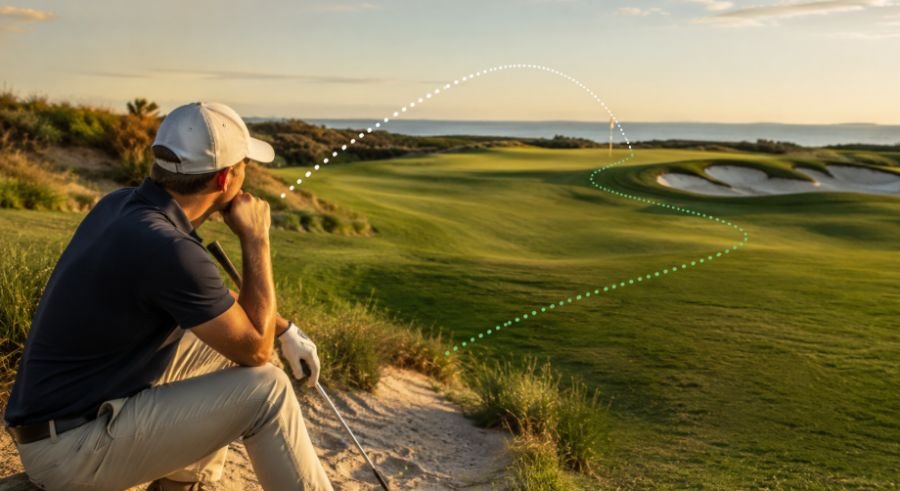
The best result from a difficult approach is not necessarily the closest one.
If the green slopes sharply from one side, a missed approach toward the lower side may leave an easier putt or chip. If one side is short-sided, giving yourself 25 feet from the opposite side may be a far better outcome.
That is where the idea of using technology to make golf practice more effective becomes useful. Shot-tracking data, launch monitors, and simulators can show where your approaches actually finish, how wide your dispersion is, and which distances create the most reliable results. You can then use that information to choose realistic targets rather than relying on your best shots.
The technology does not make the decision for you. It simply gives you better information about the player making it.
Build a Simple Pre-Shot Routine
A difficult approach becomes easier to manage when you use the same decision process every time.
Start with the lie. Identify the main danger. Check the real yardage. Choose the safest useful area. Decide what miss you can accept. Then select the club that gives you the best chance of executing that plan.
Once you have made the decision, stop changing your mind over the ball.
A consistent routine keeps attention on the target rather than swing mechanics. It also helps prevent the emotional decisions that often appear after a poor tee shot or a frustrating hole.
Practice the Shots You Usually Avoid

Many golfers practice approach shots from perfect range lies because those shots are comfortable. The course does not always give you that luxury.
Spend some practice time on uneven lies, different distances, rough, awkward targets, and shots where one side of the green is clearly worse than the other. Work on choosing a target before swinging.
You can also practice how to play safer without becoming too conservative by giving yourself realistic scoring choices. Hit one shot toward an aggressive target and another toward the wider safe area. Compare the likely outcomes, not just which ball finished closer.
The objective is to become comfortable making smart decisions when the perfect shot is not available.
Frequently Asked Questions
1. What should I consider before a difficult approach shot?
Check the lie, real yardage, wind, slope, hazards, pin position, and your likely miss. These factors should determine your target and club.
2. Should I always aim for the middle of the green?
No. The middle is a strong default when the pin is dangerous, but an aggressive target can make sense when the approach offers enough room and the risk is reasonable.
3. What should I do from thick rough?
Prioritize solid contact and a realistic target. Thick grass can reduce spin and make distance unpredictable, so avoid forcing a shot you rarely practice.
4. How can I avoid turning one bad shot into a big number?
Choose the safest useful recovery option. Accepting a longer putt or a bogey chance is often better than attempting a low-percentage shot that brings a penalty into play.
Why Difficult Approaches Do Not Have to Become Difficult Holes
The hardest approach shots often expose decision-making more than technique. You cannot control every lie, gust of wind, slope, or pin position, but you can control how much risk you accept. When you start judging an approach by its safest useful outcome rather than its most impressive one, you give yourself more chances to finish the hole without unnecessary damage.
A difficult lie does not require a heroic shot. Read it honestly, choose your margin, and commit to the option you can actually execute.