
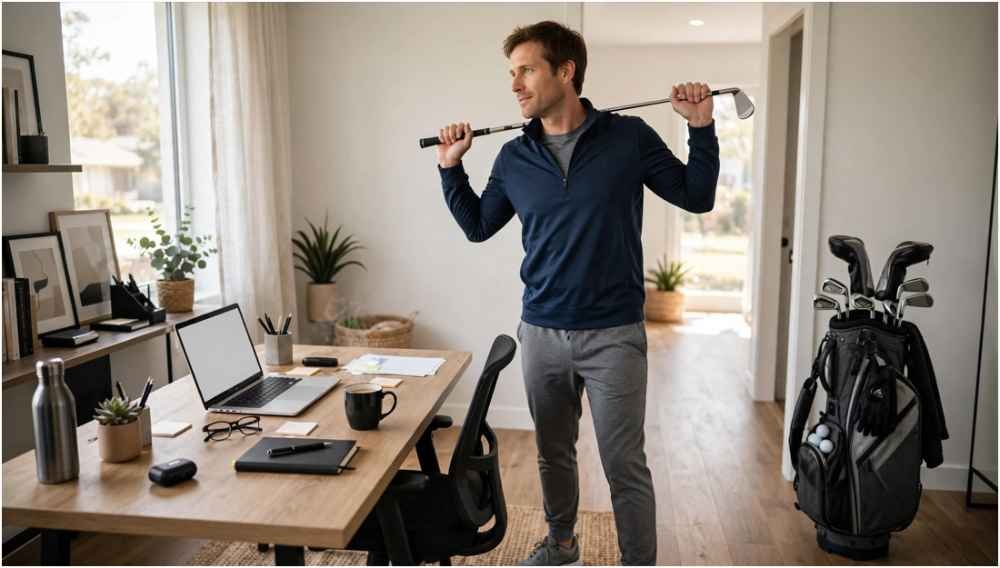
If your hips feel glued to your office chair by 5 p.m., your golf swing may feel much the same on Saturday morning. The best golf exercises for people who sit all day restore hip movement, improve mid-back rotation, activate the glutes, and teach your core to control that new range.
When I structure a routine for a desk-bound golfer, I do not rely on stretching alone. I use a simple order: regain motion, activate key muscles, then rehearse rotation in a golf-like position.
Research involving office workers has linked longer sitting periods, static posture, and fewer movement breaks with more low-back complaints. Studies also suggest active breaks and regular postural changes can reduce neck and lower-back problems in some office workers.
Why Sitting Can Make Your Golf Swing Feel Stiff
Hours at a desk keep your hips flexed while your rib cage and pelvis move very little. That does not mean your glutes literally “switch off,” but long periods with little movement can leave your body feeling stiff and poorly prepared for an athletic golf swing.
Golf requires coordinated rotation through the hips, pelvis, trunk, and shoulders. Biomechanics research describes the golf swing as a complex rotational action, while Mayo Clinic recommends preparing the hips and upper body before playing.
That is why I organize golf exercises for people who sit all day around four priorities: hip mobility, thoracic rotation, glute strength, and core stability.
Best Golf Mobility Exercises for Tight Hips and Mid-Back
1. Couch Stretch for Tight Hip Flexors
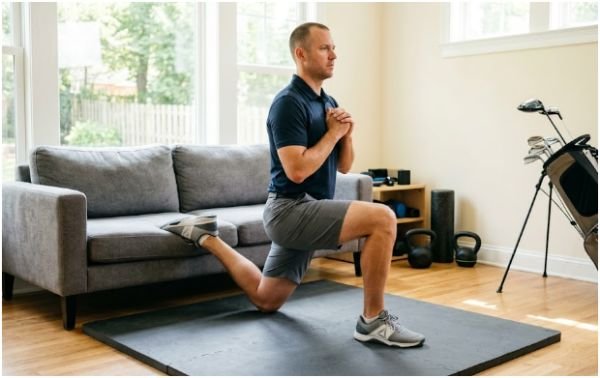
Kneel with one foot forward and the opposite knee on the floor. Rest your rear foot against a couch, chair, or wall.
Gently tuck your pelvis and squeeze the glute on the kneeling side. Hold for about 30 seconds, then change sides.
You should feel the front of your hip rather than pressure in your lower back. I prefer using longer stretches after work or after warming up instead of forcing them immediately before the first swing. Mayo Clinic also recommends warming muscles before deeper stretching.
2. 90-90 Hip Switches for Golf Hip Rotation
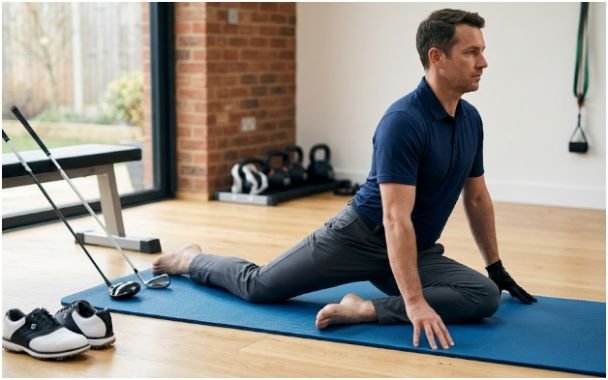
Sit on the floor with both knees bent. Slowly rotate your knees toward one side and then the other while keeping the movement controlled.
Perform 8 to 10 repetitions.
This is one of my favorite golf exercises for people who sit all day because it works both internal and external hip rotation without weights or machines.
Better hip motion can make it easier to turn without asking your lower back to create all the rotation.
3. Seated Thoracic Rotations for Desk-Bound Golfers
Sit tall near the front of your office chair. Cross your arms over your chest.
Keep your hips facing forward while rotating your rib cage to one side. Return to center and rotate the other way.
Do 8 to 10 controlled repetitions per side.
I like this drill because you can perform it during the workday. You do not need gym clothes, floor space, or equipment.
4. Open Book Stretch for Upper-Back Rotation
Lie on your side with your hips and knees bent. Extend both arms in front of you.
Slowly open the top arm toward the floor behind you while keeping your knees together. Perform 6 to 8 repetitions per side.
Controlled thoracic rotation also appears in Mayo Clinic’s golf mobility recommendations.
These four mobility-based golf exercises for people who sit all day prepare your body for the strength work that follows.
Glute and Core Exercises for a More Stable Golf Swing
Extra range only helps when you can control it. Once I improve movement, I want the hips and trunk to create a stable platform for rotation.
5. Glute Bridges
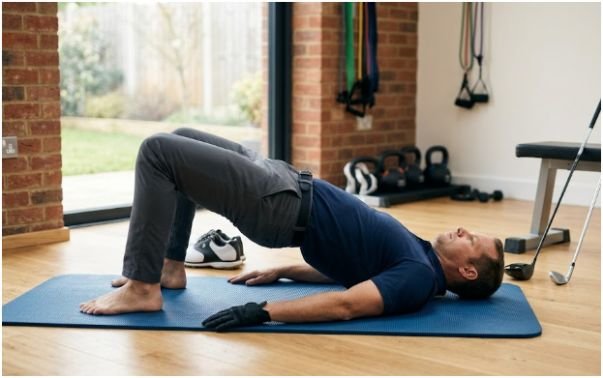
Lie on your back with your knees bent and feet flat.
Drive through your feet and raise your hips until your thighs and torso form a comfortable straight line. Squeeze your glutes for two seconds.
Perform 2 to 3 sets of 10 to 12 repetitions.
Do not chase extra height by aggressively arching your lower back.
6. Monster Walks With a Resistance Band
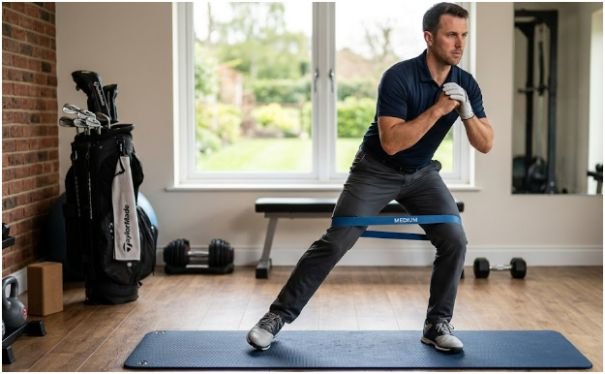
Place a mini resistance band above your knees or around your ankles. Lower into a shallow athletic stance.
Take 8 to 10 slow steps sideways while maintaining tension in the band. Repeat in the opposite direction.
Monster walks train the lateral hip muscles while keeping you in a position that resembles an athletic golf setup.
On strength days, I would combine them with a resistance band workout for golfers at home rather than using them only before rounds.
7. Dead Bug for Core Stability
Lie on your back with your hips and knees at roughly 90 degrees. Extend your arms toward the ceiling.
Brace your core, then slowly extend one leg and the opposite arm. Return to the starting position before changing sides.
Perform 6 to 10 repetitions per side.
Among golf exercises for people who sit all day, I like dead bugs because they train the trunk to remain controlled while the arms and legs move.
Golf strength research supports training the lower body and trunk, with strength and power qualities showing relationships with golf performance.
8. Split-Stance Golf Rotations
Stand with one foot slightly ahead of the other. Keep both knees soft and hold a golf club across your chest.
Rotate your rib cage while keeping your balance. Return slowly.
Perform 6 to 8 repetitions on each side.
This final exercise connects your mobility and stability work with a more golf-specific rotational pattern.
My 6-Minute Desk-to-Tee Reset
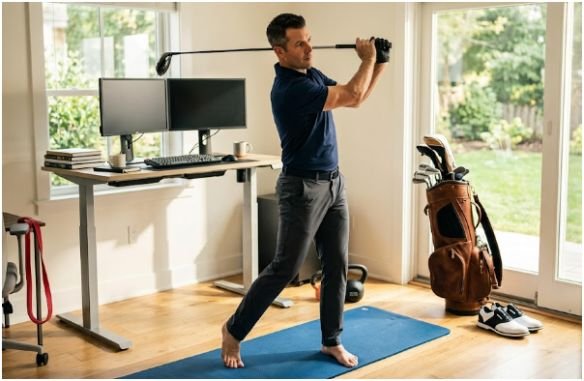
I use a simple rule when choosing golf exercises for people who sit all day: move first, activate second, rehearse the swing last.
That creates this six-minute “Desk-to-Tee” routine.
| Minute | Exercise | Dose | Main Purpose |
| 1 | 90-90 hip switches | 8 reps | Hip rotation |
| 2 | Seated thoracic rotation | 8 per side | Upper-back mobility |
| 3 | Couch stretch | 30 sec per side | Front-of-hip mobility |
| 4 | Glute bridges | 12 reps | Glute activation |
| 5 | Dead bugs | 6 per side | Core stability |
| 6 | Split-stance rotations | 6 per side | Golf movement |
The difference is the sequence. I do not simply collect stretches.
First, I restore available movement. Next, I activate muscles that help stabilize the pelvis and trunk. Finally, I practice using that movement in a golf-shaped position.
For a longer training session, use a 20 minute golf workout at home two or three times each week instead of turning your pre-round warm-up into a full workout.
How Often Should Desk Workers Do Golf Exercises?
Daily mobility and formal workouts should not be treated as the same thing.
| Training Goal | Practical Frequency |
| Hip and thoracic mobility | Daily or most workdays |
| Glute and core training | 2–3 days weekly |
| Desk movement breaks | Several times during the day |
| Golf warm-up | Before rounds and practice |
The CDC currently recommends American adults get at least 150 minutes of moderate-intensity aerobic activity each week and muscle-strengthening activity on two or more days. Those are general health guidelines rather than a golf-specific program.
For someone who mainly plays Saturdays or Sundays, I would build a golf fitness routine for weekend golfers across the week instead of doing nothing until tee time.
Consistent golf exercises for people who sit all day work better when they become part of your workweek rather than an emergency fix before a round.
What I Would Avoid After Sitting All Day
I would not jump directly from eight hours at a computer into aggressive rotational stretching.
Start with gentle movement and gradually increase your range.
I also would not treat pain as evidence that an exercise is working. Sharp pain, numbness, weakness, or symptoms traveling into an arm or leg should be assessed by an appropriate healthcare professional.
Most importantly, do not expect one workout to cancel an entire week of inactivity. ACSM emphasizes reducing sedentary time in addition to completing regular exercise.
That makes brief workday movement breaks a useful partner to golf exercises for people who sit all day, not a replacement for them.
FAQs About Golf Fitness for Desk Workers
1. What are the best golf exercises for people who sit all day?
The best options include 90-90 hip switches, thoracic rotations, glute bridges, dead bugs, monster walks, and controlled golf rotations.
2. Can sitting all day make my golf swing feel tighter?
Long periods with few movement breaks can contribute to stiffness and musculoskeletal discomfort, which may make rotating comfortably feel harder.
3. How long should a desk golfer exercise each day?
Five to 10 minutes of daily mobility is practical, while dedicated strength sessions can usually fit into two or three days each week.
4. Should I stretch before golf after sitting at work?
Start with five to 10 minutes of dynamic movement and controlled rotation rather than immediately forcing long, deep stretches.
Your Desk Chair Does Not Get the Last Word
I would never try to out-stretch eight hours of sitting with one heroic session on Saturday morning. Better results come from small, repeatable movement habits.
Keep golf exercises for people who sit all day simple: open the hips, rotate the mid-back, strengthen the glutes, control the core, and finish with golf-specific movement.
Try the six-minute Desk-to-Tee reset for the next seven days. If you can maintain it comfortably, add two weekly strength sessions. Your desk may own most of Monday through Friday, but it does not have to own your weekend golf swing.