

I used to think inconsistent iron contact was mostly a swing-speed problem. If a shot came out thin or heavy, my first instinct was to change something in the downswing or swing harder. Over time, I noticed the better results usually came from much simpler work. When I could control where the club reached the bottom of the swing, my iron shots started feeling more predictable without adding extra effort.
I also found that hitting a large bucket of balls wasn’t automatically productive. If the same poor contact kept repeating, I was simply practicing the mistake. A few focused drills gave me better feedback because I could see where the club was striking the ground and whether the ball was getting hit first. That makes practice much more useful for golfers who want a repeatable strike rather than one perfect shot.
Why Iron Contact Gets Inconsistent

Solid iron play starts with one basic idea: the club should contact the ball before it reaches the turf. The bottom of the swing should be slightly ahead of the ball, allowing the clubface to compress the ball before the club continues into the ground.
When that low point moves behind the ball, the result is often a fat shot. Move it too far forward, and the club can catch the upper part of the ball, producing a thin strike. Ball position, pressure movement, posture, and timing can all influence where that low point ends up.
That is why chasing a perfect-looking swing isn’t always the answer. It is often more useful to give yourself a clear task that teaches your body where contact needs to happen.
Drill 1: The Tee-Ahead Drill
This is one of the easiest ways to train ball-first contact.
Place your golf ball on the ground and put a tee about two inches in front of it, closer to the target. Start with a short iron and make a controlled swing. Your goal is to strike the ball first and then clip the tee or brush the turf around it.
Don’t try to dig a deep divot. The useful feedback comes from learning to move the low point forward. PGA instruction commonly uses a similar setup because it gives golfers a simple visual target for ball-then-turf contact.
Start with half swings. Once you can repeatedly strike the ball and reach the tee afterward, make the swing slightly longer.
This is also a good place to check your ball position. If the ball is too far back or you feel like you need to scoop it into the air, your contact can become harder to control.
Drill 2: Feet-Together Step Drill
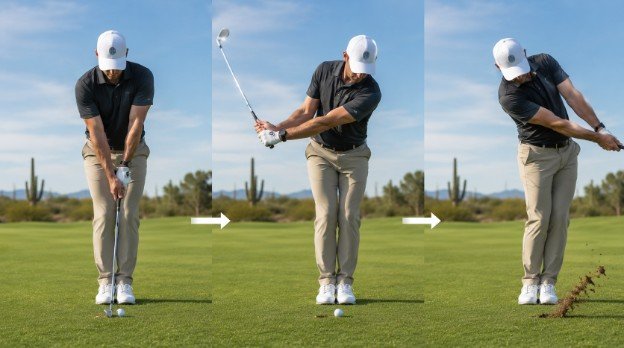
If you tend to leave too much weight on your trail side, try practicing with your feet together.
Set up to the ball with your feet close together. Make a small backswing. As you begin moving down, step your lead foot toward the target and swing through.
The movement encourages a more natural pressure shift and keeps the drill athletic rather than overly mechanical. PGA coaches use step-through variations to help golfers feel pressure moving toward the target while maintaining balance.
You don’t need to hit full-speed shots. In fact, starting slowly makes the drill more useful. The goal is to feel your body move through the shot rather than staying planted and throwing your arms at the ball.
If your iron contact has been unpredictable because you hang back, this can be a useful addition to how to stop coming over the top in golf without trying to fix your entire swing at once.
Drill 3: Trailing Foot Back Drill
This one is useful when you feel like your body sways away from the target during the backswing.
Take your normal stance, then move your trail foot straight back a few inches. Keep the ball in its normal position and make controlled swings.
The slightly altered stance can reduce excessive lateral movement and make it easier to feel a stable center while the upper body rotates. Keep the swings compact at first. You’re looking for centered contact, not maximum distance.
Try 10 to 15 slow repetitions without a ball first. Then hit a few short shots while keeping the same balanced feeling.
The key is not to force your hips to stay completely still. Good golf swings still involve rotation and pressure movement. The drill simply gives you a different sensation so you can recognize what stable contact feels like.
Drill 4: Towel Under the Lead Armpit

Connection can be another useful piece of the puzzle.
Place a small towel or glove under your lead armpit and hold it gently in place while making short swings. You don’t need to squeeze hard. The idea is to keep the arms and torso working together instead of letting the lead arm separate dramatically from the body.
Golf Digest has used towel variations to help golfers feel a better connection between the arms and body, particularly when working on thin contact.
Keep this drill short. Make a few slow practice swings, then hit a few half shots without worrying about distance. If the towel drops immediately, don’t treat that as failure. Use it as feedback that your motion may be changing more than you realize.
This type of feedback can support improving ball striking consistency because you’re learning to recognize a repeatable motion instead of judging every swing only by where the ball finishes.
Turn the Drills Into a Practice Routine
The biggest mistake is hitting each drill once and immediately returning to full swings.
Instead, give each drill a specific purpose. Spend a few minutes on the tee-ahead drill, then move to the step drill. Follow with the trailing-foot drill and finish with normal shots.
A simple practice session might look like this:
- 10 slow rehearsal swings
- 10 half shots with a specific contact drill
- 10 normal shots using the same feeling
- 5 shots toward a real target
The final step matters. A drill should eventually disappear into your normal swing. If you can only strike the ball well while thinking about three technical movements, the improvement probably won’t hold up on the course.
Once you start hitting normal shots, stop analyzing every detail. Pick a target, make your usual setup, and focus on one simple cue such as “ball, then turf.”
Use Your Divot as Feedback

Your divot can tell you a lot about contact.
With most iron shots, you want the turf interaction to happen after the ball rather than several inches behind it. A shallow, consistent divot pattern is generally more useful than trying to create a large divot simply because you think good players take deep ones. The exact depth varies with the club, swing, turf, and player.
TrackMan describes low point as the location of the bottom of the swing arc relative to impact, and its guidance for iron shots emphasizes having that low point after the ball.
You can also use a line on the range. Draw a line across the turf and place the ball just ahead of it. Make small swings and try to brush the ground on the target side of the line.
That gives you immediate feedback without requiring launch-monitor numbers.
Don’t Try to Fix Everything at Once
Better contact rarely comes from collecting ten swing thoughts.
Choose one drill based on your main miss. If you hit behind the ball, prioritize the tee-ahead or step drill. If you tend to thin shots, pay closer attention to setup, balance, and connection. If your strike changes dramatically from swing to swing, slow the motion down before trying to add speed.
Short practice sessions can be more useful than exhausting yourself with hundreds of repetitions. You want enough swings to build a feel, followed by enough normal shots to test whether that feel survives without the drill.
If you want to explore more structured practice ideas, golf swing contact drills can also give you different ways to train strike location and club-ground interaction.
Take Better Contact From the Range to the Course

The real test is not whether you can hit ten perfect shots in a row on the range. It’s whether you can stand over a 7-iron on the course and make a reasonably predictable swing without trying to manufacture the contact.
Use your practice drills to build a simple routine. Before a round, make a few rehearsals that remind you of ball-first contact and forward pressure. During the round, keep the technical thoughts to a minimum.
A solid iron shot doesn’t need to feel violent or complicated. When the low point is controlled, and the club meets the ball before the turf, the strike usually becomes easier to repeat.
FAQs: Simple Drills for More Consistent Iron Contact and Better Ball Striking
What causes inconsistent iron contact?
Poor low-point control is a common cause of fat and thin shots. Ball position, pressure movement, posture, and timing can also affect where the club reaches the bottom of the swing.
How can I practice ball-first contact?
Place a tee a few inches in front of the ball and try to strike the ball before brushing the turf or clipping the tee. Start with short swings.
Should I take a divot with every iron shot?
Not necessarily a deep one. The useful goal is consistent ball-first contact with turf interaction occurring after the ball. Divot size can vary by club and swing.
How many golf balls should I hit during practice?
Quality matters more than quantity. A focused session of 30 to 50 purposeful shots can be more useful than repeatedly hitting balls without feedback.
Why Better Contact Starts With Better Feedback
Consistent iron play becomes much easier when practice gives you something specific to measure. The tee ahead of the ball, the location of your divot, your balance through impact, and the quality of the strike all provide useful information. Instead of guessing what went wrong, you can see or feel what changed.
That is what makes simple drills valuable. They don’t replace a good swing, but they give you a practical way to build one repeatable piece at a time.