

The vast majority of weekend golfers believe their handicap represents their average score, but the system is actually engineered to measure something far more specific: your optimal potential performance.
Understanding how does golf handicap work requires thinking less like a casual athlete and more like a data analyst or audio engineer calibrating a complex multi-variable system. Managed globally under the World Handicap System (WHS), created by the USGA and The R&A, the algorithm removes human bias and local environmental noise to create a single, portable metric of potential skill.
Whether you view the course through a camera lens or an analytical framework, the handicap system acts as a universal equalizer, enabling players of vastly different technical baselines to compete on equal terms.
| Step | Calculation / Formula |
| 1. Raw Gross Score | Enter the raw gross score (e.g., 88) |
| ↓ | |
| 2. Adjusted Differential | (Score − Course Rating) × 113 ÷ Slope |
| ↓ | |
| 3. Handicap Index Calculation | Average of the best 8 differentials from the last 20 |
| ↓ | |
| 4. Course Handicap | Index × (Slope ÷ 113) + (Course Rating − Par) |
Decoding the Signal: The Core Mechanics of the World Handicap System
To understand the mechanics, treat a golf course like a camera sensor. Just as ISO, aperture, and shutter speed alter exposure across varying lighting conditions, course parameters adjust raw scoring data to match environmental difficulty.
[ COURSE RATING ] [ SLOPE RATING ]
Expected score for a scratch golfer Relative difficulty for a bogey golfer
under normal conditions compared to a scratch golfer
(e.g., 71.2 on a Par 72 course) (Standard Baseline = 113)
To establish an official Handicap Index, a player must post at least 54 holes of recorded scores—which can be submitted as three 18-hole rounds, six 9-hole rounds, or a combination of both. Scores are typically tracked via official network portals like the GHIN system.
Once fully populated with 20 recorded rounds, the algorithm drops the 12 highest differentials and averages only the top 8. This ensures that a single catastrophic afternoon doesn’t artificially inflate your standing, keeping the focus entirely on peak capacity.
The Master Equation: Translating Index to On-Course Strokes
Converting your baseline Handicap Index into actual stroke allowances for a specific match requires a two-stage formula.
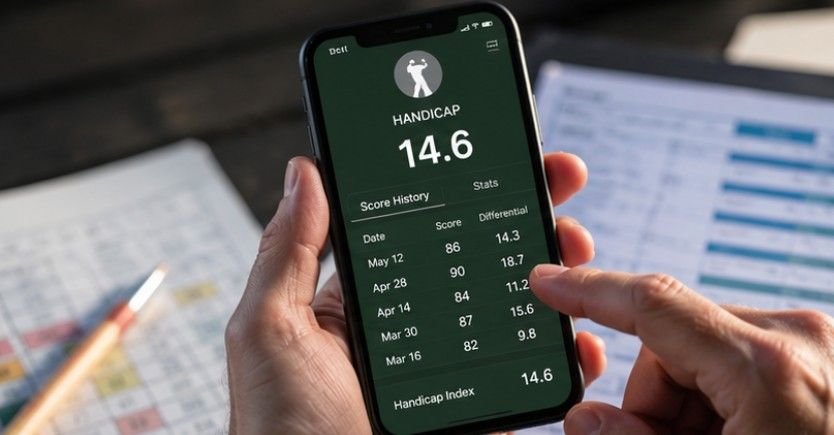
First, calculate your Score Differential for any given round:
$$\text{Score Differential} = (\text{Adjusted Gross Score} – \text{Course Rating}) \times \frac{113}{\text{Slope Rating}}$$
Next, calculate your Course Handicap on game day:
$$\text{Course Handicap} = \text{Handicap Index} \times \left(\frac{\text{Slope Rating}}{113}\right) + (\text{Course Rating} – \text{Par})$$
Stroke Allocation Matrix
| Skill Tier | Typical Index Range | Best 8/20 Target Range | On-Course Role / Dynamic |
| Scratch / Plus | 0.0 or lower (+1, +2) | Shoots par or better | Giving strokes back to the field |
| Low Handicap | 1.0 – 10.0 | High 70s to low 80s | Precision-driven control, rare catastrophic errors |
| Mid Handicap | 11.0 – 18.0 | Mid 80s to low 90s | Strong baseline performance with occasional outliers |
| High Handicap | 19.0 – 54.0 | High 90s to 100+ | Higher variance; significant stroke allowances received |
Editor’s Note: For visual presentation in dynamic dashboards, this data is best rendered as a horizontal stacked bar chart showing scoring distribution variances across skill tiers.
Why the Data Matters: Real-World Applications and Equity
Without an objective handicap system, competitive golf would collapse under the weight of uneven matchups. By utilizing a net scoring framework—where stroke allowances are subtracted from gross scores based on hole difficulty rankings—golfers of widely disparate skill sets can play meaningful matches together.
PLAYER A (Index: 4.0) PLAYER B (Index: 20.0)
Course Handicap: 4 Course Handicap: 20
Gross Score: 76 Gross Score: 91
—————— ——————
NET SCORE: 72 NET SCORE: 71 <– WINNER
Research published through sports metric studies at institutions like MIT highlights how statistical handicap systems minimize structural advantage in recreational sports. The framework allows a photographer shooting low-80s golf to compete fairly against a scratch player shooting even par, shifting the focus from absolute mechanical output to relative performance against one’s own baseline.
Diagnostic Checklist: Calculating Your Net Scoring Baseline
If you are ready to evaluate your true relative skill level, follow this simple diagnostic protocol:
- Step 1: Collect Raw Data — Log at least three 18-hole rounds (or 54 total holes) on rated courses.
- Step 2: Adjust for Anomalies — Apply Net Double Bogey limits to prevent single-hole blowups from distorting the dataset.
- Step 3: Calculate Differentials — Run each round through the Differential formula using the tee box Course and Slope ratings.
- Step 4: Isolate Top Performances — Identify your lowest differentials (the best 8 out of your last 20) and calculate their average.
- Step 5: Apply On-Course Conversions — Multiply your resulting Index by the target course’s Slope divided by 113 to derive your final match allowance.
Edge Cases, Anomalies, and Common Misconceptions
While the World Handicap System is meticulously engineered, several operational exceptions exist that players often misunderstand:

- The Anti-Cap Mechanism: The system imposes Soft Caps and Hard Caps on rapid index inflation to prevent artificial score manipulation (often called “sandbagging”). If an index rises more than 3.0 strokes above its lowest point in the preceding 365 days, further increases are suppressed.
- Exceptional Score Reduction (ESR): If a player posts a score differential that is 7.0 to 9.9 strokes lower than their current index, the system automatically applies a -1.0 stroke reduction to their index. If the differential is 10.0+ strokes lower, a -2.0 adjustment is triggered instantly across past rounds.
- Playing Conditions Calculation (PCC): The algorithm evaluates all scores posted at a facility on a given day. If extreme weather or unusual course setups cause scores to spike or drop dramatically across the board, the system automatically adjusts differentials for that day by -1.0 to +3.0 strokes.
Frequently Asked Questions
1. What does a +7 handicap in golf mean?
A +7 handicap means a player is seven strokes better than a zero-handicap (scratch) golfer. Instead of receiving extra strokes during a round, a +7 golfer must add seven strokes to their gross score to calculate their net score.
2. How bad is a 30 handicap in golf?
A 30 handicap is completely normal for beginner and recreational golfers. It simply means you typically shoot around 100–105 on a standard par-72 course, leaving plenty of room for measurable improvement as your technique develops.
3. What is my handicap if I shoot a 90?
If you regularly shoot 90 on a standard par-72 course with average slope difficulty, your handicap index will typically sit between 14 and 17, depending on the specific Course Rating and Slope Rating of the tees played.
4. What does a 2.8 handicap mean in golf?
A 2.8 handicap means you are an advanced player capable of shooting around 75 or 76 on a standard par-72 course. You sit comfortably within the top 10 percent of all registered golfers globally.
Operational Summary
Understanding how the golf handicap system works transforms raw numbers into actionable performance metrics. By tracking potential rather than simple averages, the World Handicap System removes environmental bias, levels the playing field, and provides a clear benchmark for ongoing skill development. Treat your handicap as a precise diagnostic signal—track your scores accurately, calculate your differentials correctly, and use the data to measure your real progression on the course.